‘As a child, I was always observing textures, colours, the way fabric moved, the way people carried themselves. But more than that, I was drawn to transformation. The quiet alchemy of it. How something external could reveal something deeply internal. I watched how tradition and modernity coexisted in the same gesture. A sari worn one way could speak of heritage, worn another could signal defiance. A colour could hold memory. A silhouette could suggest freedom or restraint. There was a delicate, constant negotiation taking place, between who one was expected to be and who one quietly longed to become. That was my first education in fashion. Not in a classroom but in observation. In nuance. In the poetry of everyday life.’
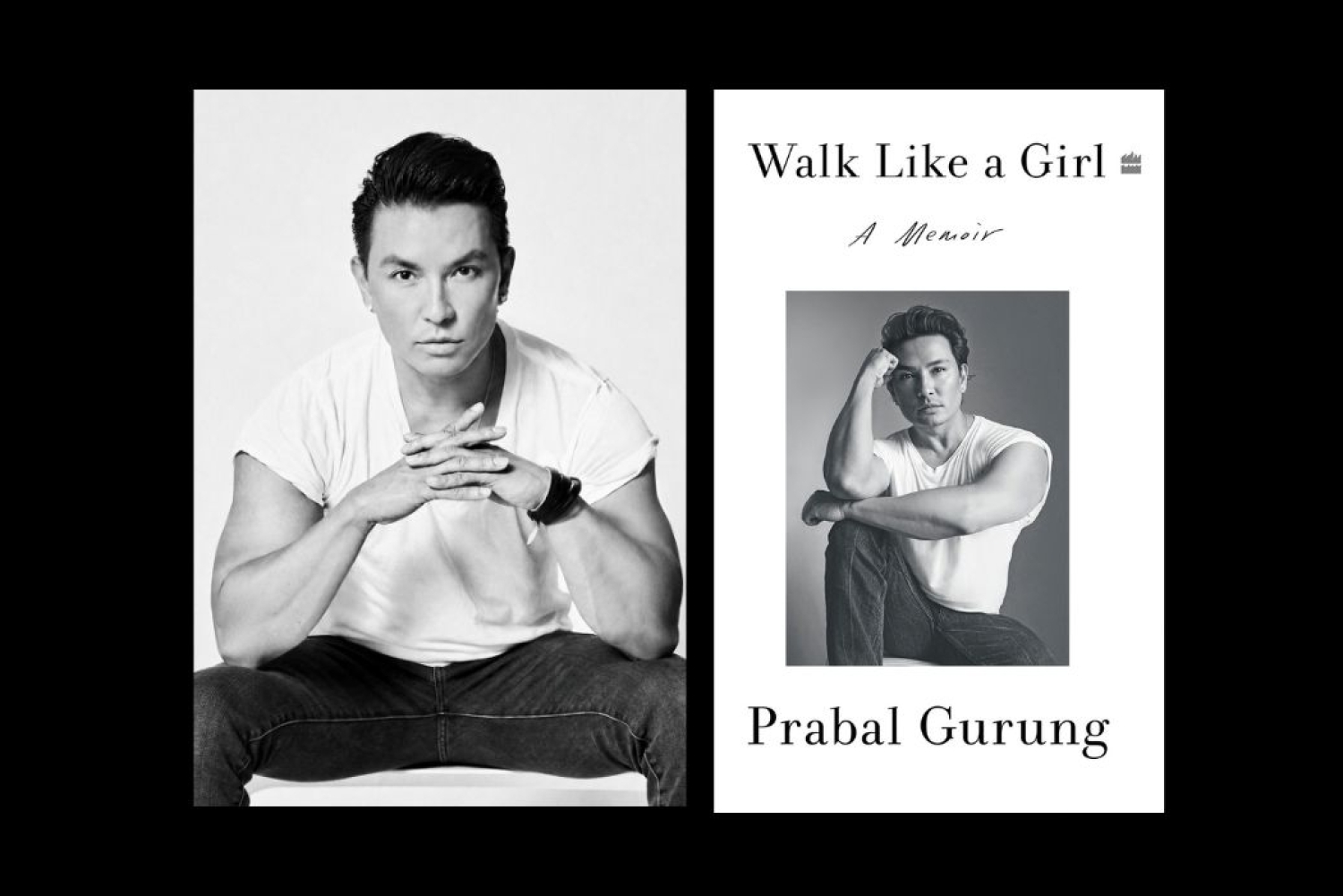
Prabal Gurung is one of the only fashion designers to come out of Southeast Asia, who has presented his designs, storytelling; bold yet soft ideologies on a global stage. The only one to stand tall and reach higher since he stepped foot into this industry sixteen years ago. He experienced different landscapes, mixed cultures and during his discoveries, fell down umpteen times, only to stand up, more spirited and raring to go. Today he has created a name that resonates with resilience, brilliant artistry and timeless designs. I remember interviewing Prabal thirteen years ago and being so moved and impressed with his humble beginning. His artistry is so driven by his reality that one can see pure joy and honesty in his work. As I finished reading Walk Like A Girl, his memoir, not only was I moved by such an evocative read, I was intrigued by his form of storytelling that celebrates identity, emotion and freedom. I was fascinated by how he uses the language of clothes to communicate. I was drawn to his ideology of what a piece of garment expresses. Each creation of his has its own individualistic narrative. With remarkable consistency, Prabal has built a massive body of work, dressed some extremely inspiring and powerful individuals and continues to give back and uplift through his foundation, Shikshya Foundation and does it all with an honest approach. The work he has done, the decisions he has made, the interactions he has had, have helped define who he is today.
Prabal, congratulations on such a beautiful, inspiring and rollercoaster of a read. I feel even though the story of a memoir is already lived, putting it down on paper is the hardest of all genres. When you sat down to write your memoir, what were your initial thoughts and how did they evolve as you wrote?
When I first sat down to write, I wasn’t thinking about a book; I was thinking about survival. About memory. About truth. There is something profoundly unsettling, almost sacred, about looking at your own life without the armour of time, without the mercy of nostalgia. A memoir does not allow you the luxury of distance. It asks you to remember not just what happened but how it lived inside you. And feelings… they do not move in straight lines. They surge. They recede. They return uninvited, carrying the weight of everything you once tried to outrun.
In the beginning, I was hesitant. Protective, even. There were parts of my story I had folded away so carefully, like garments too fragile to ever be worn again. Parts I had convinced myself were better left untouched. But writing has a way of undoing you before it remakes you. And somewhere in that unravelling, something shifted.
I began to understand that honesty is not exposure, it is emancipation. That to name your truth is not to relive your pain but to release its hold over you. The act of writing stopped being about recounting a life and became, instead, an act of reclamation. A quiet, radical return to self.
By the end, I was no longer writing from fear. I was writing with a kind of grace I didn’t know I possessed. With tenderness, for the boy who endured more than he could name, for the man who is still learning how to hold it all with compassion. And for anyone who has ever felt like they existed just outside the frame.
This book is, in many ways, for those who dared to colour outside the lines. For those who learned to see their own worth in the absence of affirmation. For those who chose themselves, again and again, in rooms where they were never fully seen. Because sometimes, the most radical thing you can do… is to witness your own life and still choose to love it.
You grew up in three countries, Nepal, India and The United States. How has each experience shaped the person you are today?
Each place gave me a different language of becoming. Nepal gave me my soul. It gave me stillness, spirituality, a sense of beauty rooted in humility and resilience. It taught me to see the world not just as it is but as it could be. It gave me calm in a world filled with chaos.
India gave me my emotional vocabulary. It was where I understood complexity, of relationships, of culture, of identity. It was vibrant, chaotic, layered… and it taught me how to feel deeply, to hold contradiction without needing resolution. America gave me my voice. It gave me the permission to dream unapologetically, to claim space, to build something from nothing. It taught me ambition, not as greed, but as possibility. I am not from one place. I am a conversation between all three.
“Art, for me, is not replication. It is translation. It takes something deeply personal and allows it to travel, to become something others can feel, even if they do not know its origin. It is how a private emotion becomes a shared language.”
Directly and indirectly, you have always interacted with the art of fashion. When did you realise that you wanted to tell stories through this art form?
I do not think I chose fashion. I believe fashion chose me as a language long before I understood it as a profession. Much of this understanding was shaped by the women in my life. My mother, my sister and the women around me, carried themselves with a kind of unspoken eloquence. Through them, I began to understand that fashion was never just about clothing. It was a language. A way of communicating what could not always be said aloud. What was revealed, what was withheld, the subtleties in between. The realisation came later that this was not simply about clothes. It was about storytelling. About identity. About giving form to emotion. Fashion became my way of speaking when words felt insufficient. It still is.
Through your journey, you have been extremely honest with your creations. How easy or challenging has that been?
Honesty is not easy. It is often the most expensive choice you can make. There are moments when the world encourages you to dilute yourself, to be more palatable, more commercial, more expected. And each time, you find yourself at a crossroads. Do you belong or do you become? I have chosen, again and again, to become. But that choice carries a cost. It invites risk. It brings rejection. It lives alongside doubt. And yet, it is the only choice that allows me to sleep at night. Because in the end, the work is not separate from me. It is not simply what I create, it is who I am.
Over time, through this constant negotiation between my truth and the world around me, through the act of storytelling, of learning, of unlearning, I have arrived at a kind of grounded clarity. A philosophy shaped by both honesty and pragmatism, what I would call a lived integrity. It is not idealistic in a naive sense, nor is it purely strategic. It is a way of moving through the world with conviction, while understanding its realities.
What I have come to realise is that the ultimate journey is a solitary one. It is about coming into alignment with yourself, again and again. And in doing so, something shifts. Not because you set out to influence others but because there is a quiet power in living your truth with consistency and integrity. Impact, then, becomes a by-product. Not a goal, but a resonance. A reflection of a life lived honestly.
How much of your own reality do you see in your artistry?
All of it. And yet, none of it in a literal sense. My work does not recount my life in a direct way but it carries its pulse. It carries its breath. It is deeply autobiographical in feeling, in memory, in longing. Every collection holds a fragment of me, not as a record, but as a residue. A trace of something lived, something questioned, something still unfolding.
I do not believe you can ever truly escape who you are. Nor would I want to. I come from places that have shaped me in ways both tender and difficult, Nepal, India, America, each leaving behind its own imprint. And for someone like me, who holds those histories with pride, with all their contradictions, it became instinctive to carry them forward.
In a world that so often asks people like us to soften our edges, to dilute what makes us distinct, I found myself moving in the opposite direction. Not as a statement, not as resistance in the obvious sense, but as something quieter. More instinctive. I followed what felt true. I followed what felt like home within me. Art, for me, is not replication. It is translation. It takes something deeply personal and allows it to travel, to become something others can feel, even if they do not know its origin. It is how a private emotion becomes a shared language. And perhaps that is the closest I come to understanding it. My work is not about telling my story as it happened. It is about offering its essence. So that somewhere, in some small way, someone else might recognise their own.
“A sari worn one way could speak of heritage, worn another could signal defiance. A colour could hold memory. A silhouette could suggest freedom or restraint. That was my first education in fashion. Not in a classroom but in observation. In nuance. In the poetry of everyday life.”
As an artist what kind of stories do you wish to tell through your art?
I want to tell stories of humanity. Stories of vulnerability in a world that often rewards armour. Stories of beauty that exist beyond perfection. Stories of joy as a form of defiance. I want to create work that makes people feel less alone, that reminds them their softness is not weakness and that their differences are not deficits but distinctions. At the same time, I have come to understand that the only story one can truly tell is one’s own. Not in a literal sense but in an emotional one. The most honest work comes from living deeply, from paying attention, from allowing yourself to feel everything without resistance.
My intention has never been to inspire in any deliberate way. I have never sat down and thought about impact in those terms. My only commitment has been to live truthfully, to face life with openness, with courage, with a kind of surrender to all that it brings. To create from that place. To respond to the world as I experience it, not as it is expected of me. And in doing so, something quiet begins to happen. When you live and create with that level of honesty, it carries. It reaches people in ways you cannot predict or control. Not because you are trying to move them but because truth has its own resonance. If there is any hope within my work, it is this. That in witnessing one life lived with sincerity, someone else might feel permitted to do the same. That they might recognise themselves, not in the details, but in the feeling. Because ultimately, the most powerful stories are not the ones that seek to impress. They are the ones that dare to be real.
This article is from the June EZ. For more such stories, read the EZ here.
Words Shruti Kapur Malhotra
Photo Javier Ortega
Date 13.6.2026