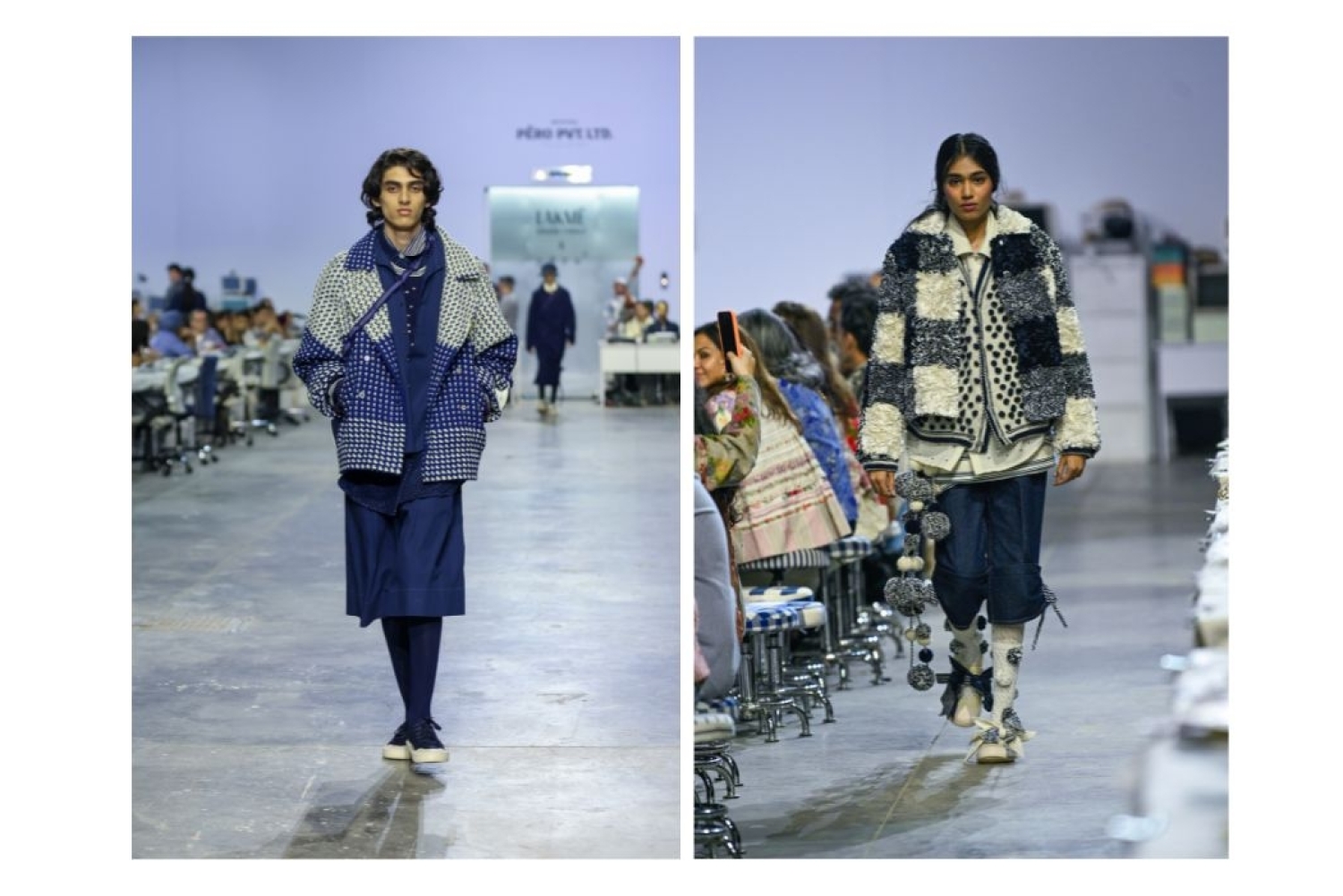
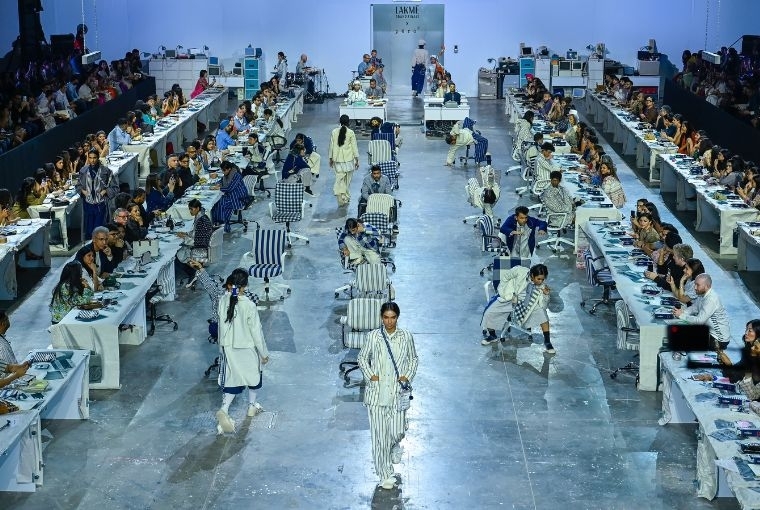
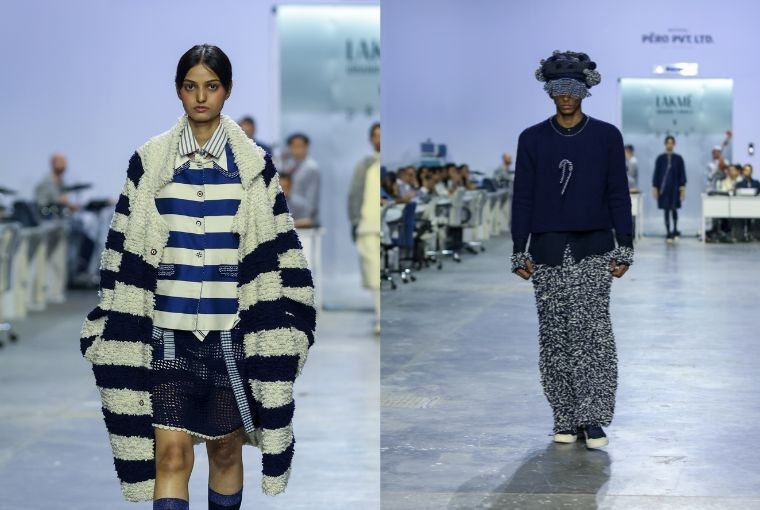
With Elsewhere, her new collection for Pero, Aneeth Arora imagines workwear as a quiet act of refusal. Think work clothes that keep to the timetable but ignore the rule book: blue-and-white stripes that slip from desk to daydream, office to out-of-office. This season, Pero turns duotone (white & blue) deliberately broken only by a flash of coral. Stripes, checks and florals travel across Maheshwari and Mashru, Chanderi and Pashmina, Bengal cottons and northern wools, carrying the same gentle pull towards a life lived beyond the cubicle. Pero is known for their colours yet this collection becomes a study in limits that somehow opens up more room to play.
It’s hard not to appreciate what Aneeth does with her work. She treats it with both playfulness and sincerity, always starting with the textile rather than the silhouette. Her runway is never about what it ‘should be’, but what it ‘can be’. She moves with a quiet assurance, willing to confine an entire collection to just two colours when everyone expects a spectrum from Pero. We asked Aneeth how she got here and what comes next for her.
Is there a memory stitched into this collection that only you know? A moment or feeling that became its starting point? When was the seed of this idea first sown?
I think it was last winter, a very colourful and over-the-top season. I started feeling that we had been having very vibrant winters for a while and that we were getting used to it. I thought it would be good to challenge ourselves and restrict the palette to just two colours for the season. So I decided we would work only with blue and white, and that is how it all began. It started when I walked into my studio and saw a rack of my winter collection that was about to be sent to the shops. I felt it was time to offer people something different and surprise them. They always expect a lot of colours from Pero, so we decided to do something much more restrained.
Your collections often begin with fabric rather than silhouette. What was the first textile that grounded this collection?
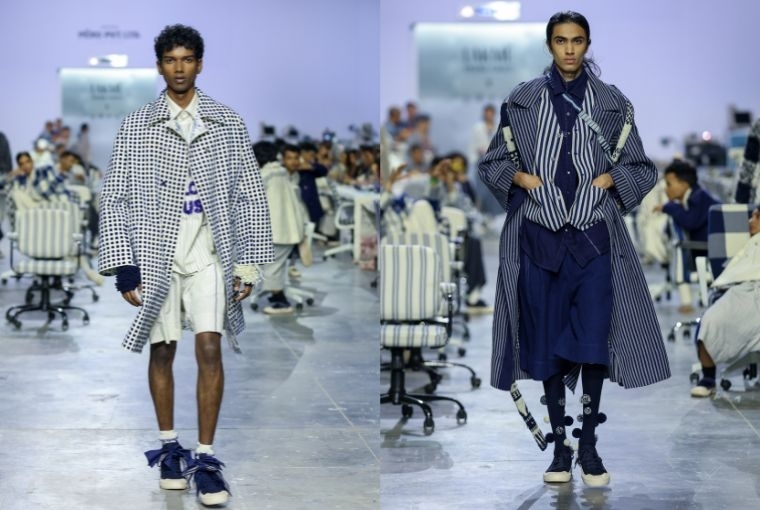
It’s a lovely question, and it did start from there. In fact, I saw somebody wear a particular kind of stripe on a vacation, and then a few days later, I saw the same stripe on somebody who was headed to the office. I thought it was such a beautiful thing that the same stripe could transition from something for a vacation to something a bit more formal. It reminded me of those French Riviera stripes, and it just stayed with me. Luckily, because we work on our fabrics almost two years in advance, we were already working with only blue and white. We started incorporating blue and white stripes of all kinds. We did pinstripes, we did French Riviera stripes, we did Breton stripes. I thought we could do an alternative take on office dressing that could take you from morning till evening. Then you can step out anywhere you want, or, for all you know, it could also be something you wear on vacation as well.
In this line, you’ve brought together Maheshwari, Mashru, Chanderi, and Pashmina. How do you approach blending textiles with such distinct histories and hand-feels? Can you walk us through your creative process for this particular collection?
Our process is very rigorous. This one began with two colours: blue and white which entailed extensive research. We first studied what has already been done with blue and white so we would know what not to repeat. We looked at traditional textiles from India and abroad, as well as crafts, cultural objects, and artefacts that use these colours.
Our research led us to Chinese porcelain, Delft pottery with its striking blue and white ceramics, and Toile de Jouy, a French fabric known for its narrative scenes. Drawing on these references, we developed our own interpretation. Our clusters, as always, formed the foundation of the season. We approached them with a fresh concept and challenged them, within their skill sets, to create something distinctly different from the previous season. When images began arriving from the clusters, it was remarkable to see French Riviera-inspired stripes and pinstripes being woven across India: wool in Himachal and Punjab, mashru in Gujarat, and khadi stripes in West Bengal. Everything came together seamlessly, unified by the two core colours.
What’s the one rule you would happily break for your art?
We break all the rules all the time. Even when we are thinking of a new season, we do not stick to one particular way of approaching it or follow any trends. Even on the runway, we just play and experiment. We have a very childlike approach to this. Rules are being broken daily in our office, except that we are very disciplined about coming on time and following the timetable. But when it comes to creating, there are no rules being followed. We explore in every direction, and no one is ever told, “We don’t do things like this.” Everybody is free to explore and suggest what they like, and then whatever fits within the period or domain is taken forward.
Let’s create an outfit together for daydreaming at work, from top to bottom. What would you put someone in?
Firstly, it is not something that is coordinated, so if you’re playing with stripes, it can be pinstripes on top but bold stripes at the bottom, with a little pop of florals and a very quirky take on the collar. Maybe they could just be wearing a T-shirt inside with only a collar on top to add that quirk. There could also be a very different take on the tie, which is there but yet not there: it is either tied at the waist, or you roll your sweater into a tie and secure it so that it comes to the front but does not function like a regular tie. The scarf could be worn as a tie as well. No rules, everything is mismatched, but still within blue and white. It’s amazing to see a play of patterns when the base colours are the same; everything works together beautifully because the colours provide a binding factor. That restraint we practised this time really helped when we were putting things together; everything complemented each other, and it was a lovely experience styling these pieces.
What does success mean to you? How do you define it?
I think a smile on a wearer’s face and the messages full of love that we receive when they are wearing something of ours, when they are stopped on a street in Paris or London or even in India and people ask them, 'Are you wearing Pero?' or 'Who are you wearing?', such messages and love notes from people are the epitome of success for me. That is what we are living for: we are creating things for people, and if they accept them with so much warmth and love, there is nothing more fulfilling for a creator.
Words Hansika Lohani
Date 24.3.2026