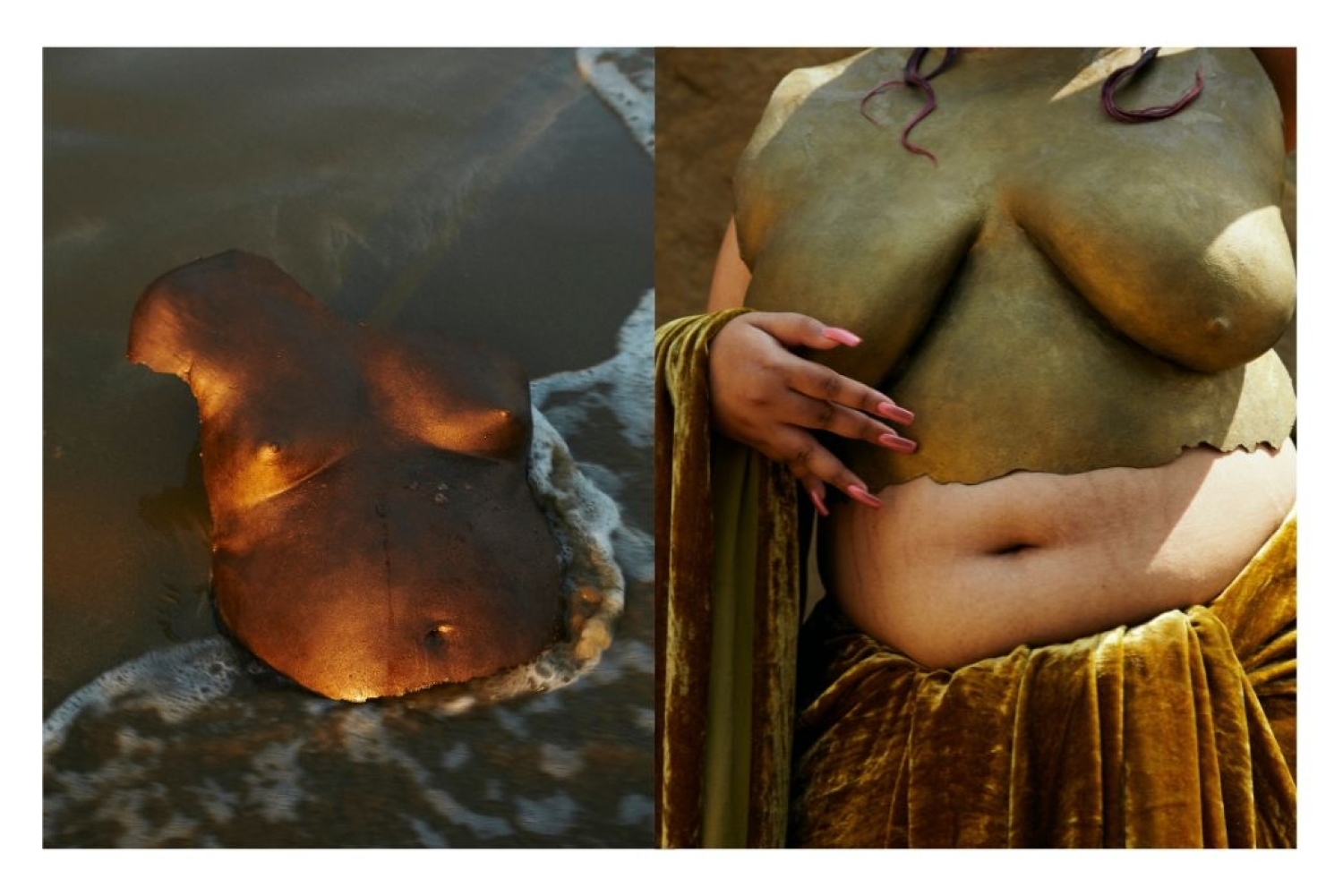
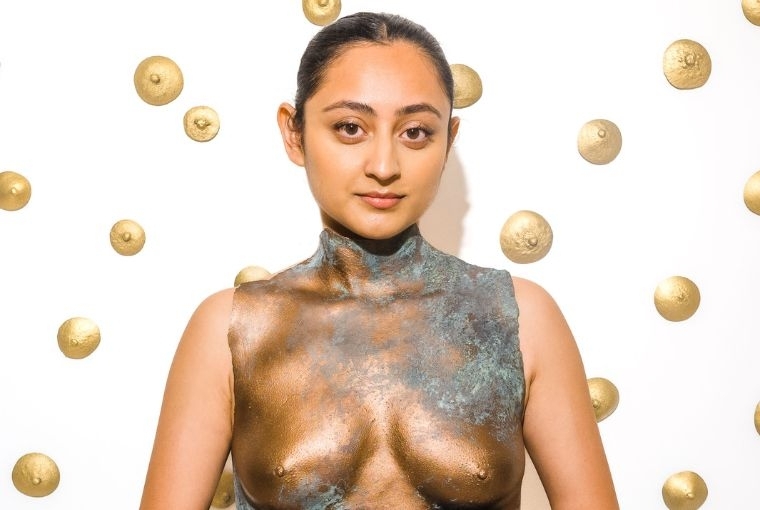
Misha Japanwala’s practice acknowledges that adornment and shame exist simultaneously within South Asian cultures. Her sculptural work and jewellery practice bring these conflicting ideas together, using the parts of our bodies we have been conditioned to feel shameful about, as adornment. Through Beghairat Studio, she creates jewellery pieces that feel more everyday, exploring how shamelessness can exist in something intimate by moulding hands, nipples, waists, stretch marks. Her practice also looks to regional histories and older civilisations. She finds inspiration from artefacts from the Indus Valley civilisation, including those that are often left out of the narrative in the present day. Known for her corsets, breastplates and armour-like garments, her pieces have been commissioned by Cardi B, Gigi Hadid, Lil Nas X, and most recently, the costume department of Christopher Nolan’s The Odyssey. Lupita Nyong'o, who Misha has styled previously and plays Helen of Troy, can be spotted wearing a custom breastplate and choker. We sat with Misha and dove into the core of her practice.
When did you begin to understand the correlation between shame and the body?
Growing up in Karachi as a South Asian woman, I had a very intimate relationship with fashion. And it was just something that I loved so much from such a young age, and I decided that I wanted to go into fashion and be a fashion designer super, super young. I moved to New York at 19 years old to go to Parsons School of Design and I was continuing to design clothes with fabric. The plan was always that I would graduate, move back home and build a bridal or ready to wear label because that is what I had seen around me growing up, right? I never really allowed myself to imagine another possibility because I didn't know it could exist.
And then in senior year, my thesis professors gave us a project where we had to collect news clippings that jumped out at us. I decided to use the local newspapers in Karachi because I was home for the summer and everything that stayed with me were all headlines about women. Women, their agency, their bodies, their rights to their bodies or lack thereof.
It was those headlines, that weight and heaviness that I brought in with me into my senior year. And I think just generally being in the fashion world and really immersing myself in it those years at fashion school, I realised that, the kinds of imagery that I was seeing, the kinds of clothes that I was seeing made around me, while absolutely beautiful, did not resonate with me in a deeper way. I think especially when it comes to traditional media and fashion imagery that we see, as a young Pakistani woman, I did not come away looking at those images feeling good about my own body, you know?
I found my way to the artwork of some really amazing Pakistani artists and started using that as inspiration. Naiza Khan, Hiba Schahbaz, Shehzil Malik, all Pakistani women that are engaged in what I consider very radical work. It was through that that I realised that I didn't want to be just another person designing clothes and that what I wanted to talk about was deeper than that; the bodies that wear the clothes and not the clothes themselves.
Can you take us through the creative process of building clothes that are essentially our own bodies?
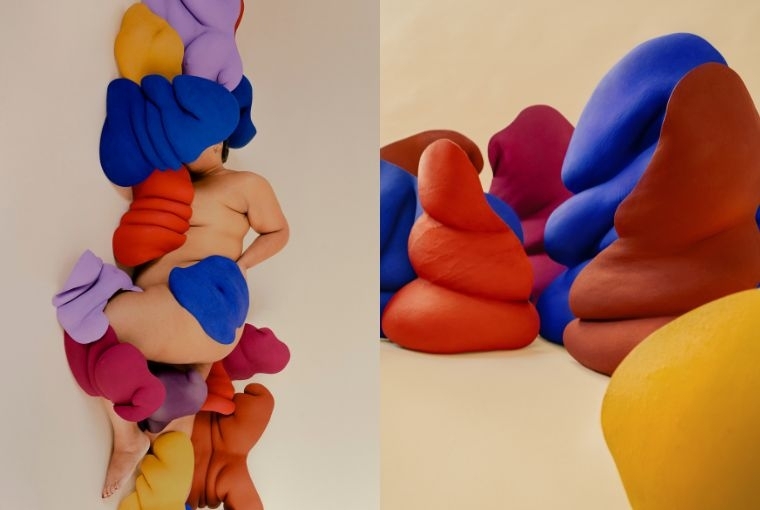
When I initially started it, I was moulding and casting my own body, right? And then as I engaged in this work deeper and understood just how much it meant to me, how I felt moulding and casting my own body, I realised that that was something that I wanted to share. Especially because there's so many different types of bodies, features and details that every person carries so differently on their bodies and I felt all of that was worthy of documentation, all of that was worthy of turning into art.
I had an opportunity to have my first solo exhibit with Hannah Traore Gallery, who now represents me. She had reached out to me in 2021 and I took a couple years to build an entire body of work. I had done pieces for other people in the years following fashion school. My first ever commission that I did was for this amazing woman, who at the time, was fighting metastatic breast cancer. And I made a breastplate for her that she wore in a fashion show for this awesome brand that creates bras and undergarments specifically for people that are undergoing cancer treatment. And again, that was an example that showed me how meaningful this work was. Around 2021, I started expanding into my own community in Karachi and asking people if I could document their bodies and bring them into this archive of bodily documentation.
How did you reclaim shame through your work?
From a young age, we’re taught that existing in the body that we do is something that is inherently shameful. In the way that you're taught to think about your own body, and in the way that everybody around you thinks about your body. And so that is just something that I had carried with me, always.
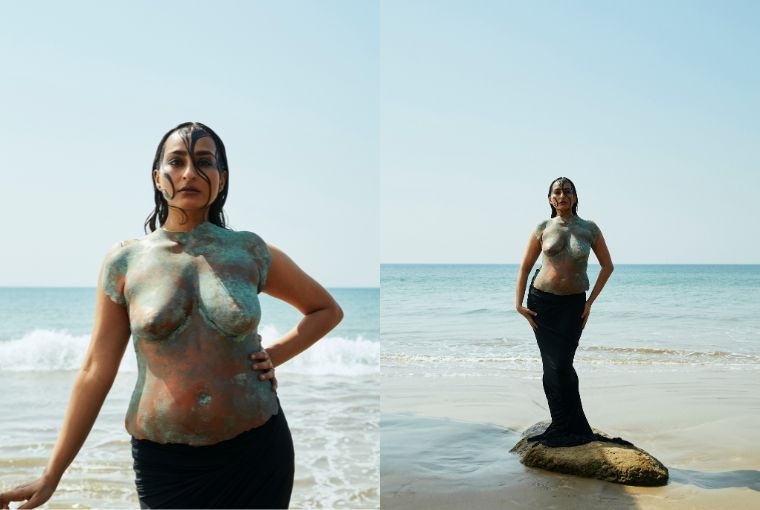
It's a conditioning that goes so deep, you might not be thinking about it at the forefront of your mind, but it sits with you. And the real ‘aha’ moment, I would say, is when I started moulding and casting my own body. And feeling this sense of necessity in doing it. At that time, I was sharing a lot of my process work and the pieces that I was making on my Instagram. I had a very small following, but the more and more I shared, the louder and louder the backlash was.
Something that was coming up constantly was the way people were describing the work. They were calling it shameless, and they kept saying, the work is shameless, and you are a shameless person for making it. After seeing that word come up again, and again, and again, I realised that this is also a form of conditioning and a tool of control; if we can convince marginalised bodies that their existence is shameful, it forces us to stay on the fringes. That was when I really made the decision to reclaim the word shameless and root my entire practice in it, because that is really what I was getting to.
How has your relationship with your own body evolved since you began working so closely with the theme of the body?
I think my relationship to my body is constantly evolving. I think it's really interesting that I am confronting shame so intimately, so constantly in my artistic work and my artistic practice and it's still something that I struggle with on a day to day basis. It has been really humbling for me to know just how much work needs to be done. To release shame little by little is a continuous, everyday practice. The way my studio is structured in my house in New Jersey is, we have our bedroom, and then you have to walk through the bedroom and go upstairs, and the studio is in the attic, so it's connected to the bedroom, essentially.
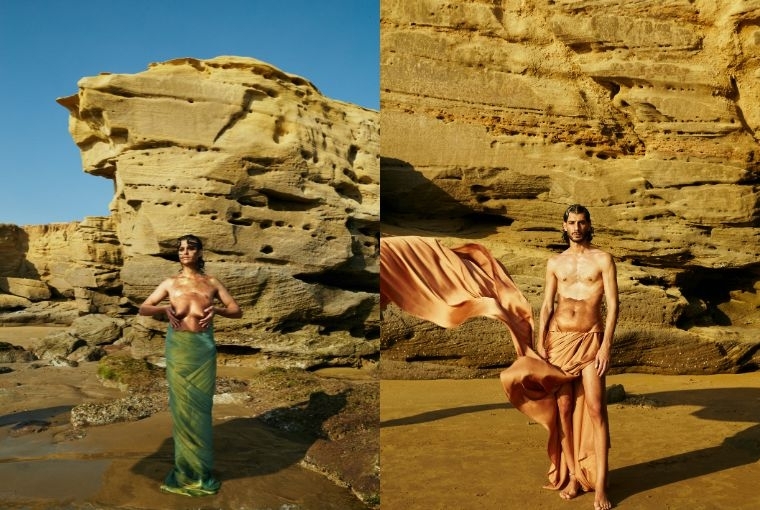
And there have been a few times where I've been looking in the mirror downstairs in my bedroom, and not been feeling great about what I'm looking at in the mirror. A couple of those times, I was like, ‘Misha, shake it off, and do what you know best.’ I went upstairs to my studio, and moulded the part of myself that I was fixating on, judging, policing and scrutinising. I just decided to turn that into artwork.
Even when muses come into the studio, we always have a conversation. And I've entered a phase of my practice where, especially the last couple years, I will ask the person to choose the part of the body that is being moulded, that is being documented for whatever reason they want. I always encourage people to pick parts of their bodies that they have carried shame in, either in the past or present. To really focus on that spot and turn that into the artwork.
This is an excerpt from the September EZ. For more such stories, read the EZ here.
Words Neeraja Srinivasan
Date 19.9.2026
Misha Japanwala