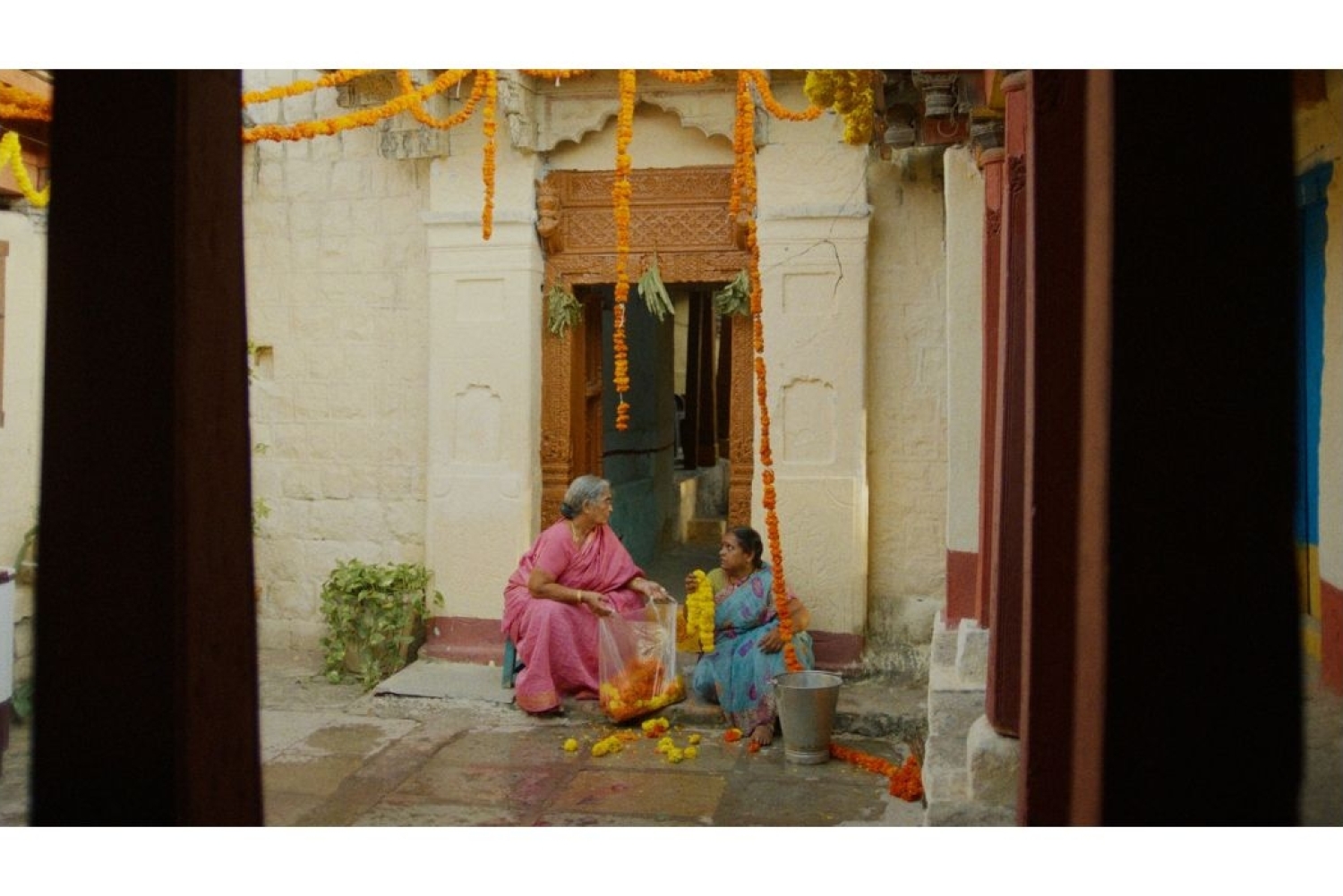
O’Sey Balamma, a Telugu-language short, turns Raman Nimmala’s memories of his grandmother’s Hyderabad home into an intimate study of care, class and companionship. The film is inspired by Raman’s summers spent as a quiet observer in a bustling household. It distills the textures of rooms, rituals and routines into a relationship drama between an aging matriarch and the domestic worker who becomes her closest confidante. Drawing on women he watched navigate loss with humour and defiance, Raman sketched Ammagaru and Balamma, the pivotal characters as composites of firebrand elders and the caretakers who orbit them, bound by affection yet separated by feudal hierarchies. Conceived before his time at Columbia and later refined within the discipline of a five-to-twelve–minute film, O’Sey Balamma is a love letter to his grandmother’s legacy and one of the only very few films from India to screen at Sundance Film Festival this year.
O’Sey Balamma
For me, it began with space. The film is a slice of life, so remembering the story meant remembering the rooms, the routines, and the rhythms of my grandmother’s home. I grew up watching my grandmother and her domestic help move through their day, so I could walk through those memories very clearly; their conversations, their habits, even the cadence of their steps. I was a fly on the wall for all of it. The story is not a one-to-one recreation, though. Ammagaru and Balamma are composites of many relationships I have observed over the years between elderly women and the domestic workers who become their companions. From there, my writing became about finding moments that revealed different layers of their bond: the bickering, the intimacy, the boundaries, the feudal dynamics, and the circumstantial companionship underneath it all. I wrote the first version of the script before I got into Columbia, in a very free-form way. At Columbia, our first major project is a five to twelve-minute film, and I felt this story could be told honestly and fully within that format. So, I shaped it to fit that space.
Life And Its People
My grandmother was the person who had and continues to have the most significant impact on me to this day. She was my best friend, and even now I feel her watching over me. It feels a little personal to share, but I want to be real about it. My parents recognized early on that we shared a very special connection, because I never wanted to do anything other than spend every holiday with her. They would fly me out to India even when they could not come themselves, and even when flight tickets were not exactly in the budget, just so we could have that time together. She had a huge influence on me growing up. She went through a lot of loss at a young age, but if you spoke to anyone who knew her, that is not what they would mention first. She never let those things define her. People would describe her as social, fun, someone who lived life entirely on her own terms, a real firebrand. I was the one who got to witness her interiority over the years, and through that I got to see an example of someone who felt deeply but also lived very candidly and with presence. That lesson stays with me. Through our relationship, I found the inroads to stay connected to Hyderabad, my hometown, and to assimilate culturally in a way I might not have otherwise. I feel these are ways in which her legacy continues, through me and others she impacted through her example.
Narrative Therapy
I am exploring stories at the intersection of plural, cultural and social identities. I want to tell them with heart, humour, and, when possible, cheap thrills. Stories shape the way I see the world, and my day-to-day experiences shape the way I see stories. Those two things are always in conversation. So, I guess the purpose of my filmmaking is to affect others in the way narrative affects me like through its dimensionality, its emotion, fun, and sensory experience. Also, I want to explore worlds, characters, and experiences that I find interesting and entertaining and show them on screen. In that sense, the purpose of my storytelling is twofold: to explore [that part is for me] and to affect [that part is my hope for the audience].
This is an excerpt from the February EZ. For more such stories, read the EZ here.
Words Hansika Lohani
Date 18.2.2026