Photo by Raya Ghosh-Roy
Photo by Raya Ghosh-Roy
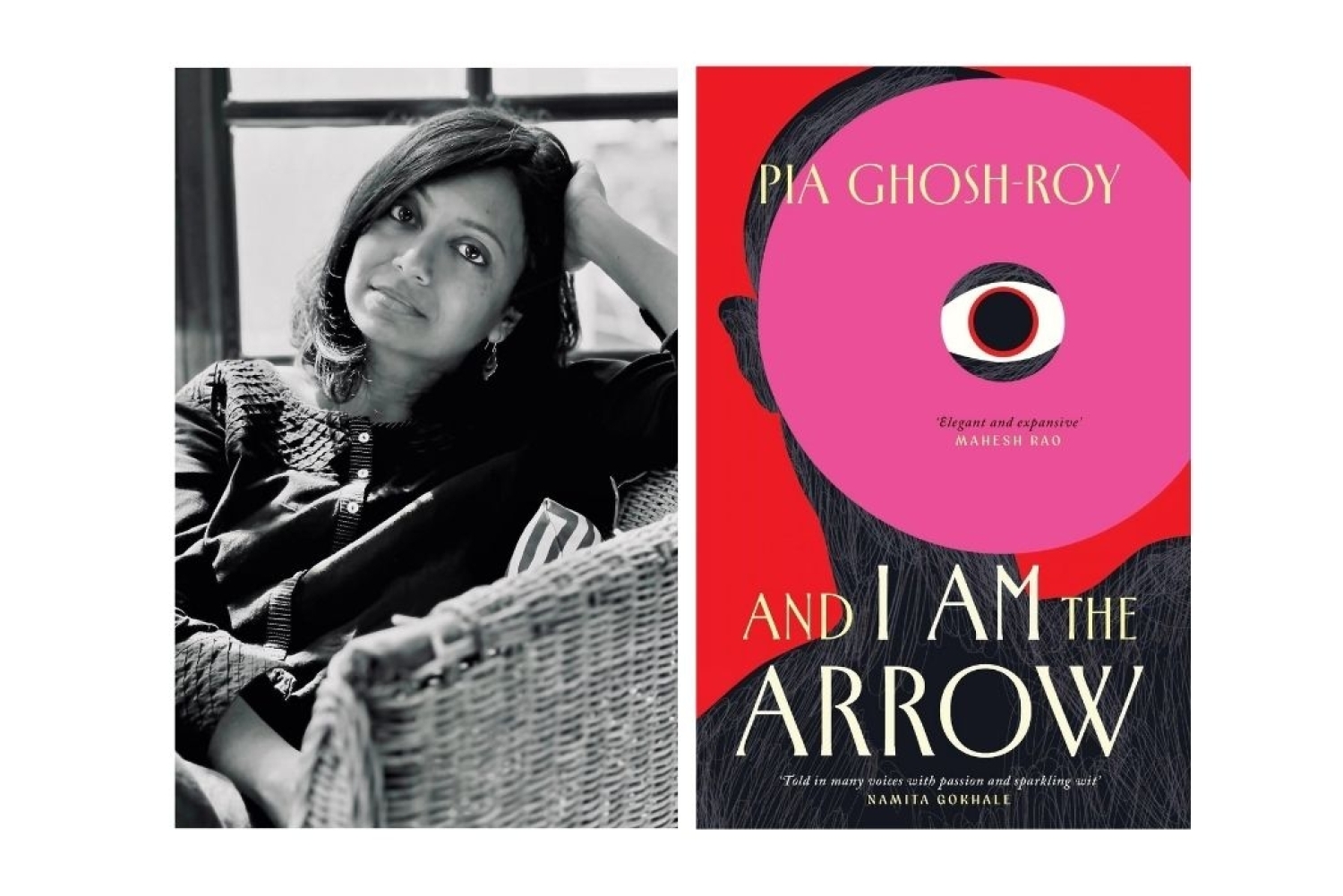
And I Am The Arrow began with an image. A collage, really. Of a granddaughter, a grandmother, some old letters, a journey. What began as a story about Mishu, the granddaughter, and Niyoti, her grandmother, grew into a many-armed story of women across generations, with each of them wanting to have a say. For Pia Ghosh-Roy, the intimate relationships of women hold multiplicities: strength and softness, openness and stealth, care and coercion. Set in Calcutta, a city whose cadence she carries in her bones, the novel also became a way of engaging with death, asking what it means to disappear and whether death is absolute. Ten years in the making, And I Am The Arrow allowed Ghosh-Roy to listen to her characters, letting the women lead, some loud and some quiet, while exploring the space between ourselves and everything else.
The Chatterjee Family
I’d been writing and publishing short stories, but I had a sense this wasn’t going to be short. It needed the breadth and free rein of the long form, and I wanted to find out if I could do it, if I could write a novel. I also wanted to find out who these people were. I didn’t know them, and yet they were so insistent and well-formed. What were the larger pieces from which their collage had been cut out? There was that promise of exploration, which was exciting; it made me write the first chapter, which is narrated by Mishu, the granddaughter, giving us a glimpse of her complicated relationship with her grandmother, Niyoti.
The grandmother-granddaughter space is not one I’m deeply embedded in, in terms of experience or memory; both my grandmothers passed away too soon for me to have a formative relationship. So, that space was a blank canvas. There was an absence of context that was freeing, it allowed these characters to be wholly themselves, to form on the page from scratch.
But after that first chapter, I had to take a step back. The ghost entered the story, and I knew that it wasn’t going to be just about a grandmother and her granddaughter. The entire scale of it changed, and I needed time to understand what the story wanted to be. I took almost six months away from the manuscript, went back to writing short stories, while I figured out how to control, contain and tell the story that was forming in my head.
A Generational Story
The intimate relationships of women have a particular politics that holds multiplicities: strength and softness, openness and stealth, care and coercion, that not just lent itself to this story but controlled the very architecture of it.
When I started writing And I Am The Arrow, I intended for it to have a single narrator: Mishu, the granddaughter, who, after her grandmother Niyoti’s death finds letters and a diary that take her on a journey into Niyoti’s secret past while also taking her on a more inward journey into her own life and mind. But after writing the opening chapter, it became clear to me that Niyoti had no intention of dying. She was feisty, determined to stay, and wanted to do her own telling. Ira, the mother, entered more quietly, almost apologetically, but she’s also the one character who surprised me most as the story progressed. So, telling the story through the voices of multiple women was something that happened organically, when each of the women entered the narrative at different points and wanted to have a say.
While writing a multi-generational novel, the last thing I wanted to read were multi-generational novels. In fact, I actively avoided them. I had enough characters and voices in my own head to contend with. The novel I dipped into often, and still do, is Proust’s Swann’s Way, translated by Lydia Davis. Some of the others that I read or returned to during this time, books that thrill me as a reader and excite me as a writer, are Michael Ondaatje’s Running in the Family, Magda Szabo’s The Door, Arundhati Roy’s The God of Small Things, Miriam Toews’ All My Puny Sorrows, Janna Levin’s A Madman Dreams of Turing Machines. And I Am The Arrow was a ten-year long project for me; there were so many excellent, inspiring, exciting books, both fiction and non-fiction, that I read during that time that are impossible to list here.
Relationship with Calcutta
Calcutta is home. I was born there, grew up there. It’s where I went to university, where I started my career in advertising. Calcutta is not an easy city to get under the skin of; it’s a character more than a place. It’s as temperamental and tacit as it is generous and big-hearted. Its wit comes with a bite, and opinions without filters. It takes the art of procrastination as seriously as it does the intentional wasting of time, not surprisingly, it is a city of readers, with miles of open-air bookshops lining its pavements. The only thing it takes more seriously is Food: which is a perpetual topic of discussion, dissertation and debate.
The Calcutta I grew up in was liberal, intellectual, political, irreverent. Big on laughs, bigger on adda. Full of brusque retorts and back-slapping humour. It’s a city whose cadence I carry in my bones. It makes me the writer I am.
The Language of the Ghost
The ghost, who is called Opor/Neech, was my way of engaging with Death. I’ve always been interested in how we interpret Death, process it, deal with it while we’re alive. Is Death something that makes a person disappear forever, or disappear only from sight and touch? What if Death is not absolute, not the ‘end’ we think it is? I wanted to throw those questions out into the void. And Opor/Neech was my way to do it.
He was also my way of interacting directly with the reader. I was embarking on this large, many-armed story, and I felt the need to assure the reader [and perhaps myself] that I would bring them [and myself] out onto the other side. I wanted to say, Trust me, I’ll figure this out. So, in a way, Opor/Neech is my way of accompanying the reader as they read. Or to have them accompany me, while I wrote, even though their reading of it was still somewhere in the future.
Apart from that, Opor/Neech was pure fun to write. He was free from the language of this world, he knew everything about everything, saw the past, present and future all at once. For me, writing his narrative was like rapping on the page. It was like playing with words as a child plays with toys.
What’s Next?
I don’t know. I never really know. I’m working on something new, but I don’t have the shape of it yet. I’ll follow my gut as I usually do and wait to see where I end up.
Words Neeraja Srinivasan
Date 29.9.2026