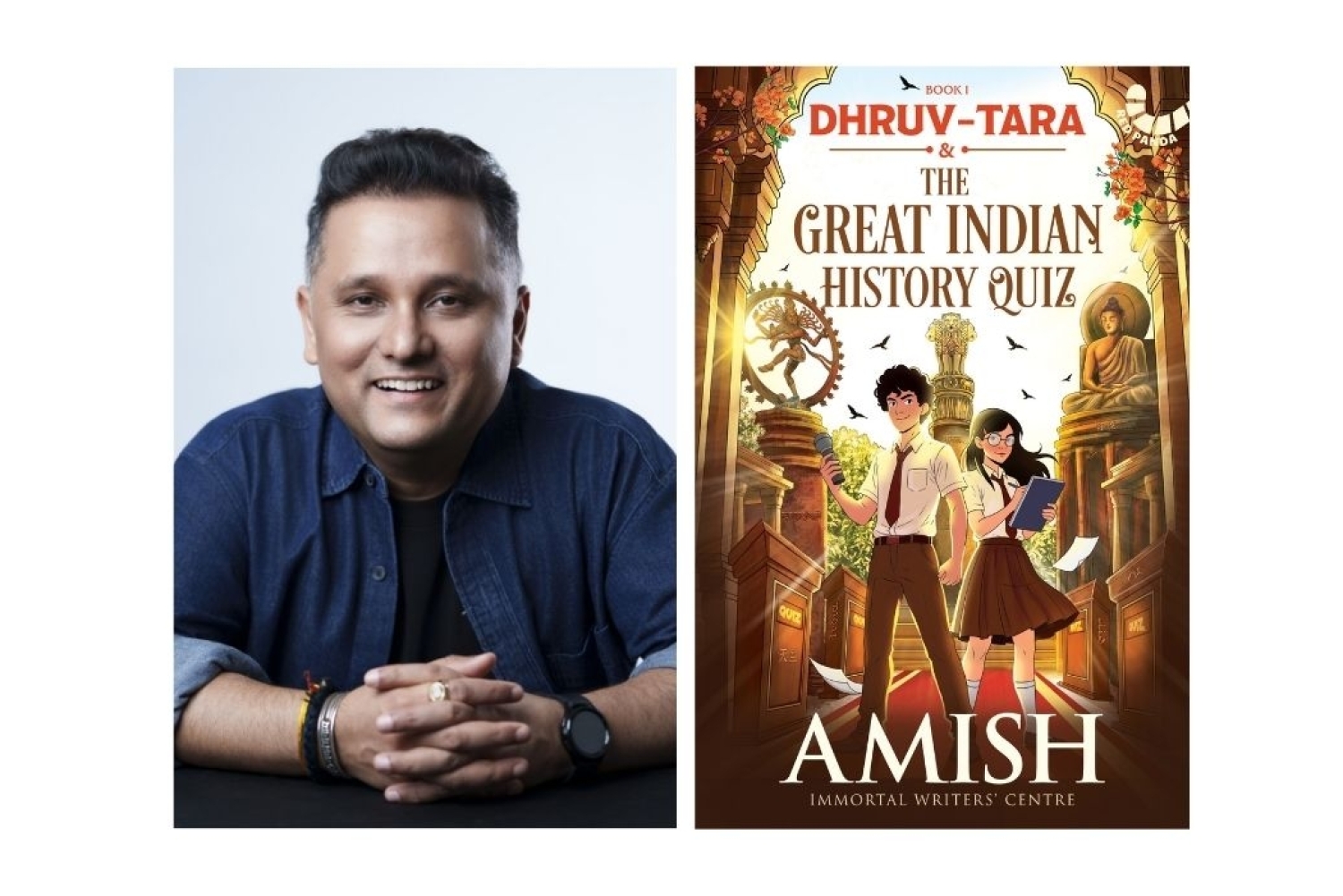
Amish Tripathi, known to use books to explore parts of Indian history that is often overlooked returns with Dhruv-Tara: The Great Indian History Quiz, his foray into the genre of children’s literature. The first book in a planned seven-part series, it follows two 11-year-olds, Dhruv and Tara, as they navigate friendship, competition and a national history quiz. Beyond the adventure, Amish is interested in the world these children are growing up in, one shaped by digital lives, changing ideas of parenting and a very different relationship with authority from previous generations. The multinational companies that existed before the East India Company, histories beyond the familiar Delhi-centric narrative, and the stories of women rulers take the spotlight.
The result is a children’s series that is as interested in the questions surrounding young people as it is in the answers they give in a quiz. For Amish, history is only one part of the journey. The larger question is how children learn to understand the world, and how they learn to handle its ups and downs.
What prompted the shift from your usual writing into children's literature, and what was the process that guided you to this book?
The beginning, like most good things in my life, started with my son. I was talking to him about what is taught to him in school. He's in an international school and I realised that while the history he is taught is more decolonised than it was in my time, it is still not decolonised enough. They’re still being taught a lot of nonsense that we learned when we were young. It is still the British conception of our history.
Small things like Vasco da Gama discovered the sea route to India, which is nonsense. It's not true. Vasco da Gama only discovered the sea route up to the Cape of Good Hope in Southern Africa. There, he met an Indian Gujarati trader called Kanji Malam, who actually guided him from the Cape of Good Hope to Kerala. Kanji Malam himself did not discover that route either. He was using the route that Indian traders had been using for 2,000 years. We were the greatest seafaring nation in ancient times.
Some things have been decolonised, which is good. I thought to myself, let me write books which present a decolonised version of Indian history, but in the garb of a fun adventure. It's not a textbook. Why will anyone read a textbook unless they are forced to do it at school? This is a fiction book. It's a fun adventure of Dhruv and Tara, two 11-year-old kids. While enjoying that adventure, you learn cool things about Indian history. I think that makes a lot of sense as a way to do big things such as decolonising what kids are learning today.
Were there any unexpected differences or similarities you encountered while writing for children compared to writing for adults?
In many ways, it's a lot tougher. A children's book cannot be that long. My average book is 80,000 to 100,000 words. My longest books are 150,000 to 165,000 words. There's no way a kid is going to read that much. 30,000 to 40,000 words is a sweet spot. Ideally, even shorter, but not more. Writing less is ironically tougher. I read a lot of children's books to get a sense of what it should be. This is a writer-centred book. I worked with another writer on this, but I was driving it, as with all my writing.
One thing is that it has to be shorter. I read a lot of children's books to get into that mind frame. There's a way of speaking as well. Proper sentences, perhaps using a bit of Gen Z language. I did some research with my son. I can't overuse it, obviously, but when the kids are talking, there are terms they use, like ‘no cap’, and then a teacher who would represent my generation would say, what does that mean? That allows the kids to see themselves.
Thirdly, the characters have to behave like kids. They're not going to behave like adults. Fourth, which is the most difficult thing, is that I need to communicate history gyan through the story. How do you put it in smoothly? Remember, history textbooks are chronological because they have no fear of being boring.
Most of our textbooks, and sadly, most of our establishment historians, are mind-numbingly boring. That is, I think, more than continuing the colonised version of history, their biggest flaw. They have made a beautiful subject so boring. There are a few historians who've got out of this trap, like Sanjeev Sanyal, William Dalrymple and Vikram Sampath. They make it interesting. How do we put that historical knowledge across while still keeping it interesting, while letting it flow in the warp and weft of a story? That's the biggest challenge.
“I thought to myself, let me write books which present a decolonised version of Indian history, but in the garb of a fun adventure. ”
The story also explores teamwork, friendship and how children can achieve things together. How did you get into the minds of these two 11-year-olds?
An author is observing all the time. We are like sponges. Wherever I am, I'm looking at people. I'm seeing how they talk. I keep observing people and all that goes somewhere in the back of the mind. I live in a complex in Mumbai, in Lower Parel, with lots of kids. There's a very large playground and cricket ground in front of the complex. You see them interacting, and if you're just observing them, some things stick. My son and his friends, and fortunately a lot of kids in our extended family, keep interacting with eachother. When you observe so much over many years, what happens for an author is that composites form from different people as a cumulation of various people that you observe. That's how it works out.
Dhruv is a kind of fly-by-the-seat-of-your-pants, take-a-risk kind of kid. Tara is a think-everything, plan-everything kind of kid. As you'll discover in the subsequent books, what kind of background leads to this kind of character? What are the strengths and weaknesses of these characters? Even the other quiz participants. We're going to go into their backgrounds as well.
You have said the series will eventually have seven books. Can you give us a sense of what we can expect from the upcoming books?
One is what type of historical subjects we cover. I want to cover how our economic system worked, and why we were the wealthiest land on earth in much more detail. We had multinational companies much before the East India Company. We aren't taught this. There are many subjects like that, things that have been ignored in our history books. I think our history books also have an obsessive Delhi focus. The rest of India has been ignored quite a lot.
When I was growing up, the history books had two or three chapters saying, ‘Meanwhile in the South.’ My South Indian friends would say, what do you mean, meanwhile in the South? But the answer to them is that the South at least gets a meanwhile. West India, Central India and Eastern India don't even get a meanwhile.
Our national history books kind of give that impression. I want to cover different parts of India as well, female rulers and many other things. With the characters, I also want to go into their backgrounds. What are the challenges they face? A kid whose parents are separated and aren't getting along. Sometimes there's alienation. Sometimes both parents are fighting for the affection of the kid, which is not good for the kid because there's no one actually being a parent. Why is there an epidemic of loneliness? How do you handle it? Various things like this.
This interview will also appear in the September edition of EZ, out soon, with many more such stories. Browse our past editions of EZ here.
Words Neeraja Srinivasan
Date 7.9.2026