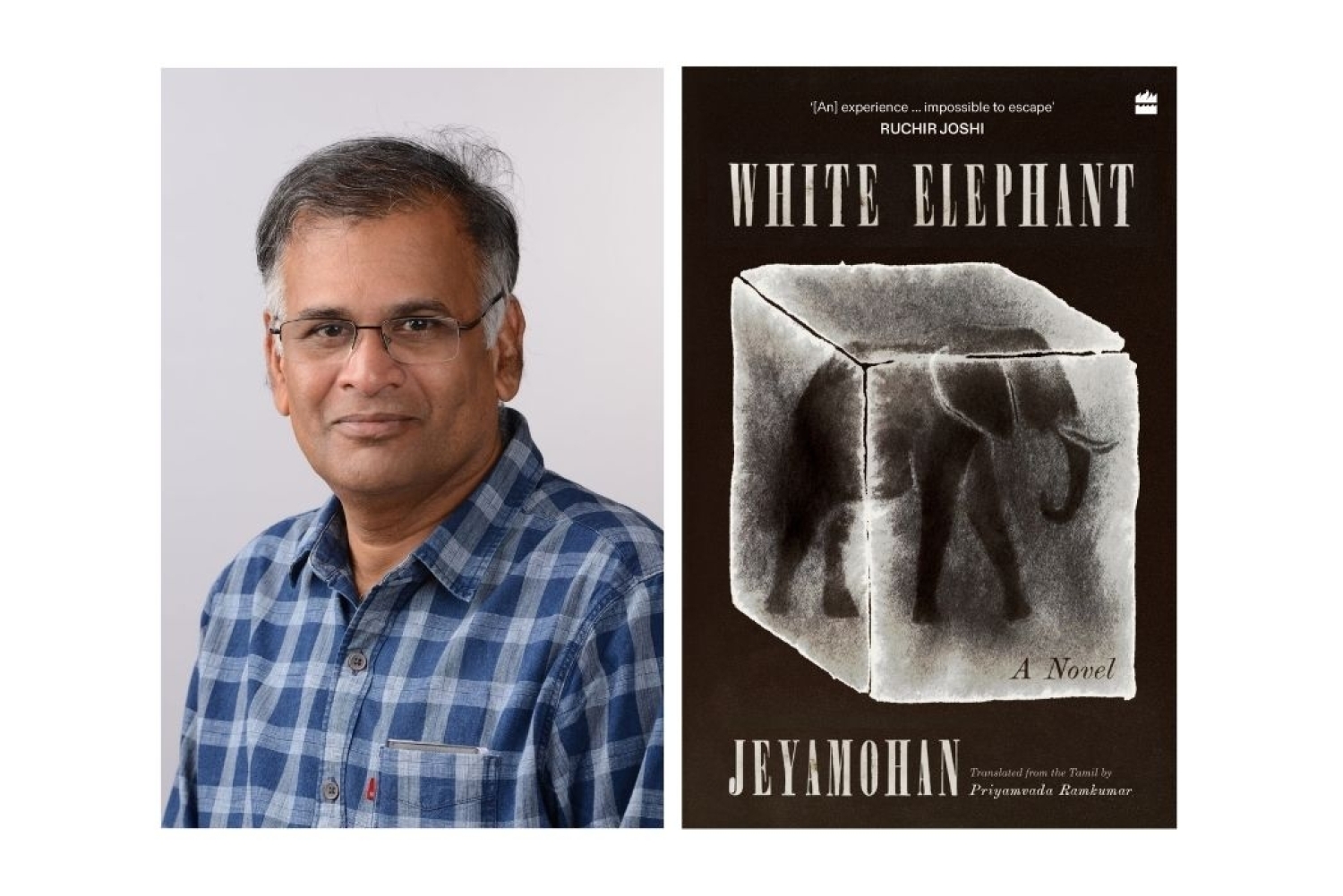
What might have been the story of the first labour uprising in modern Indian history takes the stage in Vellai Yaanai, translated as White Elephant, which follows an Irish police officer posted to India in 1878. He is introduced to the Tudor Ice Company, where labourers from lower castes work under horrifying conditions to deliver ice to lavish English banquets. Upon the murder of two of these labourers, Aiden and an activist, Kathavarayan, set out on a mission to confront one of the deadliest famines rapidly spreading across the country. Forcing Aiden to understand his own role in the cruelties committed by the British Raj, this is a searing story of corruption and power. We’re in conversation with Jeyamohan, the author.
What first drew you to the story of the Tudor Ice Company?
My metafictional novel Vishnupuram, which tells the history of Tamil Nadu through fantasy, was published in 1998. Though today many critics regard it as one of the most important works in Tamil fiction, when it was first published, it faced fierce opposition from two different quarters. Some accused me of denigrating Vishnu, while others condemned the novel for presenting a Hindu religious perspective.
At a critical discussion held in Chennai, one political critic strongly opposed a passage in which I had written about Paraiyars playing music in a temple. He accused me of concealing the history of oppression suffered by Paraiyars and of distorting history. I responded by pointing out that there is a clear inscription from the Pallava period indicating that Paraiyars in Tamil Nadu had once occupied a high social position and had served as priests and musicians in temples. But the general mood of the meeting was against me at the time.
However, someone who was present at the meeting later approached me privately and told me that what I had said was entirely correct. He was the Dalit scholar Anbu Ponnoviyam. He invited me to his home, and a long series of conversations developed between us. It was through him that I came to learn about the history of the Dalit awakening in Chennai and the struggles associated with it. From him, I learned about the Ice House revolt.
Anbu Ponnoviyam introduced me to V. Alex, a pioneering Dalit activist and publisher, who later became one of my closest friends. Alex urged me to write this novel. He collected and gave me the historical material I needed and eventually published the book through his publishing house, Ezhuthu.
How did the history of the 1878 famine shape the world of the novel?
Three of the ideas Anbu Ponnoviyam shared with me made me think deeply. First, he said that during the great famines that struck Tamil Nadu from the 1770s through the 1870s, nearly half of the Dalit population either died of hunger or left the country as indentured labourers. Had this not happened, Dalits might have constituted more than half of Tamil Nadu’s population, and they might even have come to rule the state. At the same time, however, the opportunities opened up to Dalits by the British government; particularly in the army and in government service as cooks and soldiers, gave many of them a degree of freedom from their traditional conditions. Paradoxically, the great famines also helped liberate Dalits from a life bound to the land.
Second, he told me that the first political movement in Tamil Nadu was, in fact, the awakening of the Dalits. Dalits were among those who organised some of the earliest labour struggles in Chennai.
Third, he pointed out that during the famines, much of the labour behind the major construction works in Chennai was provided by Dalits. Yet, in later years, a large number of these workers were driven out of the city. It was around these three ideas that I eventually conceived my novel White Elephant.
What interested you in interrogating the question of caste through the lives of Aidan and Kathavarayan?
The British official J. H. A. Tremenheere was the model for Aidan. He was one of those who recommended that surplus land in Tamil Nadu should be acquired and distributed to Dalits. He was an important figure in the history of the Dalits.
Kathavarayan was modelled on Ayothidhasar, the great Dalit leader. Ayothidhasar’s original name was Kathavarayan. The two figures stood at opposite ends of a spectrum. One looked upon the people of this land with compassion; the other, driven by anger, sought to mobilise and unite them.
By bringing these two figures into conversation with each other, I wanted to explore and debate certain fundamental questions. Ayothidhasar, who had once been a staunch Vaishnavite, converted to Buddhism. He was also one of the figures who paved the way for Ambedkar’s turn towards Buddhism. In this novel, I explore how that conversion came about, and how Aidan’s Christ was transformed within him.
.
What did researching this period reveal that surprised you most?
According to official data, tens of thousands of people were dying of famine every day in Chennai and Coimbatore. Yet, in almost none of the classical Tamil literary works written during that period is there any significant mention of this devastating famine. The only records are found in the folk literature of the oral tradition. But most of these works have been lost. S. Rasu of Erode collected and published the songs and other works that have survived. I was deeply astonished by the ignorance and indifference that existed in our society toward this terrible tragedy.
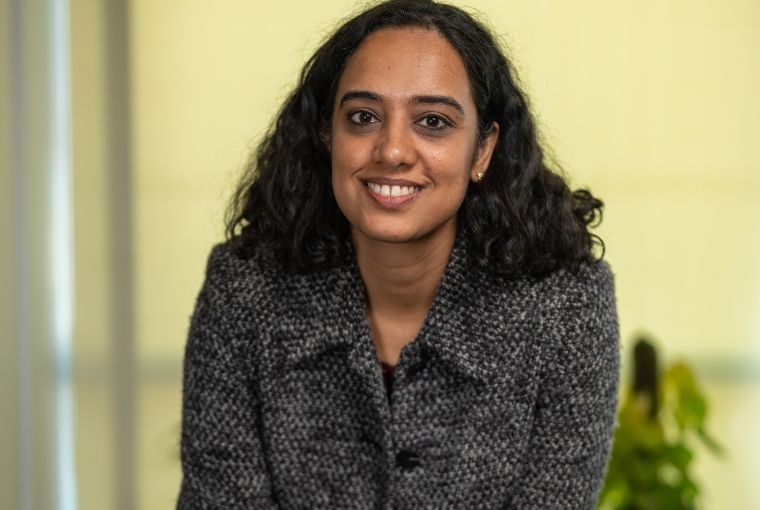
Translator, Priyamvada Ramkumar
We also have some insights from Priyamvada Ramkumar, the translator.
What were the biggest challenges in translating White Elephant?
White Elephant is a unique work for several reasons. It is one of only a handful of novels centred on the massive famines that ravaged India during British rule. It is also a work that inhabits a foreigner’s psyche in telling its story, which is rare in Indian writing. I don’t say it because it is virtuous to do so, but because the character of the prose is influenced by the point of view the novel takes. White Elephant, originally written in Tamil, casts Aiden Byrne, an Irish police officer as its protagonist. The novel is also peppered with characters of other nationalities and ethnicities: British, Austrian, Scottish, Anglo-Indian and of course, Tamil. It’s unimaginable that all of them would have spoken Tamil, but that is the language through which we hear them in the original novel. In that sense, the original is itself a translated work.
So, while translating this work into English, I had a sense that I was in fact excavating the ‘original’ from a translation, a case of reverse translation. But what kind of English did they speak? What kind of English did the author have in his mind, if subconsciously, when he wrote these lines? While the novel is written in third person, it slips in and out of Aiden’s mind ever so often. Shelley’s romanticism, which is a huge influence on Aiden, also bleeds into the prose. Finding this voice organically posed the steepest challenge in translating the novel. To do so, I resorted to reading more broadly. Shelley’s poetry, a few of Mary Shelley’s essays on the poet; Angela’s Ashes by Frank McCourt, in particular, opened up the Irish psyche to me. I also read contemporary Irish writers like Claire Keegan and Sally Rooney. I don’t think any one of these influenced me in isolation, but they unconsciously shaped my inner language while translating the novel.
How did you retain the novel’s sense of 19th-century Madras?
This is an interesting question. I think the novel simply made me more curious about Madras history. Madras is my birthplace, but when you stay in a city for long you often take her landmarks for granted. Reading and translating this work prised me out of that lethargy. I went on heritage walks in some of the localities that feature in the novel. Royapuram, George Town, a few buildings designed in the Indo Saracenic style by Robert Chisholm who makes an appearance in the novel. I also read Glyn Barlow’s Story of Madras, written in 1921. I think all this helped me inhabit the Madras of
those times a little better. Although, I must admit, these wanderings were led by curiosity rather than any kind of conscious attempt to imagine 19th century Madras. There’s another thing. The sea, which is often a counterpoint to Aiden’s mental state in the novel, as is the aptly named character Marisa, is just down the road from where I live in Chennai. Even now, a couple of years after translating the novel, there are moments when I catch myself watching the waters through Aiden’s eyes.
What is your relationship with Tamil and English?
Tamil is my mother tongue and a language that I chose to study closely in school. I was fortunate to have some passionate teachers who made sure that I resisted all temptation to make a more utilitarian choice. However, thanks to an appalling lack of introduction to contemporary Tamil literature until my late twenties and a family that read largely in English, the exposure I had in my formative years was entirely to anglophone literature. Years of comfort with reading and speaking the language has ensured that I think largely in English.
However, language is much more than thought and expression. It is a gateway to culture. When I began reading modern Tamil literature, despite the difficulty of often reading in dialect, despite having to read a lot slower than I would have liked to, it truly felt like a homecoming. For me, speaking and reading in Tamil is inextricably linked with understanding where I come from. English, for me, doesn’t carry that cultural power or baggage, depending on the way one looks at it. Having said all that, I constantly feel like an imposter in both worlds, as if I exist in a liminal space between the two and belong to neither. Which I think is a great place to be as a translator.
Words Neeraja Srinivasan
Date 22.9.2026