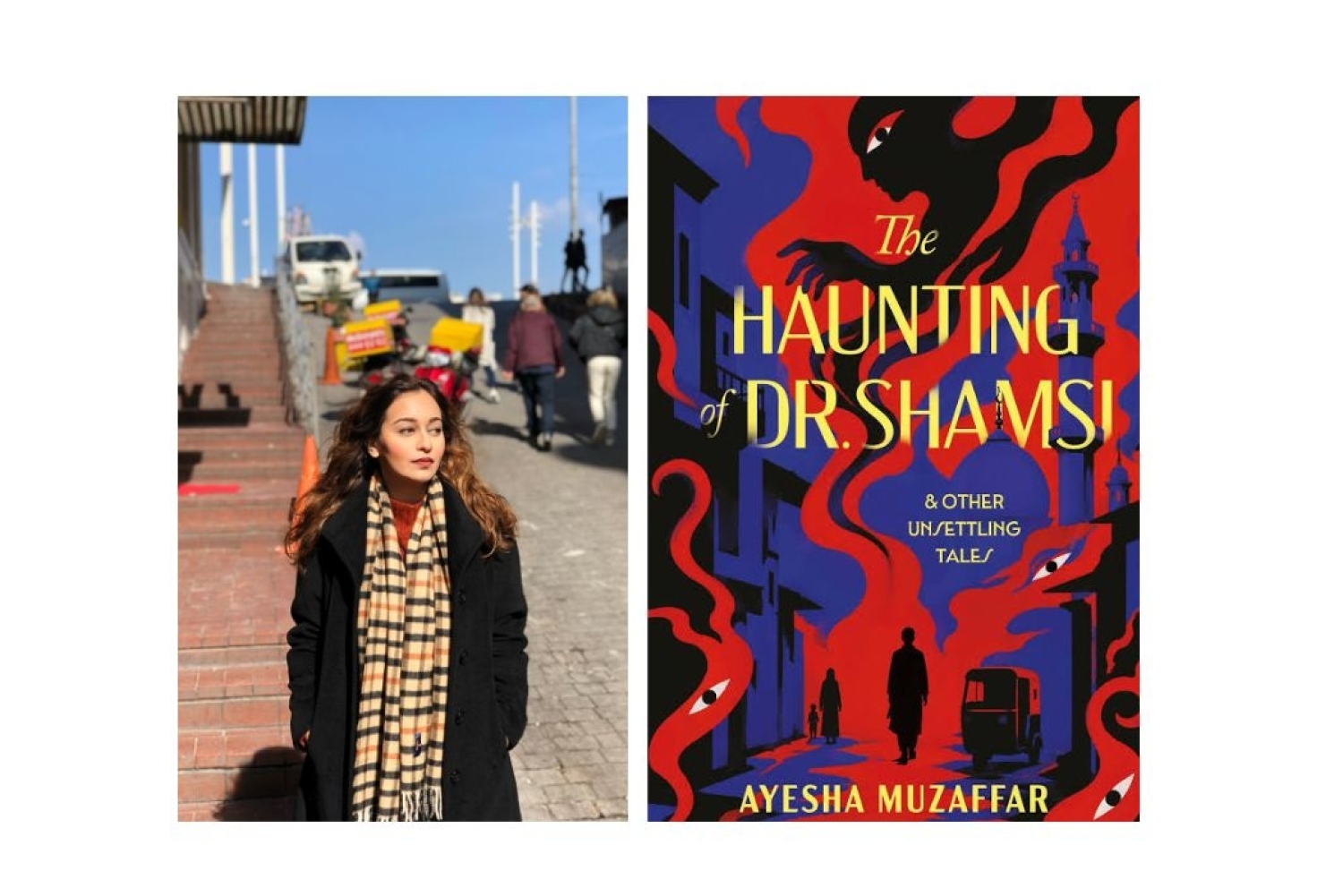
Ayesha Muzaffar’s relationship with the supernatural has been brewing for a long while before she thought of it as something to write about. Growing up, she listened to her baba recount strange adventures with his cousin Khawer, stories of things seen, felt and experienced beyond the visible world. By grade five, she had written her first supernatural story, Woh Aurat, about a neckless woman she had seen during a family trip to Murree. “I don’t really consider the supernatural a ‘field’ I chose to write in,” she says. “To me, the unseen is as much a part of existence as you and I are.”
Her new collection, The Haunting of Dr. Shamsi and Other Unsettling Tales, grows out of this long familiarity with the unseen, while also marking a shift in how she approaches it. Ayesha spent years gathering real accounts through conversations with people across different cultures and belief systems, from spiritual practitioners in Malaysia to people in Turkey and Indonesia, before beginning to weave these narrations into fiction. More from her below.
What draws you to the field of the supernatural in your writing?
I don’t think I was ever really drawn to the supernatural. I think I was raised standing very close to it. Even the name Abusjinns comes from my baba. It quite literally means Abu’s jinns, my Baba’s jinns. When I was little, he would sit me down and tell me stories about himself and his very dear cousin Khawer. They would go on these little adventures together, and almost every story had something strange hiding inside it. My baba would speak about what he understood as a kind of sixth sense, things they had seen, things they had felt, encounters that did not quite belong to the visible world. When you are a child, you don’t necessarily understand that these are unusual stories.
By grade five, I had written my first supernatural story. It was called Woh Aurat, about a neckless woman I had seen during a family trip to Murree one weekend. My teacher was deeply troubled by it, which, in retrospect, should probably have told everyone where this was headed. So I don’t really consider the supernatural a ‘field’ I chose to write in. To me, the unseen is as much a part of existence as you and I are. I believe we live beside things we cannot always perceive or explain and I simply grew up with an awareness of that world. And when something has walked beside you for most of your life, you don’t exactly become drawn to it. You just co-exist with it.
Take us through your process of translating real accounts of horror and folklore from around you into stories. Did it involve conversations, reading and really digging into certain undiscovered histories?
For many years, I wrote almost exclusively from real narrations. A large part of my early work came from accounts connected to the life of an exorcist (not me), but eventually the search became much wider than that. For years, my research existed in conversations more than in books. I found stories in living rooms, over long phone calls, during travels, and in the pauses people took before deciding whether they trusted me enough to continue. I spoke to people whose religions, cultures and ideas of the paranormal were completely different from my own; spiritual practitioners in Malaysia, people in Turkey, accounts from Indonesia, and complete strangers who sometimes handed me stories they had never quite known what to do with. What fascinated me was how wildly the language changed from one place to another, while the fear itself remained remarkably familiar.
About six years ago, though, I changed the way I wrote. I realised that constantly entering other people’s darkest experiences was beginning to take something out of me. I would fall ill often, and I started to feel that I simply did not have the spiritual strength to keep exposing myself to certain accounts so closely. Whether one chooses to understand that spiritually, psychologically or otherwise, I knew I needed a little distance between myself and the stories I was so eager to carry.
That is when I began weaving real narrations into fiction. And I would like to think that it made me a better writer because fiction gave me a veil. I could preserve the emotional truth of an account without treating somebody’s trauma as spectacle. I love speaking about the unseen, but I am also very conscious that it is not a circus. There are things I will research, things I will write, and things I have learnt are better left exactly where I found them.
What is your relationship with the landscape of Karachi and Lahore? Why did you choose them to situate these horror stories in?
Lahore is home. Lahore will always be home. My love for it is very peculiar because Lahore feels ancestral to me. And I think that feeling becomes even more interesting when we speak about the subcontinent because our histories do not obey the borders that exist today. There are families in present-day India whose dadas and nanas or great-great-grandparents carried Lahore inside them for the rest of their lives. There is something about the soil of Lahore that feels like a thousand different memories. Old havelis that have lived several lives. Trees have watched families arrive and disappear. For somebody who writes about the supernatural, that is irresistible.
Karachi is different. I do not love Karachi in quite the same personal way, but I am fascinated by it. To me, it is a city of arrivals, hope, and sea air.
And I think horror works best when the landscape is allowed to participate. I never want to simply put a jinn or a pichal-peri in Pakistan. I want the horror to belong to the specific street, the weather, the house and the people living in it.
With reference to the story about Dr. Shamsi; he’s caught between science and the unseen. What inspired this exploration between a practitioner of science and the supernatural?
Dr. Shamsi is a dentist. His world is anatomy, nerves, roots, X-rays, diagnosis: there is enormous comfort in the idea that if something hurts, you can locate the source of the pain. I wanted to slowly take that comfort away from him. Not because science becomes false, but because, for the first time, it is no longer enough to explain everything happening around him.
And I think, unintentionally perhaps, that question began running through the other stories too. In Finding Faraz, Farwah knows grief, love and memory intimately, but then reaches a point where she can no longer trust what her own eyes are showing her. In Bareera Khurram’s story, the language shifts again, this time towards therapy, trauma, memory and the mind, until even the person trained to understand those things has to wonder whether she is dealing only with a patient anymore. So the book keeps changing the lens. Medicine. Love and grief. Psychology. Each one gives us a perfectly reasonable way of understanding what is happening. Until it doesn’t. I think that is where I find horror to be most amusing. Not when we know there is a monster, but in that deeply uncomfortable moment when every explanation available to us is still reasonable and none of them is quite enough.
Working in the space of literary horror, what is your favourite South Asian eerie story or trope?
There's not just one tale. There never can be. South Asian supernatural storytelling is full of beings that deceive, mimic, shapeshift, borrow voices, borrow faces. And I find that infinitely more frightening than something with claws standing at the foot of your bed.
If I see a lady in white, fine. I know I should run. But if something that looks exactly like me, calls my name in my ama’s voice from another room, now we have a problem. I love that particular kind of horror because it corrupts intimacy. Fear knowing exactly what you fear. Fear borrowing what you love. Fear feeding on the very thing that would normally make you feel safe.
What are you working on currently and what’s next?
I am currently working on a book called Shaam, and I very much hope it finds its way to India too. It is for adults, and it is probably the least merciful thing I have written so far. Spiritual horror, but without looking away when things become ugly. I think with my earlier work, there was still a part of me that would stop at the door and wonder if perhaps I had gone too far. With Shaam, I am much less interested in stopping.
I don’t want to reveal much yet, but the title itself says enough. Shaam is that strange hour when the day has not completely died, the night has not completely arrived, and for a little while, everything seems to belong to neither. That is more or less where this book lives.
Words Neeraja Srinivasan
Date 9.9.2026