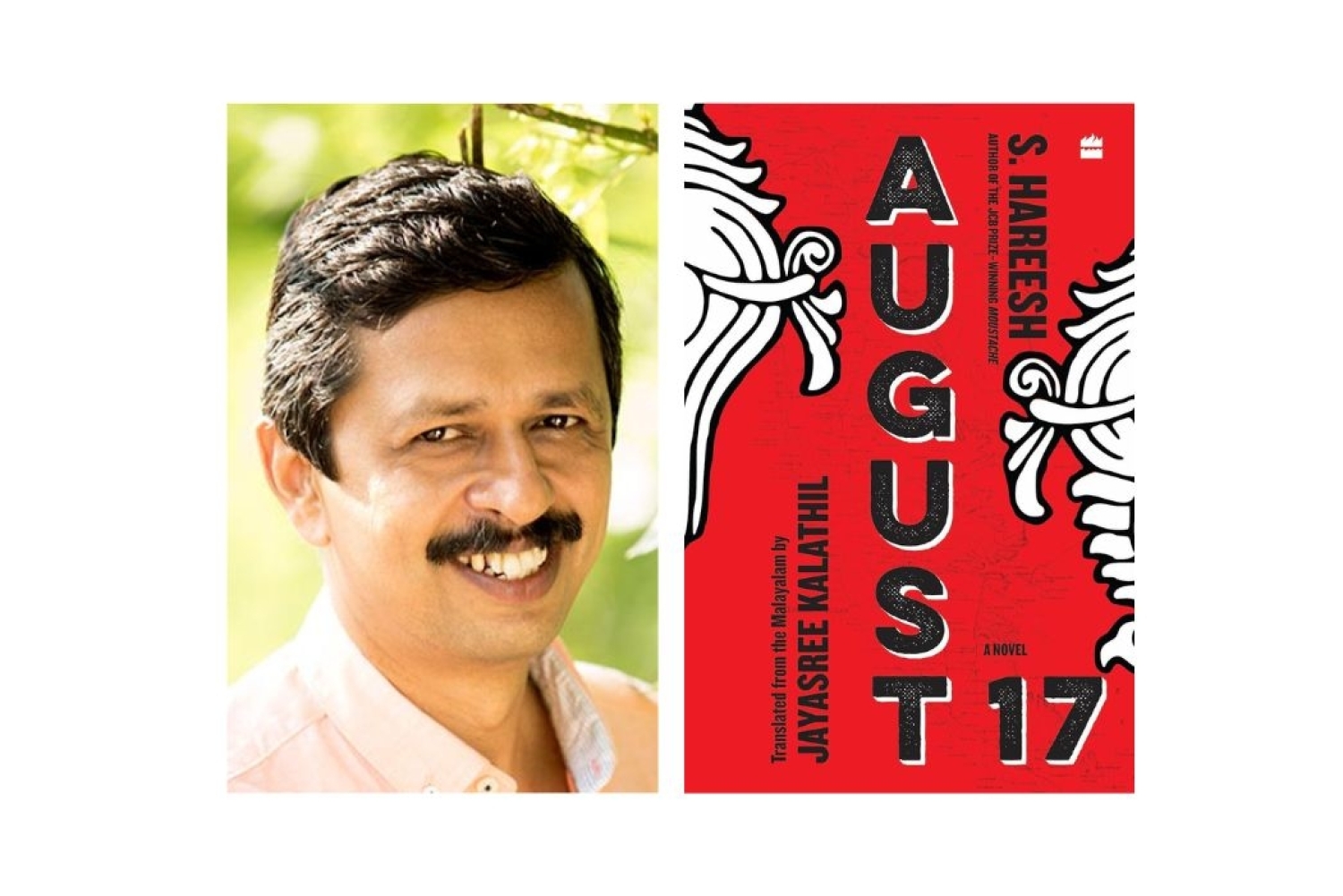
The world of August 17 imagines an alternate history in which Thiruvithamkoor, one of the British princely states, never joined the Indian Union, asking what might have happened if it had remained independent. ‘The fate of a country,’ S. Hareesh, the author reflects, ‘is often not based on careful consideration of people’s will but the selfish desires of a few individuals.’ Told through the eyes of a shadowy informant, the novel draws from forgotten histories, secret police networks, and the political undercurrents of Kerala’s past. Translating the novel into English, Jayasree Kalathil approached the text through tone, rhythm and voice, choosing to stick to the story and the storytelling rather than over-explaining its historical context. Together, they discuss research, translation, bilingualism, and the possibilities of speculative fiction.
We spoke to the author on reimagining Kerala, his writing style and finding the perfect balance between history and fiction.
What first drew you to imagine an alternate history of Kerala?
I have always been a fairly good reader of history. Even small, insignificant places can have dramatic and eventful histories. It is also natural that, as we read about pivotal events, we wonder, what if it had happened in a different way? Keralam, the state, was formed of a part of British India and two princely states. There was a time when one of these princely states, Thiruvithamkoor, had decided not to join the Indian Union and remain an independent country. If that decision had come to pass, the history of our subcontinent would have been an entirely different one. As had happened in many countries that had gained independence from colonial rule, it too might have suffered civil wars and dictatorship. August 17 began from such thoughts.
Why did you choose the perspective of a shadowy informant to tell the story?
During royal rule, Thiruvithamkoor had a strong secret police service. In the writings of Vaikom Muhammad Basheer, who appears as the main character in the novel, they are often portrayed as CIDs. What happens within politics is often secretive and hidden from us. It seemed that a spy was the best character to narrate the inside workings of the political process. It also opened up the storytelling to explore the complex, stressful life of such a person who does not possess a clear identity. The fate of a country, the path it takes, is often not based on careful consideration or people’s will but the selfish desires of a few individuals. It felt that the shadowy informant was a good way of telling these stories too.
How did you balance real historical events with fiction while writing August 17?
Writing a novel using history as its inspiration, it is possible to explore the history that is generally accepted as the fact as well as histories that have been kept hidden or marginalised. But writing an alternate history novel about Thiruvithamkoor is not like writing a similar novel based on European or Indian history. Those histories are fairly known to people whereas Thiruvithamkoor history has been forgotten even by those who live here. So, the readers needed to be persuaded about the real events that had taken place before imagining the events that might have taken place. That was the biggest challenge in writing this novel.
What was your writing and research process?
I don’t have a clear and concise process. In the beginning, all topics feel like great challenges, and it is only when I feel the confidence that I can write about this that I actually start writing. Research goes hand in hand with the writing. And as I travel down the paths of the story, more, better, possibilities reveal themselves.
What do you hope for readers to take away from the story?
Readers are free people. The writer or the translator cannot control them. What really matters is whether the book suits their interests, their reading, their taste. Let them take whatever they want from the story.
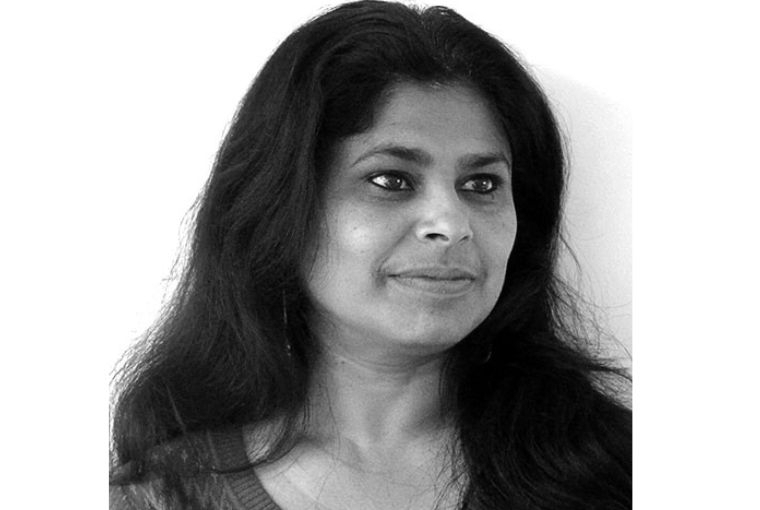
The translator, Jayasree Kalathil. Photo by Adley Siddiqi
We also had the opportunity to interview with Jayasree Kalathil, the translator of August 17, who reflected on questions of language, form, and narratorial voice.
What is your relationship with Malayalam and English?
Malayalam is the language I was born into and grew up with. It is my ‘mother tongue’ [although I am not a fan of that term] and my native language. I began learning English at a young age and I am able to use it fluently, spontaneously and intuitively, all of which makes it, according to linguists, my native language. On an everyday basis, I rarely get to speak Malayalam as there are no Malayalam speakers in my family in the UK or in my immediate community here. Still, I read and write in both languages every day. In all these ways, I consider myself bilingual. In my work as a translator, I engage closely with both languages. I also know four other languages to various levels. I am endlessly fascinated by how each of these languages behave, at the level of words and grammar as well as at the level of cultural discourse and meaning-making.
Tell me about your translation process. Take us step by step.
There is no one process. There are, however, certain constants. I only translate books that I like as a reader. I read the entire book before translating, sometimes twice. Often, I translate favourite passages or chapters, playing around with tone, rhythm, voice, and only start working systematically from Chapter One till the end when I am satisfied that I have a grip on the tone, rhythm and voice the author has used in the text. I usually write the first draft long-hand in recycled notebooks using a fountain pen. I work on at least three drafts before sending the manuscript to the author and the editor.
What were the biggest challenges in translating a story with so many parallel emotions?
All the books I have translated so far have parallel emotions, so August 17 was no different. The challenge in translating this story was working out how to engage with the history it is based on. It is not a history I am all that familiar with, nor will it be familiar to the readers of the book. Do I then explain, how and how much do I explain? These thoughts felt overwhelming in the beginning. But then I chose to stick to the story and to the storytelling in the book and to keep the ‘real’ history aside. I am an avid reader of historical, speculative fiction. That helped very much.
Were there specific Malayalam words or cultural references that resisted translation? How did you navigate those moments?
There were no such moments in this book. There is a misunderstanding that translation involves finding equivalents in one language for words in another language. But translation does not work specifically at the level of words; it works at the level of sentences, of contexts, of meaning-making overall. So, while one might not be able to find equivalent words, it is absolutely possible to translate those words engaging with their emotions, cultural specificity, resonances and so on. Therein also lies the creativity of the translator.
Words Neeraja Srinivasan
Date 11.5.2026