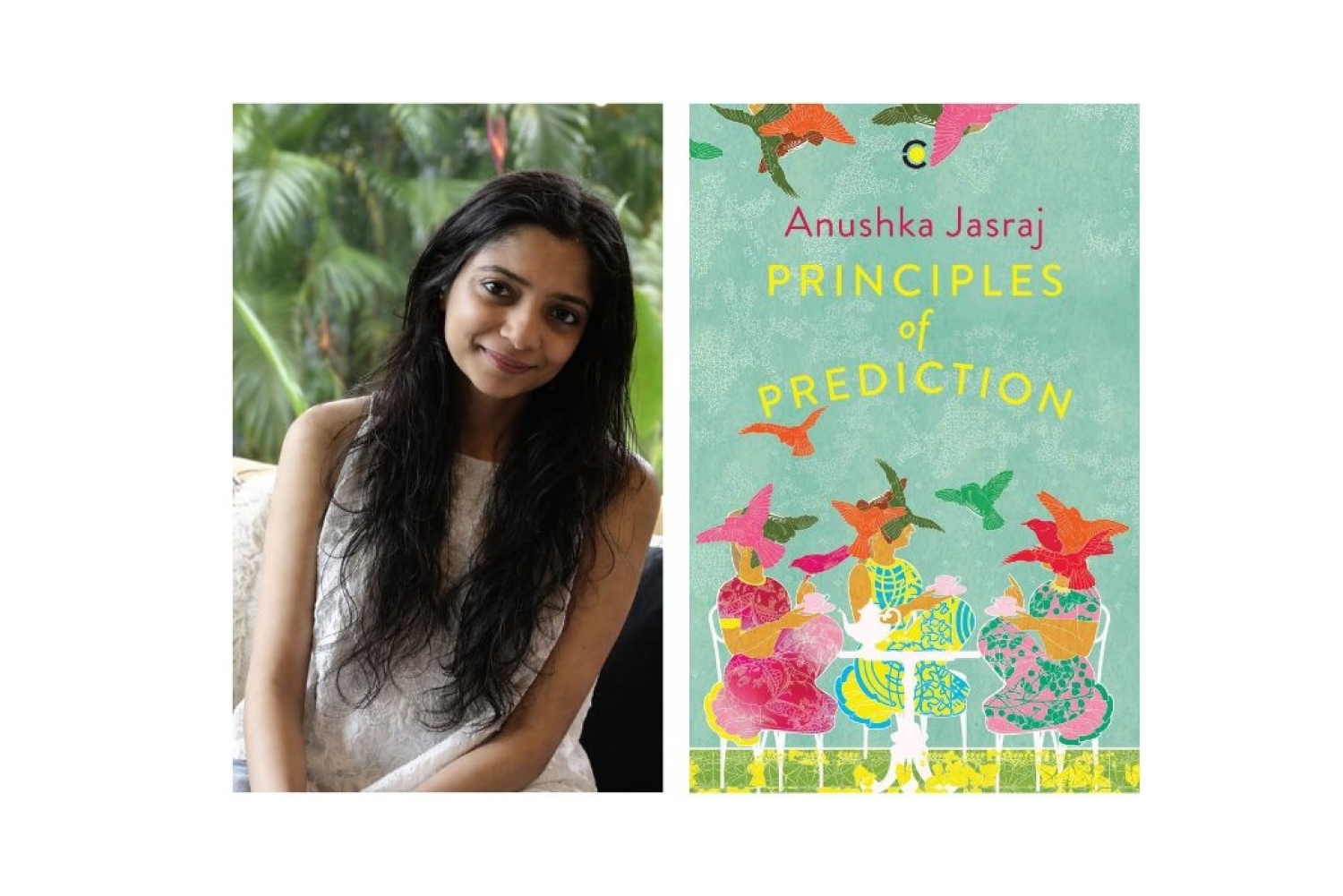
Principles of Prediction sees Anushka Jasraj works within a very contained form for working through an emotion or an idea, using the short story to explore and evoke a wide variety of characters and worlds. Across the collection, prediction appears through weather, astrology, and divination, practices she sees as ‘closer to poetry and creative arts.’ Rather than control, they reflect the need for certainty, and how little control we really have over what happens. Written over more than a decade, these stories bring speculative elements to deepen the emotional world of the characters, resulting in a collection that explores the extraordinary textures of everyday life.
What drew you to the short story form for exploring such intimate, everyday moments?
The short story is a very contained form for working through an emotion or an idea. Over time, I’ve come to love how writing short stories allows me to explore and evoke a wide variety of characters and worlds. But if I’m honest, I arrived at the form accidentally. When I was starting out as a writer, I wrote short stories because most writing fellowships and literary magazines required shorter pieces of writing. The structure of writing workshops also encourages short stories over other forms. I gradually discovered that my natural writing style lends itself best to short stories. I tried to trick myself into writing a novel by thinking of each chapter as a story, but that endeavor did not entirely succeed.
In your work, what does ‘prediction’ reveal about our need for control?
The title of the book comes from one particular story, about a woman who starts to unravel while she works at a weather prediction agency. In other stories within the book, the concept of prediction comes up through astrology or other forms of divination. For me, these practices are closer to poetry and creative arts. In the story Venus in Retrograde, the characters meet for a writing workshop of sorts, to learn about writing horoscopes and predictions. Perhaps the need for certainty, more than control, plays into our engagement with the occult. If anything, divinatory practices implicitly acknowledge how little control we have over what happens. Your question also makes me think about how the short story itself is a very controlled form, as compared to the novel.
What interested you in placing speculative elements within otherwise ordinary urban lives?
I’ve been fortunate to have editors and teachers who always questioned my inclusion of fantastical or speculative elements. The first draft is always intuitive. After the first draft, I usually ask myself whether the story would still be as good if I removed the non-realistic elements. The times when it has felt justified is when the speculation brings us closer to the emotional world of the characters.
What is your relationship with writing and why do you write? What was your process for this collection?
Writing and thinking are synonymous for me. I don’t plan ahead when I write a first draft, but I follow what emerges in the process of putting words onto paper. Whenever possible, I write in a notebook and then type up what I’ve written.
I turn to different forms of writing for different reasons. Sometimes I’ll write a long email to someone when I need life advice, or I’ll write a note on my phone when I want to hold onto a memory. But I believe all writing is relational and communicative. We always have an imagined other in mind, whether implicitly or explicitly. At some level, my writing is also a conversation with the authors I’m reading. For the collection, the stories came together over a period of more than a decade. Each story had its own process. Any explanation I try to provide would be a retroactive construction. However, I spent a lot of time on revision and sentence-level edits.
Were there any other works of writing that guided your writing along the way?
There are a few short story writers to whom my work is indebted: Lydia Davis, Grace Paley, and Joy Williams. Lucy Corin and Kuzhali Manickavel, both of whom write with an inspiring recklessness. One of my friends likes to accuse me of writing with the minimalism of Raymond Carver, but I don’t agree. I also love Clarice Lispector, Arundhati Roy and Elena Ferrante. I read a lot of poetry and I absolutely love Ada Limon, but I would say her work has guided me in life even more than in my writing. Audre Lorde’s essay, Poetry is not a Luxury, for life guidance as well.
What are you working on currently and what’s next?
I’ll soon be starting doctoral work in psychoanalysis and my next big writing project will be my dissertation. I plan to do research on how Lacanian psychoanalytic theory and technique can be applied within creative arts therapy. I intend to continue writing short stories, as and when I can.
Words Neeraja Srinivasan
Date 27.4.2026