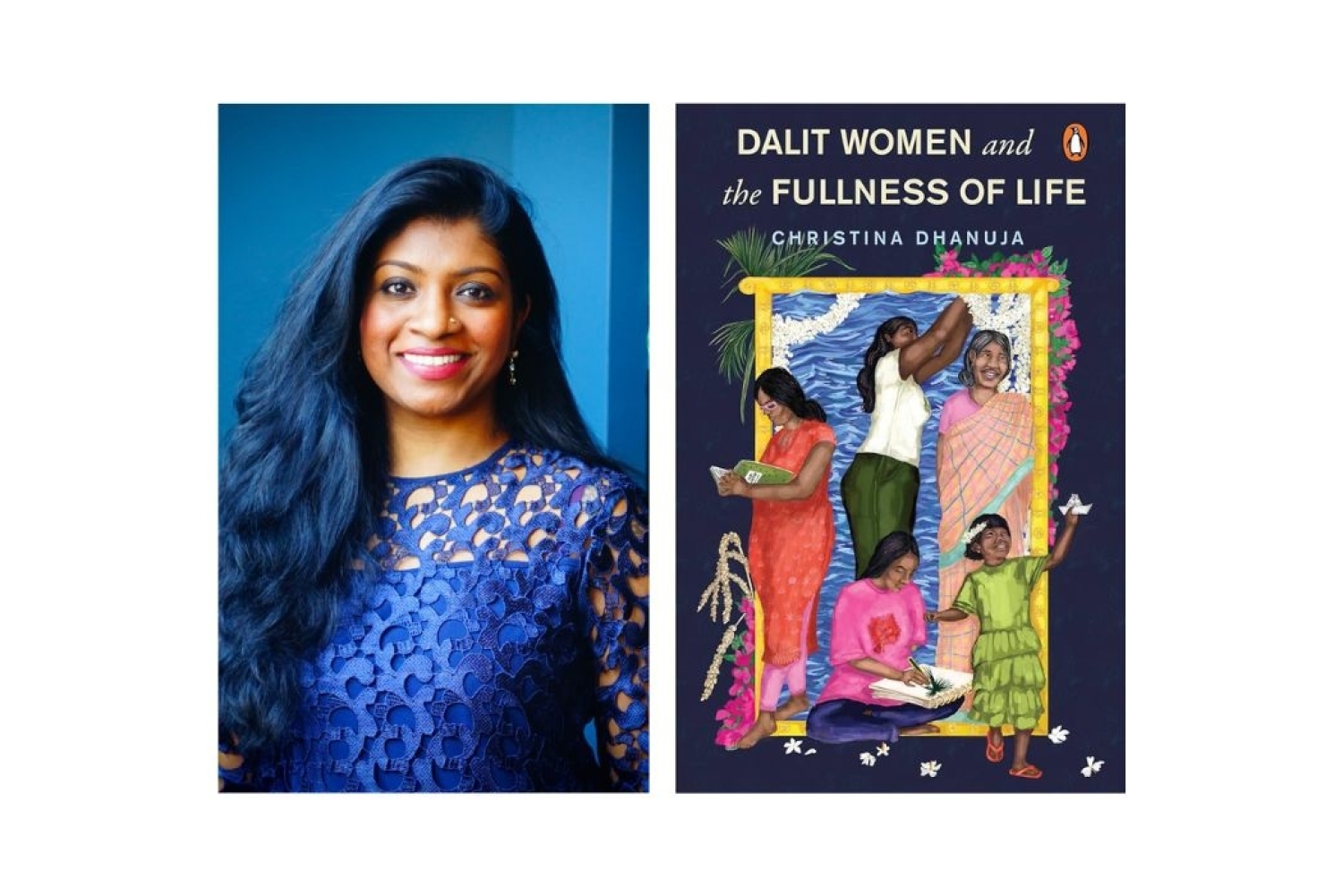
‘For far too long, Dalit women have been viewed and treated as unidimensional stereotypes, victims, maids, sirens, criminals, and workhorses, with little to no interest in how we actually make sense of the world around us. This has, in turn, justified a ruthless lack of accountability in the way we’ve been discriminated against and exploited in underpaid, menial and unproductive jobs and in being denied our rightful access to a full life. What will get the world to see Dalit women as wholesome human beings, who can be as flawed as they are innocent, and as gifted as they are ordinary? What will get us to see ourselves and each other as humans first, superheroes second? What theoretical distortions and caste-coloured distractions must we let go of to recognize our own fullness?’
Christina Dhanuja wrote Dalit Women and the Fullness of Life from a long-felt absence. ‘When I was hungry for stories about Dalit women, there were almost none,’ she recalls. Her work responds to portrayals that rendered Dalit women as peripheral beings; helpless and hopeless. Moving beyond such limits, the book brings in desire, trauma, faith, sisterhood, community, and joy to assert Dalit women’s rights to fullness. Arising from spaces of both the personal and political, it is her attempt to imagine Dalit women as wholesome human beings, complex, flawed, and fully alive.
What first made you feel that there was a gap in how Dalit women’s lives were being written about?
I can’t think of a single moment, but I do remember that in my 20s, when I was hungry for stories about Dalit women, there were almost none. The Indian fiction books a friend introduced me to were primarily about upper caste women, their lives and desires, their negotiations with patriarchy, their pain, and their coming of age. Dalit women had no space in those worlds or their words. And when they did appear, they were nobodies, spoken of as peripheral beings; helpless and hopeless, victims in need of saving or troublemakers in need of reprimanding.
Then I turned to non-fiction. There, I found that Dalit women were afforded only certain kinds of writing: biographical [The Weave of My Life, Karukku], historical accounts [We Too Made History], short stories [Sangati, Mother Wit, Harum-Scarum Saar], and poetry. Non-fiction that articulated the politics of being Dalit and woman was often academic in nature and, importantly, upper caste or white-authored, which can be deeply limiting, especially when you notice how Dalit women are treated as mere ‘subjects’ within these texts; specimens, whose lives need to be studied and made into obedient data points for bell curves.
Your book moves beyond pain and resilience. Why was it important for you to include themes like desire and joy?
By speaking of desire, trauma, faith, sisterhood, community, and joy, the book seeks to occupy intersections that are traditionally not considered Dalit women’s subjects. It tries to expose the many worlds that open and close, that offer false confidence and fake friends. It asks questions in the hope that those who read it will answer them. And above all, the book petitions for a renewed, fuller and heterogenous understanding of Dalit women.
“I wanted to read about Dalit women’s sisterhood and Dalit women’s joy. I wanted language. I wanted narrative. ”
Could you tell me a bit about your writing process while working on this book? How did you approach writing the personal and the political?
My political writing has always stemmed from my personal, and in many cases is indistinguishable. So I knew that I would write this book for myself as much as I did for others. As Toni Morrison once put it, 'if there’s a book you want to read but it hasn’t been written yet, then you must write it.' I wanted to read a book that would help me make sense of the world. I wanted to read how stereotypes of Dalit women can be dismantled. I wanted to read about Dalit women’s sisterhood and Dalit women’s joy, and if I would ever find it. I wanted language. I wanted narrative.
The first three chapters on Identity, Movements, and Work engage with the political and professional discourses surrounding Dalit women, followed by Community and Sisterhood, which explore the social. The last five chapters on Body, Desire, Trauma, Faith, and Joy turn inward, focusing on the personal. But these are mere categories. All ten chapters are both political and personal.
However, no amount of clarity or inspiration could prepare me for the labour that was ahead. This book required that I first peel away layers of existing, and limiting, popular and academic discourses before I could centre Dalit women’s rights to fullness. Writing the Body chapter meant that I first had to establish why discourses on Dalit women’s bodies need to move beyond the sexual and the aesthetic, before I could discuss physical labour, untouchability and fragility. In the Sisterhood chapter, I had to critique the hyperfocus on Dalit–savarna relationships before I could discuss sisterhood among and between Dalit women. Of course, I attribute much of this additional labour to the damage caused by academics, intellectuals and writers, especially of savarna locations, whose ‘expert views’ have ended up pigeonholing Dalit women. My tall order task was thus to do the opposite: be a little less definitive and a little more expansive.
Was there a particular chapter or theme that was especially meaningful for you to write?
All of what I have written is meaningful to me. But perhaps what stood out the most is the last chapter on Joy. I did not expect it to turn out the way it did, and I loved that the writer in me refused to settle for platitudes. It felt really important to establish how joy, too, is treated as a caste commodity, something that is, unsurprisingly, rationed based on one’s caste [and gender, as you will see]. I also loved how the articulation around ‘caste minds’ came about in the Trauma chapter, which in turn allowed me to reimagine what anti-caste mental health practices should look like. I loved the stories I tell of the many Dalit women in my life, from my perima [mother’s elder sister] to my grandmother to my dear friend Aishwarya Rao. Most of all, I’m thankful that I stayed true to both my politics and my heart.
What are you working on next and what’s the future looking like?
My future will involve a lot of community work, primarily with the Global Campaign for Dalit Women and alongside South Asian anti-caste leaders. I’m also working on two new book projects that I hope to place with the right publishers. One that looks at how caste shapes global workplaces, and the other on lived Dalit Christian feminisms.
Words Neeraja Srinivasan
Date 6.5.2026