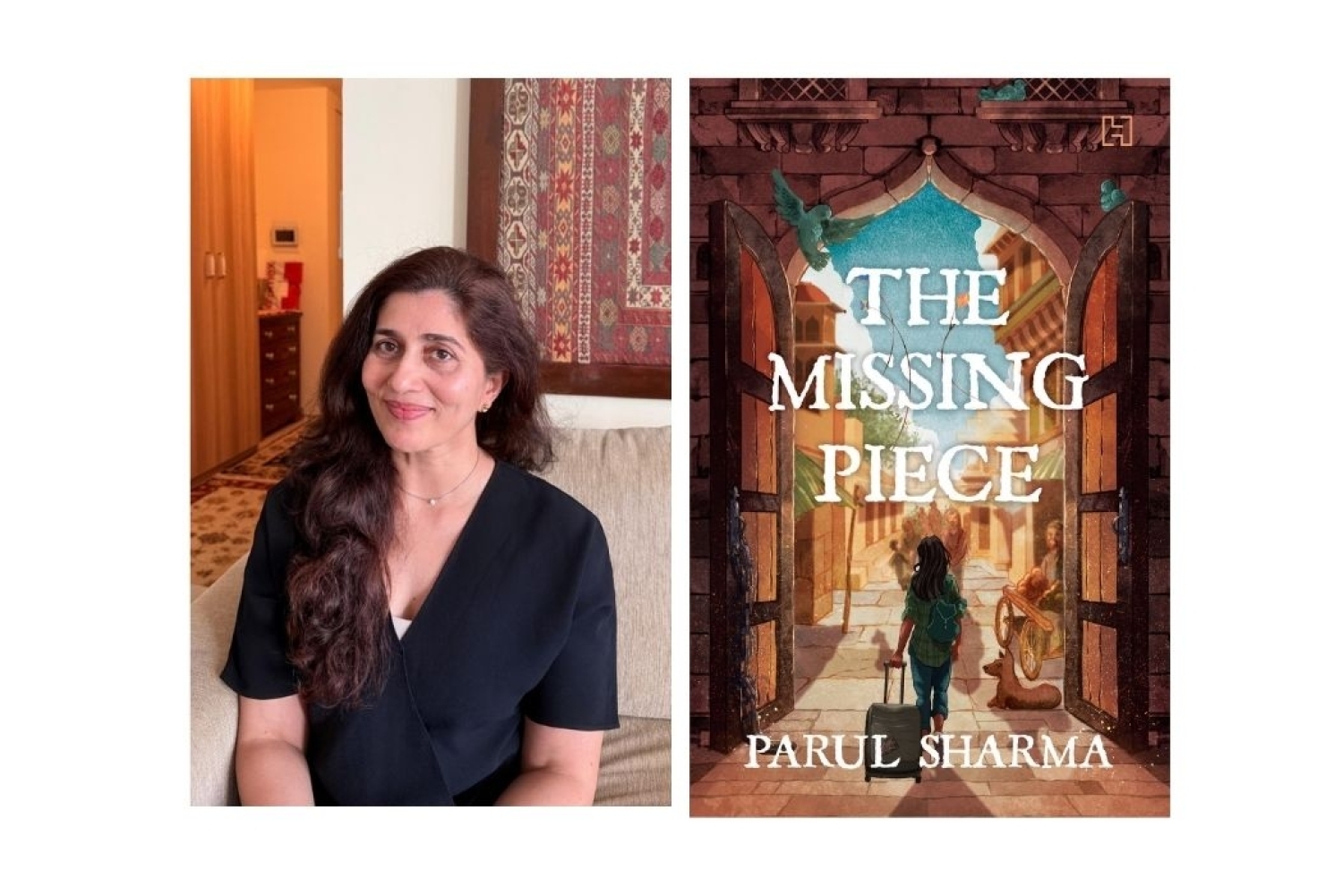
The Missing Piece by Parul Sharma is written from a special kind of homesickness, tracing geographies that risk fading physically but also from where they reside in her memories. The novel turns to ancestral homes and inheritance, asking what it means to be exiled and what a return might offer. Through Sukanya, born and bred in London, arriving in a centuries-old mohalla in Meerut, the story becomes a negotiation of identity, where we claim some parts of inheritance and reject others, looking for what belonging really means.
What drew you to the idea of homecoming and belonging in Sukanya’s story?
At this point in my writing life, I find myself wanting to work with certain geographies before they fade away completely, not just physically but also from where they reside in my memories. It’s my way of holding on and preserving. With The Missing Piece, I wanted to explore ancestral homes and inheritance, and what it means to be exiled from them. What makes them significant, what do they do to a person, and what does return offer?
Sukanya’s story emerged from there, a young person, born and bred in London, returning to claim an ancient, crumbling, centuries-old mohalla in Meerut as her own, and finding what belonging really means.
How did you shape the world of Bulandwada and its history?
The starting point was close to home. My mother comes from a similar mohalla, and I have experienced and absorbed its rhythms myself as a child. So I could draw on those fragmented memories. From there I started to build outward, looking at its food culture, architecture, social structures and all the elements that create a sense of place. There was a fair amount of research involved. I dipped into Tejinder S Randhawa’s book Vernacular Architecture of India. Nikhil Jain of Studio Dharma has done some extraordinary archival work in the region, which really helped me. Stephen Legg’s paper on pre-partition mohallas also provided rich insights. But at its core, the work is built as much from family history, memory and observation as it is from research.
The book explores inheritance beyond the material. What does inheritance mean to you here?
Inheritance is closed tied to identity in The Missing Piece. We all inherit a narrative, about who we are supposed to be, where we come from, what we are supposed to bequeath to others. What interests me is how we negotiate that inheritance. We claim some parts of it and reject others, and in turn, we are accepted and rejected by this inheritance. Sukanya’s journey is one of understanding herself, to see for herself which pieces fit, which ones she resists, and who does she become as a result of this negotiation.
What is your writing process, and where did you draw inspiration from for this story?
I have what I think of as a working-class approach to writing. Part of it comes from my corporate experience, the other from works like Stephen King’s On Writing which advocates constructing schedules. When I am writing a novel, I turn up at the desk every day without fail and meet the word-counts. The first draft is very rough and messy, but it is critical to finish it because only from there can the final work emerge.
I am a fervent believer in discipline but as a way of serving the work and not torturing oneself. It is painful to write, but it is absolute misery not to.
I used to be able to write anywhere when my children were younger and the house a lot more chaotic. Now I find myself getting quite set in my ways. I need the same chair which understands the contours of my body, the warmth of my beloved Retro at my feet, the clamour of the ocean outside, to be able to write.
For me, a novel begins with two things, an interesting geography and an interesting time. Once I have those, I wait to see who wants to visit that intersection. Once the characters arrive, so does the story. The Missing Piece was no different. The mohalla of a certain era called to me, and everything else just followed.
Did your own upbringing in the small towns of India seep into the story? And how does your background in qualitative research intersect with your fiction?
Yes, my own upbringing in small towns has had a deep influence on my work. Time stops at Shamli, said Ruskin Bond in that lovely story of his. Time stops at all small towns, I think. It stops at Meerut and Hapur and Murshidabad and Gonda and Muzaffarnagar. And when it does move, it does so slowly.
This languorousness, this texture has seeped into my writing. I’ll always be a writer who comes from the small towns of India, looking back at them both as an exile and as a prodigal who would like to return someday. It’s a special kind of homesickness. Qualitative research is where I learnt to pay attention to lived narratives. I travelled extensively across India and spoke to people about things like what does ‘salty’ mean in potato chips, what trust is in the context of hair-oil, what defines space in a car. But really, beneath all this talk serving commercial brands were stories of what it means to be a person. I never tired of paying attention to those, and that instinct has carried over into my fiction.
What are you working on currently and what’s next?
I am working on my next novel, which traces the life of a village doctor, born in what would become Pakistan, raised in rural Uttar Pradesh, and marked by a doomed love that clashes with its era. I also write personal and cultural essays on Substack to capture the lives lived between India and Singapore.
Words Neeraja Srinivasan
Date 23.4.2026