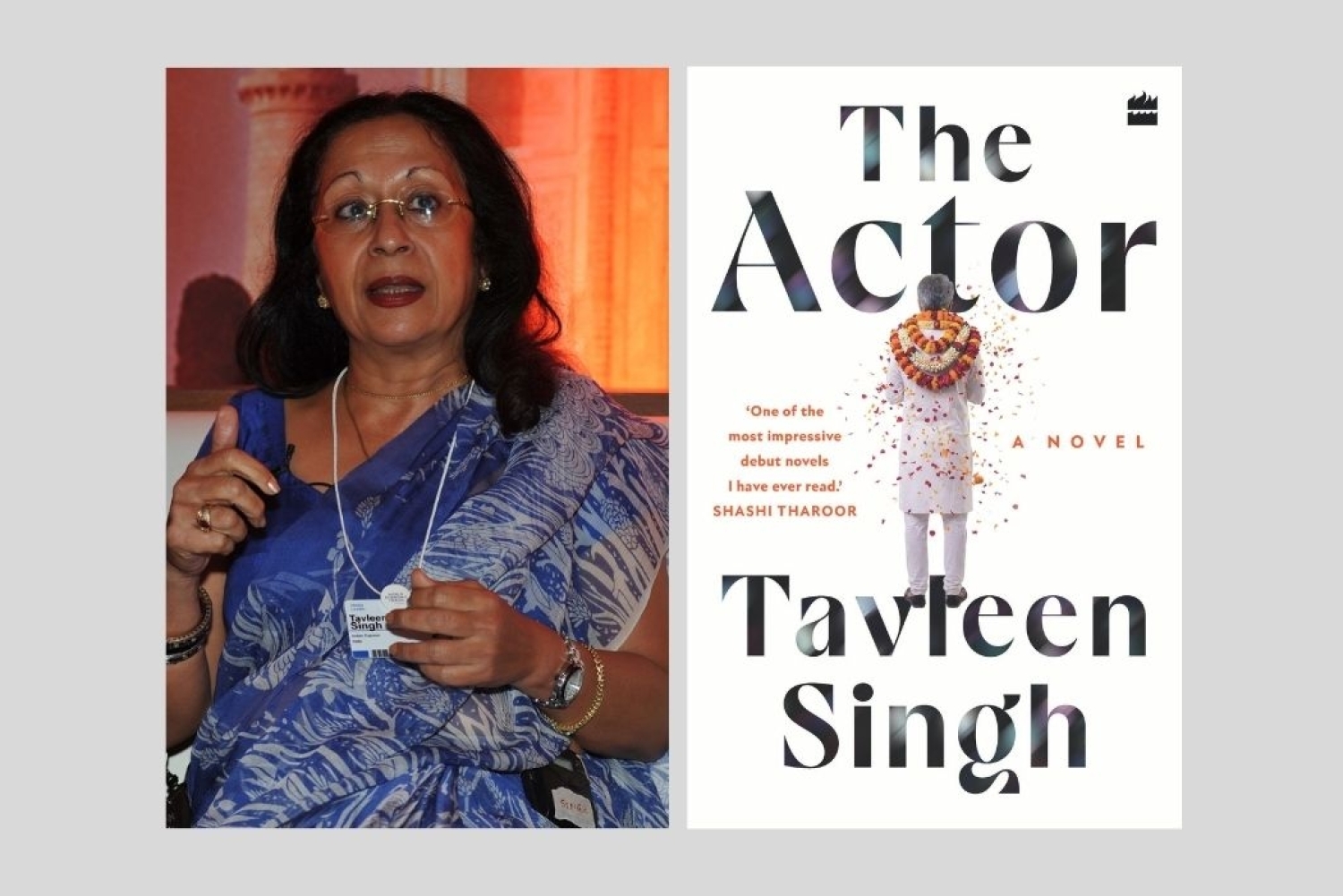
In India, it is no surprise that the world of cinema and politics are intertwined by a similar hunger for power. For years, actors have pivoted to joining political parties for a variety of motivations. This intersection has one thing in common: the allure of performance. The actor is trained into it, while the politician has no choice but to learn the art.
Tavleen Singh’s debut fiction novel The Actor follows Amit, a superstar from Bollywood who is struggling to recover from his flailing career in film. His childhood friend Naresh invites him to be a part of the Parivartan Party, a new political party aimed at creating real social change, bringing power back into the people’s hands, and more than anything, challenging the precedent of religious politics set by Guruji, India’s Prime Minister. We follow the challenges and confrontations that come with stepping into a political life, as Amit travels beyond the familiar world of Bollywood and encounters a version of India he has never truly seen before. As the boundaries between performance and politics begin to blur, Singh uses Amit’s journey to examine the realities of India and the transformations that can come with confronting them.
This story draws a very direct parallel between politics and the world of cinema. Do you think the two are inseparable?
Acting is very possible without politics. Most actors actually don't have any politics. They're just actors. I know a lot of them because I've lived in Bombay for a long while, and I've been friends with some of them. Out of the ones that I've known, I would say that less than 5% have a political view. This means they can be moulded by politicians into whatever view they want them to have. However, I think that for a politician to be able to act is vital because they're performers. The better that they perform, the more it helps them. They perform on a live stage every day of their lives, sometimes many times a day. The ability to act really helps them. Good looks really help them.
What led to the creation of this book?
In my own politics, I believe very firmly and clearly, and have for a very long time, that liberal democracy and free markets are the way forward for most countries. In the past, I used to be a devoted Modi bhakt, because I also don't like dynastic democracy. One of the things that attracted me to Modi was that he came from nowhere and that he threw out my class of people because we controlled everything for 70 years. That's a big feather in his cap. He managed to make that change. But along with that has come religion, very deeply embedded into the political culture of India now. And that worries me. I can see that all the way going forward, a theocrat could become the leader of India. A man who is actually Guruji in the book, I built a whole mystique around him, about his being in the caves of the Himalayas and then coming down to civilization. For a deeply religious country, it's very possible and, for me personally, very worrying. That's what inspired the book.
Was Amit's perspective meant to reflect that of urban India today, where development is often measured in terms of our cities rather than the villages?
I know actors who have gone into politics. There's a long list: Vinod Khanna, Amitabh Bachchan, Shatrughan Sinha, Dharmendra, Hema Malini. Not all of them have been successful. What I really found with the ones that went into politics was that they had absolutely no idea about what India looks like outside Delhi and Bombay. Their idea of rural India is in the movies: the pretty girls in pretty skirts jumping around, singing songs and romancing men from the city.
When they're clueless when confronted with the brutal realities of caste, patriarchal treatment of women and the complete degradation of rural India, that disturbs me very deeply. I blame it on all our political leaders. We need a new kind of Indian coming into politics, who is genuinely a patriot and gets as revolted by the horrors of rural India. I've been in journalism for 50 years at least, and I still cannot go into a village and see a village health center or a village school and see the degradation in which people are forced to live their lives. I'm hoping that we will, maybe in my lifetime, come across politicians who genuinely want to do something.
Politics is meant to be about public service, not self-aggrandisement. It's been the reason why we have so many dynastic parties in the Opposition. It's been about money for a very long time. For me, that's horrifying.
“I want India to be taken back by the people. I want India to work for Indians, and not just political leaders.”
Guruji remains nameless throughout the book. We only know him as Guruji, without the human connection that we have with the other characters.
Yes. I wanted him to be like a kind of mysterious figure in the background who really has no connection with normal humanity. Sociopath is the wrong word, but sociopath is also the right word for it. He's a sociopath. He doesn't have social relations. He hasn't had love affairs or children or marriages or anything. I wanted him to be a character that was really in the background. But he stayed there because the mystique is what makes him win the elections multiple times.
Guruji is also somehow as human as the rest of them. He's hungry for power, insecure and worried about losing the control that he has over people. What interested you about that contradiction?
The politicians I've known, and I've known some very well, are the most insecure people in the world. They're more insecure than actors. They're just constantly in terror of losing the next election. To win that next election, they're ready to do anything, to make any compromise, do anything. In his case, he's a religious person.
The point that I was trying to make is that even if you come from a religious background, once you taste the power of being Prime Minister of India, once you get a whiff of that, it changes you. It alters your ability to think of anything else. In this case, because he has no family and no friends, all he has is power. So he's not hungry for power, but he's very worried about losing it.
The party in the book is called the Parivartan Party, which means change, transformation, a new dawn on the horizon. What does transformation mean to you, and what do you hope it means for the country?
All the years I've been a journalist, I've wanted India to be like even Thailand or Indonesia, a country where you don't see garbage in the streets, in which children play with stray dogs, in which you see proper housing for the poorest of our people, just villages that look clean. I want India to be fully educated. I want our young people to be fully educated. I want them to be able to go to halfway decent schools and get halfway decent jobs. I want our cities to look less like slums, because I believe that India has the possibility to do all those things. I see no reason why India should be a poor country. We have all the resources; just tourism, for instance. But the tourists can't come into India at the moment, visas are so difficult, because I really believe we handed this country into the hands of officials and politicians, and they made it their country. Which is why I'm very happy to see the Cockroach Janta Party trying to take it back. I want India to be taken back by the people. I want India to work for Indians, and not just political leaders.
Words Neeraja Srinivasan
Date 12.10.2026