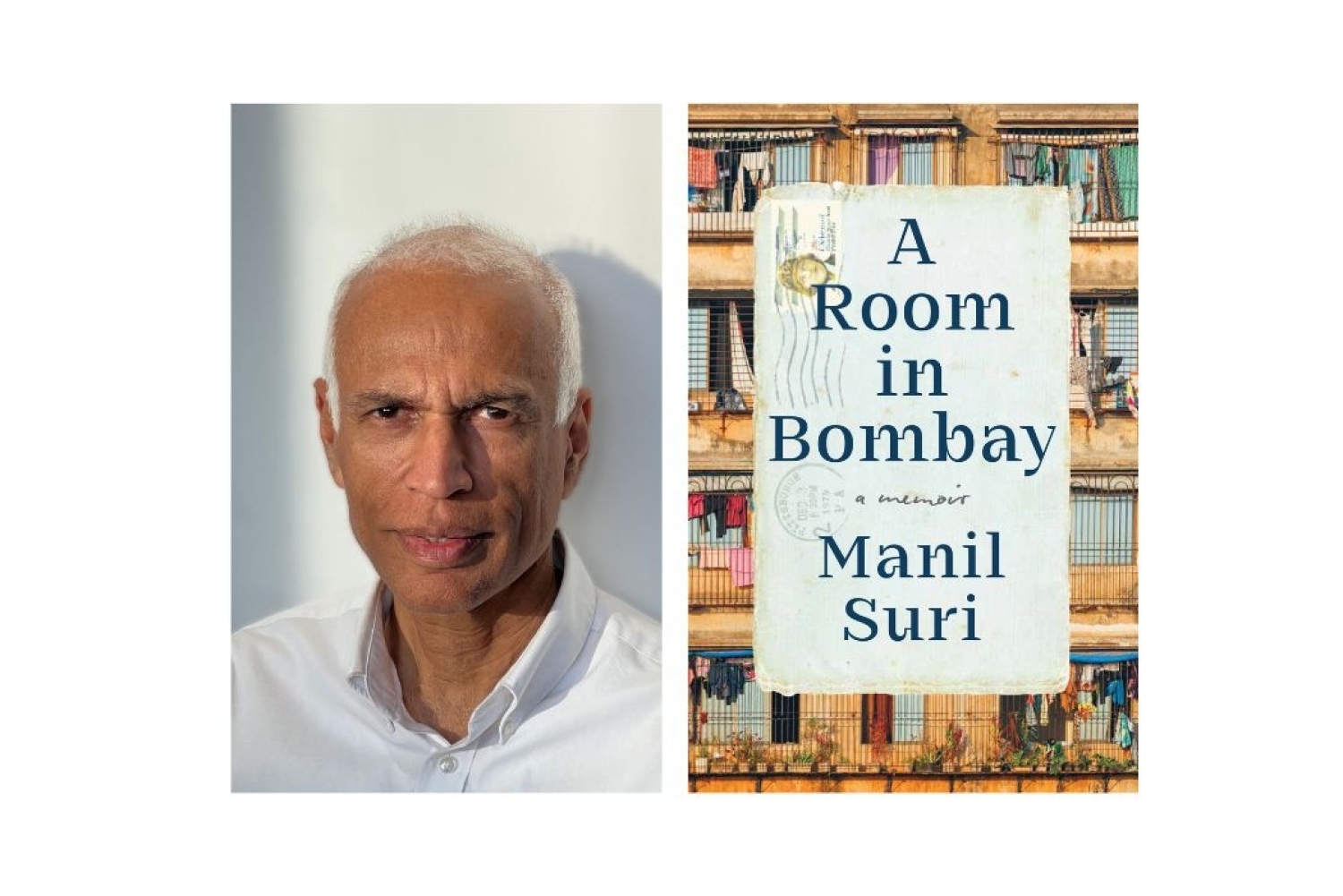
A Room in Bombay by Manil Suri revolves around his childhood single-room apartment in Bombay, shaped by a lot of solitude and a certain intensity of growing up alone. The memoir follows a life lived within a single room, where introspection opens into questions of love, sexuality, identity, and life. The narrative moves between a childhood marked by distance, Manil’s relationship with his mother, exploring his own queerness, and many other slivers of manifestations of the room. Over time, the room shifts in meaning, becoming ‘a metaphor for something that has to be overcome.’ Even years after leaving Bombay, the city returns, such that his mother’s presence and the city's presence have ‘kind of almost merged,’ leaving behind a diffused feeling that continues to pull him back each time.
When did you realize that the room you grew up in was more than just a room?
When I was writing the book, it was only after people started reading the draft, the first draft, that they pointed out that the room is also a metaphor for something that has to be overcome. We are all surrounded by our circumstances, and that's the stifling room that holds us back, and you have to transcend that somehow. I hadn't really thought about that, and the book went through several drafts, so I did three major rewrites, and in each of those I think that concept got more crystallized. And so in terms of the version you have now, I have put in things that really point to this, how the room is more than just a room.
In terms of growing up in such close quarters, did that do anything to your idea of love, sexuality and your identity?
I suspect it played a part, just because I was left to my own devices a lot, since I was going to a very good school in Bombay. Most of my classmates were much wealthier, so I always felt that I couldn't really have them over, and I didn't. So there's a lot of solitude, a lot of activities that I indulged in myself to keep myself entertained, and that of course, promotes more thought. I was willing to go down these roads of thinking while other people might not have been okay with being so introspective.
I don't know if that played a role. Of course, one could argue that many theories of sexuality say that this is determined very early on. There are all these theories, and who knows which one is really true? Certainly, a strong mother figure and a weaker father figure, which is something that Freud used to say is one of the things that can determine sexuality. But again, who knows? It's never been decided.
I do think that a lot of young people who are going through finding out what their sexuality is, and if it's same sex attraction, can go through a very difficult time with that. They don't understand it, and they don't have anyone to talk to about it. I think even if they are surrounded by lots of people, there is this self-isolation that occurs, and that has to be broken through. I was much luckier, because my mother was a psychologist, and so she was able to tell me that this is just a part of growing up. I was fortunate that way.
I was wondering what it was like to sort of characterize somebody in your own life, and somebody as close to you as a parent, in terms of writing about them. What was your process for that?
Let's face one thing first of all, that Indian mothers have a hard time keeping their distance, their boundaries, and if Indian parents are concerned, they'll willingly cross all those boundaries. Which is to say, my mother and I were extremely close. Your question is how does one write about that? It's a hard task, because you have to be fair to that person. You need to really distance yourself from the subject that you're writing about, while still retaining all the emotions and all of what you have observed about them.
My mother died in 2013, and it was only after several years that I felt I had that distance to be able to write about her. And I always think to myself, ‘Did I paint her too gloomy, or too exuberant?’ It's hard, and you can never get a person completely right. But I feel that if you feel you've done a reasonable job, I think that's the best one can aspire to.
“‘We are all surrounded by our circumstances, and that's the stifling room that holds us back, and you have to transcend that somehow.’”
Why did the room and the city keep pulling you back, even after you left?
The main reason was of course, when my parents were alive, I kept visiting. My mother was very attached to the city, and so I had to keep coming back. And after she passed, it's a different city now, but I still find myself returning every few years. There is no longer that imperative to come back because of taking care of her, but in some ways, her presence and the city's presence have kind of almost merged, and so it's like coming back to the ‘mother’ city, because it's so closely identified with her.
As a Professor of Mathematics, how do mathematics and writing intersect for you?
This actually came up while writing this book. I mean, first of all it helps in many ways, but this book went through several iterations, and at the last iteration, my editor, when everything was done, said, ‘Oh my god, I don't think this works, you need to rewrite it once more.’ She felt that the different strands were somehow not working together, because she felt that it should only concentrate on one thing, like my mother and me, and that should be the main thing. I felt that she was right in a way, but also wasn't, and that my alternative was equally valid, of having these different strands. I said, okay, let me take a deep dive into it, and I approached it much like I would a mathematical problem.
I've taught for so many years, and what I know is that a very abstract kind of thought in Mathematics can be really explained much more simply, and people can find it accessible if you can somehow visualize it as a picture. And so what I did was, I assigned a colour to each strand, and I put a colour for each section, and each line represented one strand, and if that strand was represented in that section, I put a certain colour. Then you could actually see all these colours, and how the strands went along in the narrative, and I was able to use that to convince my editor that this works.
Do you think writing this has changed what home means to you?
I think it's a nice way of tying everything up, basically. Bombay changed from being the only place I knew to a place that I visited very frequently, to a place that I no longer had ties to, but I still felt an attraction to. And by writing this memoir, I've put into print all of these stages and wrapped them up in one package, and it's a way of both paying homage to Bombay and also kind of tying it up and saying, okay, this is something that is done, a part of my life that’s over.
This week, we spotlight artists from the queer community, and revisit conversations from our archives with those who are telling powerful stories through diverse creative practices.
Words Neeraja Srinivasan
Date 18.5.2026