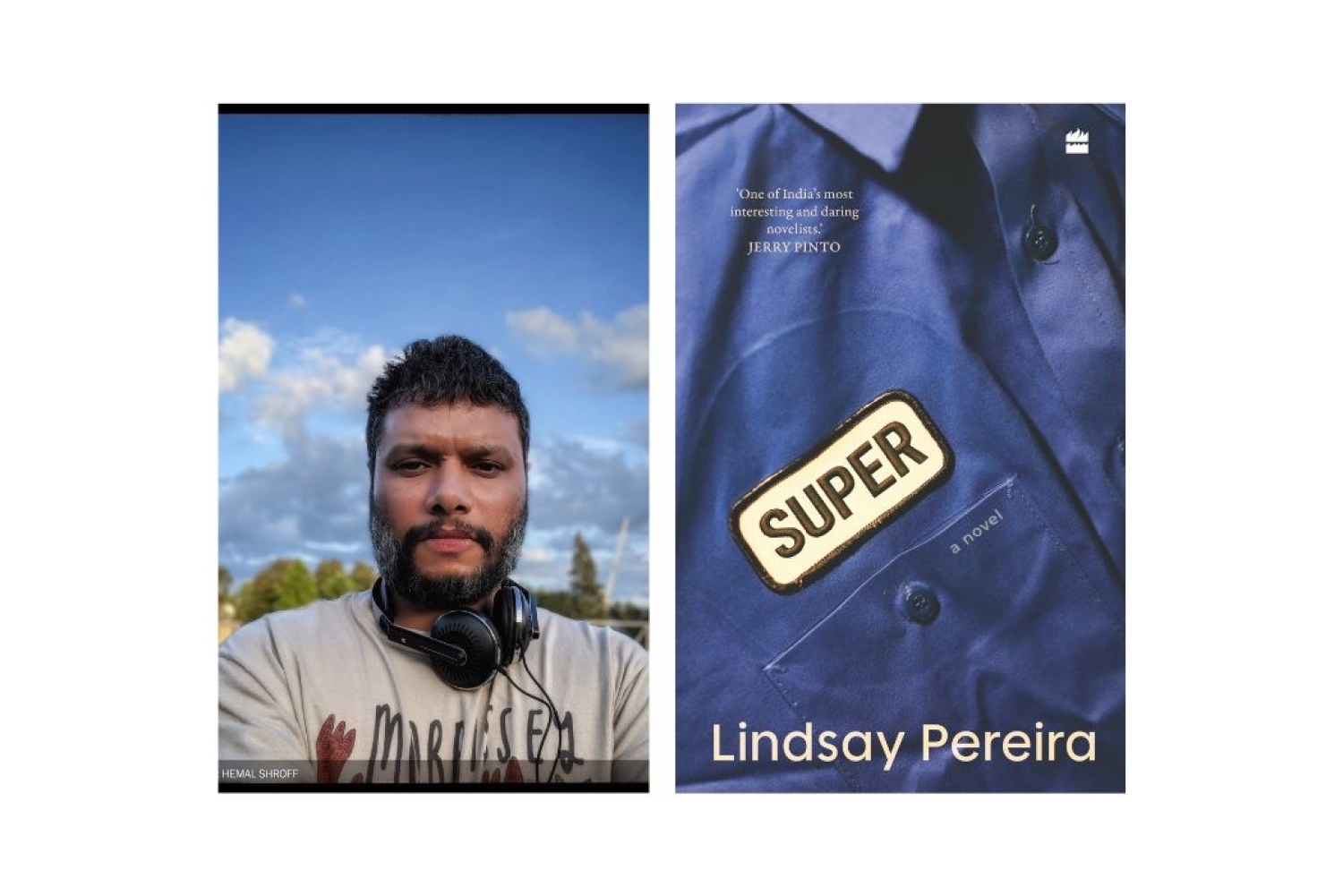
Photo by Hemal Shroff
Photo by Hemal Shroff
What does it mean to chase a dream across oceans, only to find its edges fraying on arrival? This question sits at the heart of Lindsay Pereira’s novel Super, a work that examines migration as a movement across borders, as well as a deeply human act with emotions of hope and risk at its foundation.
At the centre of the novel is Sukhpreet Gill, a young man driven by the familiar promise of life abroad. When he thinks of Canada, he imagines prosperity and stability, a future that pushes him to leave behind his home, his relationships and his sense of certainty. Running alongside his story is that of Maynard Wilson, a Canadian confronting his own economic anxieties. When their lives intersect, Lindsay explores a dual hardship, which includes the fears and pressures that shape the lives of both those who arrive, and those who are already there.
For him, the novel began with a moment of discovery. ‘I stumbled upon a news report a few years ago,’ he says, ‘about a funeral home in Toronto that dealt specifically with deaths in the Indian community and the transportation of these remains to their homes in India.’ What struck him was not just the report itself but what it revealed about a growing unease. ‘According to the report, more young Indians were dying, and it felt as if communities were struggling to accept why or how this was happening. There appeared to be a state of denial in effect.’
The numbers stayed with him. ‘The funeral home transported the remains of eight people in 2018 and, by 2022, that number had risen to 33 bodies.’ As he followed these developments, he noticed something else. ‘By this point, other organisations had begun to document a disturbing rise in suicides by international students in Canada, but I found no parallel reporting from India on what had begun to sound like a crisis.’ The story widened as he continued to read. ‘As I followed that story,’ he explains, ‘I came across other reports about students applying for study or work permits, the vast amounts of money involved in the business of immigration, as well as the gap between what they had been promised in India and what they found in the West.’ That moment of recognition became the beginning of the book. ‘That was the spark for my story.’
The novel also reflects Lindsay’s attempt to understand conflicting viewpoints without simplifying them. As he explains, ‘It felt as if I had to try and empathise with two radically different points of view,’ particularly because ‘both characters had compelling arguments for and against immigration.’ Rather than choosing sides, he says, ‘I had to be respectful of these opinions and take on the role of neutral observer’” which allowed him to explore their emotional realities. This approach, he notes, helped him ‘articulate what they were going through without letting their backgrounds get in the way of the ideas themselves.’
To build this world convincingly, he grounded himself in research. ‘My research involved looking closely at Canadian government policy over the past decade,’ he says, particularly noting how that had shifted during and after Covid-19. What interested him was not just policy but the social response to it. ‘Immigration has always been a fraught subject in the West,’ he observes, ‘but it started to encompass more radical views as economies began to shrink and issues such as housing or healthcare began to rise to the forefront of what critics were saying.’
His research also took him into the mechanics of policy and its consequences. ‘I looked at what Canadian governments had been doing over the past decade,’ he says, including ‘things they had initiated such as the Labour Market Impact Assessment program,’ and more importantly, the impact of these initiatives on the lives of common people in India as well as in Canada.
At a deeper level, Super is also about how the idea of the dream abroad continues to shift. He describes it as ‘an idea that evolves constantly,’ shaped ‘not only because of geopolitical realities that get in the way but because of how commercial interests tend to exploit the vulnerabilities of people who are marginalised.’ What he found especially troubling was how this dream is marketed. ‘I came across several large companies and businesses that were actively engaged in promoting the idea of a better life abroad,’ he says, but what they were selling did not match what he was seeing. ‘Their promises were distinctly at odds with what appeared to be happening on the ground in those countries.’
The book also represents a personal shift for Lindsay as a writer. ‘It felt like a departure of sorts, not only because I was writing about places, I knew little about but because I was changing my approach to structure and form.’ The unfamiliarity became part of the creative challenge, pushing him to rethink how he shaped narrative and character. Despite the scale of the themes he tackles, his writing life itself is defined by routine. ‘I don’t really have a favourite spot,’ he says simply, but he does believe in consistency. His process, he explains, involves writing for a fixed amount each day until he has a first draft. Distance is just as important as discipline. ‘I then take a month off until my second draft,’ he says, before returning with a fresh perspective. From there, he continues refining. He describes how he will keep giving himself deadlines until he arrives at a version of a story that he is satisfied with.
Described as his most ambitious work yet, Super is a novel that explores immigration and identity through the lens of the cost of ambition. Lindsay himself frames it as a response to what he saw happening around him. ‘I began writing this novel as a response to what I believed was starting to look like a crisis: an exodus of young Indians to the West,’ he says. What concerned him most was the gap between expectation and reality. ‘For anyone paying attention, there appears to be a huge gap between what is promised to many of these students, and the reality they find themselves in.’
Ultimately, his motivation was simple. ‘I wanted to try and give them a voice,’ he says, adding that he hopes it resonates with anyone who chooses to read the book. As for what lies ahead, he continues to move between projects and possibilities. ‘I have completed a novella that is currently with my agent,’ he says, while also noting that he is ‘in the process of writing a series of short essays for a non-fiction project.’ Like many writers, he is also circling new ideas. ‘I am also working on the idea for a novel that may or may not materialize,’ he admits, because he is yet to figure out where it’s going. And If Super is any indication, that uncertainty may well be part of the point.
Words Neeraja Srinivasan
Date 9.4.2026