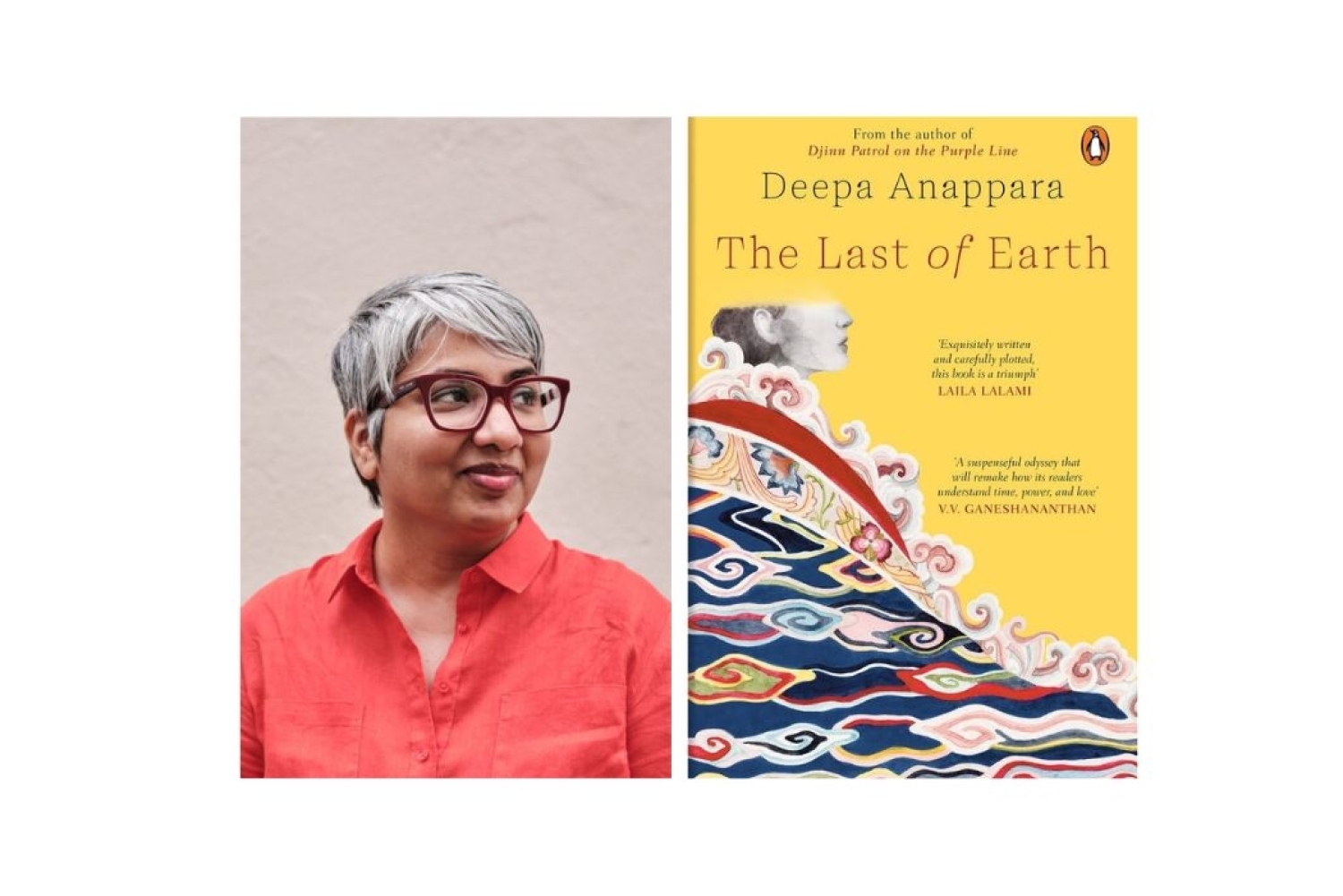
Adventure and exploration are typically associated with white men. With The Last of Earth, Deepa Anappara turns that idea on its head. She came across an Englishman’s narrative about traveling to Tibet with two Indian porters in the 19th century. It was clear that the Indians kept the Englishman, a self-styled explorer, alive in Tibet’s landscape, which can be hostile to visitors, but the Englishman didn’t see the Indians as his equals.
She explains how she wondered about the dynamic of that relationship, where the imperialist is reliant on the ‘native’ for his safety and yet has to exert his dominance over them. Through two characters, Balram and Katherine’s journeys, she seeks to ‘excavate a part of history that we don’t often see,’ asking a vital question along the way: ‘Should anyone be called an ‘explorer’ in a landscape already populated by the people born in that land?’. We’re in conversation with her about the creation of the novel.
What first drew you to nineteenth-century Tibet as the setting for this novel?
Several years ago I came across an Englishman’s narrative about traveling to Tibet with two Indian porters in the 19th century. It was clear that the Indians kept the Englishman, a self-styled explorer, alive in Tibet’s landscape, which can be hostile to visitors, but the Englishman didn’t see the Indians as his equals.
I wondered about the dynamic of that relationship, where the imperialist is reliant on the “native” for his safety and yet has to exert his dominance over them. I wanted to write about this relationship, and started looking into expeditions to Tibet, which in the 19th century was known as the Forbidden Kingdom as it was closed to Westerners.
The British, who were ruling India at the time, wanted geographical knowledge of Tibet for strategic reasons and, as they couldn’t enter Tibet easily, they trained Indians to use their bodies as surveying instruments and map Tibet. Indian spy-surveyors brought back information such as altitudes and the routes of rivers, which the British officers then used to create maps of the region. I was curious about the Indian experience of these expeditions and, as I couldn’t find that in the archives, decided to reconstruct that story through fiction.
Balram and Katherine are both outsiders in different ways. What interested you about pairing these two journeys?
The fact that they are not the kind of people typically considered explorers was why I wanted to bring their stories to the fore. Adventure and exploration, and even cartography, are typically associated with white men, and I was interested in subverting those ideas in this novel. Through Balram and Katherine’s perspectives, I wanted to excavate a part of history that we don’t often see.
Research plays a big role in historical fiction. What was the most surprising thing you discovered while writing this book?
At the Survey of India archives in Dehradun, I read that the British Survey officers trained Indians by tying a rope around their ankles which would extend exactly to 31 ½ inches. The tensity of the rope would encourage them to stop at that distance each time they stepped forward. This made each of their steps precise, and they learnt to cover a mile in 2000 steps (and this was how they calculated the distances between two places).
The book is also brimming with a lot of portrayals of nature. Could you share a little about the choice to make nature central?
It is a novel about travelling through high-altitude regions of Tibet, and the natural world is therefore central to the story as it is about exploration and cartography. My novel, of course, asks whether anyone should be called an ‘explorer’ in a landscape already populated by the people born in that land.
How did writing this book differ from your experience working on Djinn Patrol on the Purple Line?
The main difference was the amount of research that I had to do in the archives to construct the stories of the characters in The Last of Earth. While Djinn Patrol on the Purple Line also required research, as it is set in contemporary India, I had a much better idea of the lives of my characters, but for The Last of Earth, I had to do extensive research just to find out what my characters would have been eating every day or what they would have been wearing.
What are you working on now, and what’s next?
I don’t know yet!
Words Neeraja Srinivasan
Date 9.3.2026