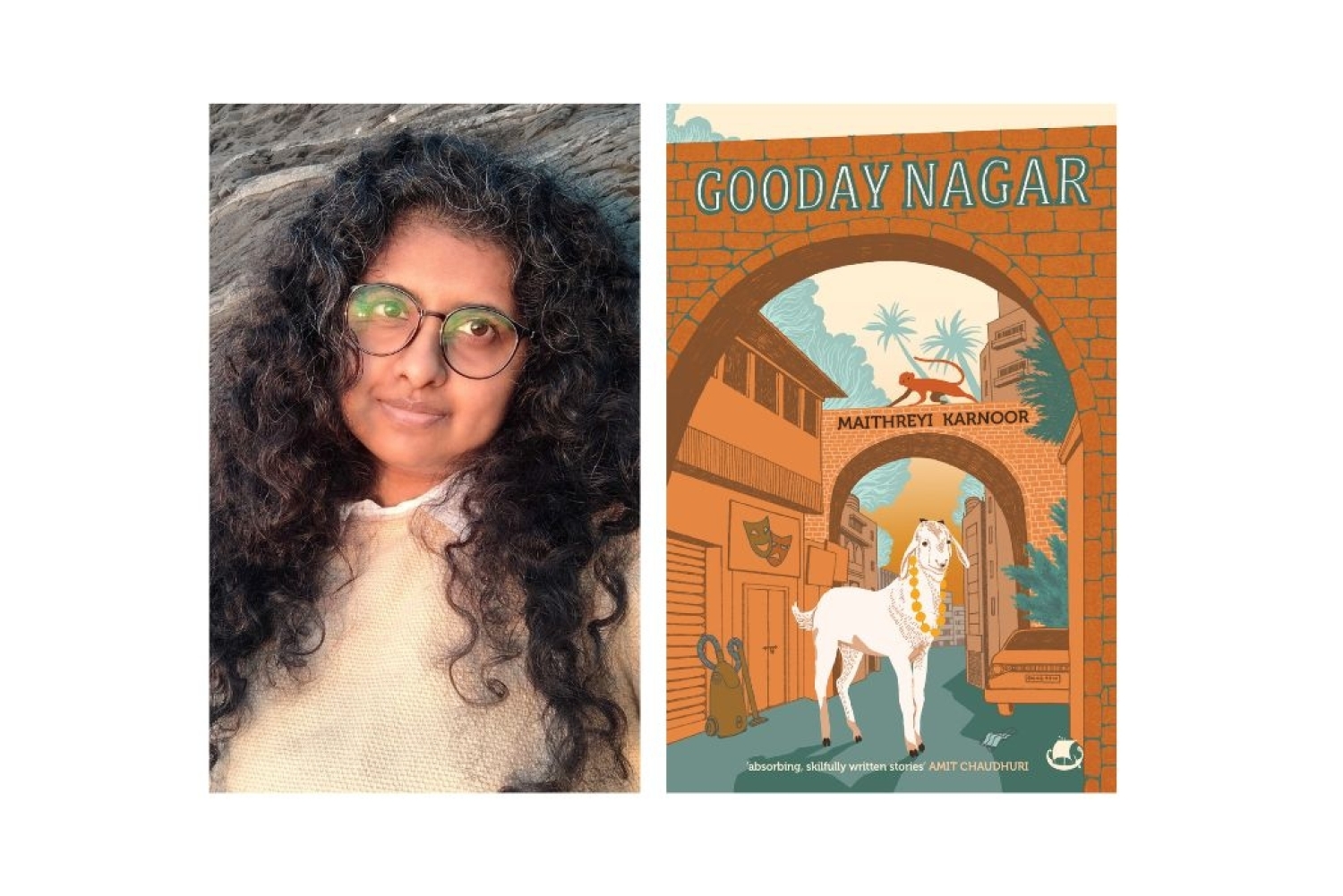
Set in a city imagined as a metropolis of time rather than space, Gooday Nagar emerges from Maithreyi Karnoor’s reflections on the changing character of Indian cities and the personal experiences that shaped her writing during a precarious period of her life. In this conversation, Maithreyi speaks about how the short story collection took shape during the Covid pandemic, a time she describes as ‘an abridged version of real life presented to you as a reminder of its ephemerality.’ Writing in isolation while living alone in Pune, she turned to the short story form as a way to continue writing when the world seemed to be falling apart. She also discusses her approach to fiction with clarity and restraint. ‘There is nothing more or less that I aim to convey than what is on the page,’ she says, reflecting her belief in allowing stories to exist without grand declarations of purpose.
Across the interview, she speaks about satire as both instinct and expression, calling it ‘an organic outlook of life as well as my form of expression’, and describes how her characters emerge from observation, imagination, and craft. More from her below.
The Setting
I feel most cities in India are losing their character to the homogenising bulldozer of new commerce. They all look the same, the tacky malls, the garish jewellery and saree shops, the glitzy hoardings with the same fake-smiling film stars, chaotic traffic, massive crowds, anthill-like apartment blocks taking over lakebeds and farmlands. If you are taken blindfolded to a busy market, you will not know which city you are in when the scarf comes off your eyes. But I lack the nostalgia for the eroded essence of each of these cities that older residents seem to be so hung up on. While I have lived the second half of my life so far in Pune, Hyderabad, and Bangalore, I’m at heart a smalltown person. I grew up in a provincial town in northern Karnataka where everyone knew everyone (but I won’t romanticise that as it has its share of problems). Although my temperament now is urban, my perspective of big cities is unlike that of someone with an urban legacy. So, I chose to set my stories in my idea of the city as a metropolis of time rather than space. However, discerning readers may be able to tell the actual cities that some of the stories might remind them of.
The Making of the Collection
I began writing these stories soon after the publication of my first book. Although it was exciting to be an author after years of being known as a translator, and the temptation to rest on my laurels was great, I decided to ride the momentum and keep writing. This was at the height of the covid pandemic. I was living alone in a 6th floor apartment in Pune. I didn’t have a job and I was trying to stretch my meagre savings, and I was going through a divorce! It was a most precarious time: you didn’t know how long Covid would last or who you might lose or if you would make it alive yourself. It was like an abridged version of real life presented to you as a reminder of its ephemerality. But it was also quite invigorating for an introvert such as myself. I went for weeks without meeting another human being and there was contactless delivery of craft beer! I marvelled at the human capacity to innovate in the face of such despondency.
The pandemic became the subject of my contemplations. But I didn’t have another novel in me just yet. So, I wrote stories. I set Return of the Salesman in the pre-market liberalization era as a reference point for the rest of the stories where covid features as a reckoning moment. I continued to write after things eased up and I travelled to Wales the following year on a writing fellowship. I spent three lovely months in a coastal town and everything I saw and felt and experienced found its way into my writing. But there is nothing more or less that I aim to convey than what is on the page. As a fiction writer if I think I will change the world with my work, I am in the wrong profession.
The Form of the Short Story
I wouldn’t pit the two forms of fiction against each other. I write both and each has its own joys and challenges, and the difference is little more than what is obvious, the length. My first novel Sylvia which came out in 2021 is 43,000-words long. I just published my second novel. This time, I wrote in Kannada. It is called Hettavara Neralu, it is 75,000-words long, and it took me a year to write. I think of the short story as a sprint, and the novel as a marathon. Writing a novel takes sustained effort. It may take months, sometimes years to finish. And when you are writing it, it takes over your whole life and there is little else you can do in that time. A story is more concise and can be finished in fewer sittings. And then you can move on to writing something very different.
A collection, depending on the writer’s ingenuity, can be like an assorted box of chocolates and each story is a new surprise. You needn’t read the book from beginning to end. You can pick and choose stories depending on your current mood. I think Gooday Nagar is pretty wide in its range and there is something in it for every kind of fiction reader. In today’s world where literature has to compete with a hundred other forms of entertainment, the short story, thanks to its size, may still push the case for the dying art of reading for pleasure.
Satire and Humour
However much you theorise the human condition, it is pretty apparent as a species we are incorrigibly effed. Socially, environmentally, politically, morally. We may all have our politics and faith in certain ideologies that we believe will lead to utopia. But the truth remains that nothing is achievable until human society as a whole becomes kinder and less greedy. And the solution is as simple as it is impossible. When you realise this, you begin to see the absurdity of life. If you are of a darker disposition, your art may tend to be grave and morbid. But if you have a strong life instinct, in spite of the despair, humour becomes your way of making sense of yourself and the world around you. It lodges your tongue firmly in your cheek. Satire, therefore, is not just a creative choice for me. It is an organic outlook of life as well as my form of expression.
What’s Next
I’m doing a practice-based PhD in creative writing in a British university, for which I am writing my third novel (and fourth book of fiction). This novel is inspired by a photograph I saw in a museum during my last visit to Wales. It is a black-and-white picture of two circus elephants being bathed in the freezing Irish sea and is labelled ‘Mixed Bathing’. I’m writing a novel of the same name and it is set partly in India and partly in Wales. It is a magic realist work that explores ideas of migration, identity, and belonging. Although these are serious topics, I am working with them in my natural style of irony and satire. My PhD is my main focus at the moment but I am also trying to squeeze out some time to translate my Kannada novel. It is a surrealist, ‘revenge fantasy’ and will be called The Mother, the Daughter, and the Polyglot in English. Apart from that, my debut poetry collection Skinny Dipping in Tiger Country is forthcoming in the UK. I am working with the publisher in bringing it out. For the first time in my life, I don’t have to have a day job to indulge my ‘literary vice’. I’m thankful for that. I’m trying to enjoy this phase while it lasts and live in the moment.
Words Neeraja Srinivasan
Date 6.4.2026