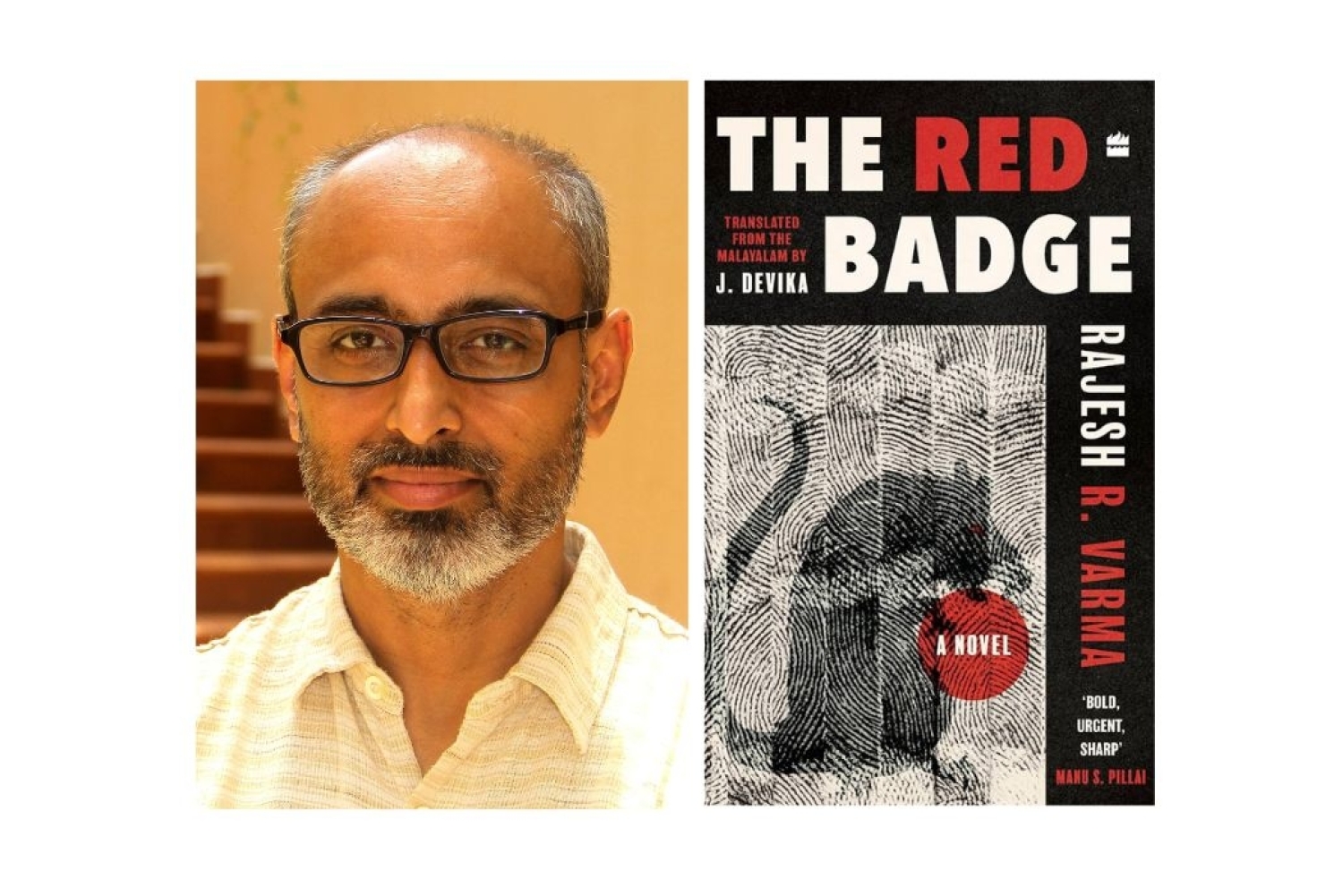
Rajesh R. Varma's The Red Badge, translated from the Malayalam by J. Devika, begins with the familiar anxieties of childhood before unfolding into a disturbing portrait of caste privilege, social exclusion and authoritarianism. The landscape of 1970s Kerala comes to life in this novel that traces a young box’s fixation on academic success, observing how such ordinary desires can be influenced by prejudice and systems out of our control. Humour runs through its pages, making its sharpest observations all the more unsettling.
In conversation with us, the author reflects on why a school became the ideal setting for this story, the role of comedy in writing about violence, and the slow evolution of the novel. Devika discusses what compelled her to translate the book now, the creative demands of translation, and why its examination of Othering extends far beyond Kerala.
What drew you to situate the story in the educational environment of a school? What did that allow you to explore about caste?
Some of the questions I was trying to ask with this story were: Where are we headed as a society or nation? What historic factors have set our trajectory? Caste is certainly a defining factor in Indian society, but it operates alongside gender, economic class, and physical or intellectual ability. How do we treat those who speak a different language, pray to a different god, or look and dress differently from us?
Few places expose these dynamics as rawly as a school. It is an environment where cutthroat competition is not just encouraged, but mandated. And if the schools of today are the hatcheries of tomorrow’s society, they are also where children learn to weaponize words and ideas they barely understand, in order to gain domination. That is why a school, along with the playground, the family, and the neighborhood, became the setting for this story.
What is your writing process?
I wish I had one. Most of the time, writing is an exercise in avoidance, hesitation, fumbling and false starts. But let me speak about the rare times when things have worked out. This book was one such instance.
When I get an idea that feels like a story, I start making notes. In this case, they grew to almost one hundred pages over time before I decided to start writing. The first draft took several months. Early on, I felt the story taking on a life of its own—an indispensable feeling for any writer. After finishing the first draft, I read and listened to a number of books about the holocaust, mostly memoirs, which anchored me in the right frame of mind for revision. That took a few years. Every day I sat down to write, I felt happy to be working on it, a reassuring feeling that I don't take for granted.
The novel moves from childhood to a broader political nightmare. Did you always imagine those two timelines as inseparable?
While I was conceiving this story, Malayalam literature was experiencing a deluge of memoirs. Most were drenched in nostalgia, painting the past as an unblemished golden age. In response, my story began to take shape as a subversion: it would adopt that same nostalgic tone, but use it to unearth the darker realities of bygone years.
Once I decided to adopt the guise of a memoir, it felt natural to cast myself as the central character and one of my closest friends as the antagonist. As I recall, that decision fell into place very early in the process.
What did comedy allow you to say that a more solemn tone could not?
One of the unsettling truths about tragedy is that it would often be funny if it weren't so heartbreaking. In fact, much of what we call comedy is simply someone else’s tragedy. In this book, there are characters, some of them genuinely likable, who do and say horrible things, deriving amusement from them. Even now, when I reread those passages, I feel a sense of discomfort for having imagined such situations and put them into words. For the readers, I think I might have been trying to challenge the reader: to not laugh with characters they can easily identify with, and to pause and consider the humans on the receiving end of those jokes.
J. Devika
We also have some insights from the translator, J. Devika.
What drew you to translate this story during this point in time?
Chuvanna Badge was for me an important response to an ongoing social process, the normalisation of fascist tendencies among my community of birth, the savarna Hindus of Kerala. As a social researcher and historian, especially having lived through the conservatism backlash against the Supreme Court judgment on the entry of women of menstruating ages to the forest-shrine of Sabarimala in Kerala, I could not look away from the manner in which social conservatism and ritualism, even among highly educated women translated effortlessly into outright fascist tendencies. But Rajesh's wonderful writing was especially appealing to me because it is actually about Othering in general, as a universal scourge, which can foment hate and violence anywhere in the world.
What is your translation process? Take us step by step.
Translation calls for a kind of 'deep reading' that is quite different from either reading for pleasure or for information. That kind of reading rests upon the analytical and historical readings of the text, but is also different from them. My interest in translation has been always a critical one; I choose texts which I believe mark important milestones in Malayalam, politically and culturally, from a feminist point of view [and in the Indian context, the nexus of the powers of caste and gender is so intense that words like 'intersectional' just don't capture it well enough]. So an analytical and historical reading of the text always precedes the final one for translation. In the last reading, I give in to all the aesthetic aspects, the pleasure in the play of meaning, also especially the way the book sounds, because that is the hardest to reproduce in translation.
Were there any challenges you faced along the way, in terms of certain cultural references?
In my experience as a translator, I have never felt a 'challenge' ; it is much more joyful, and that is really what calls for the creative process [and I suppose AI translation can never replace it]. But for this book, the hair-raising counter-history that it sketches with such marvellous skill needed to be presented in such a way that the violence of Othering is foregrounded, and not merely the references to the adversarial communities. Secondly, since it delves into the unsavoury inner worlds of caste elitism, we had to make sure that no part of the book was reinforcing of violence or humiliation. It is absolutely possible to present critical accounts and representations of the casteism of conservative elites without language that reinforces it.
What are you working on currently and what’s next?
I've been working on a fabulous book by Mini P C called Veru -The Root which is about three women of tribal origin from the mountainous district of Idukki in Kerala which is a tale of 'beyonding', not belonging. It is a story told with much lightness and love, and definitely casts these three women as explorers; seekers of pleasure and adventure and agents of their own lives to different degrees, a far cry from the usual victim-status that Dalit women are often trapped in, especially in literary representations. This work needed much more editing, though; Malayalam novels are rarely edited. They are often serialised in magazines first and publishing houses do not edit their work, and so, sometimes translation requires dropping a whole bunch of details that are unnecessary for readers of the work in English. Mini and I worked for months on this, and it was indeed a great pleasure. We haven't yet found a publisher, but we will.
Words Neeraja Srinivasan
Date 4.8.2026