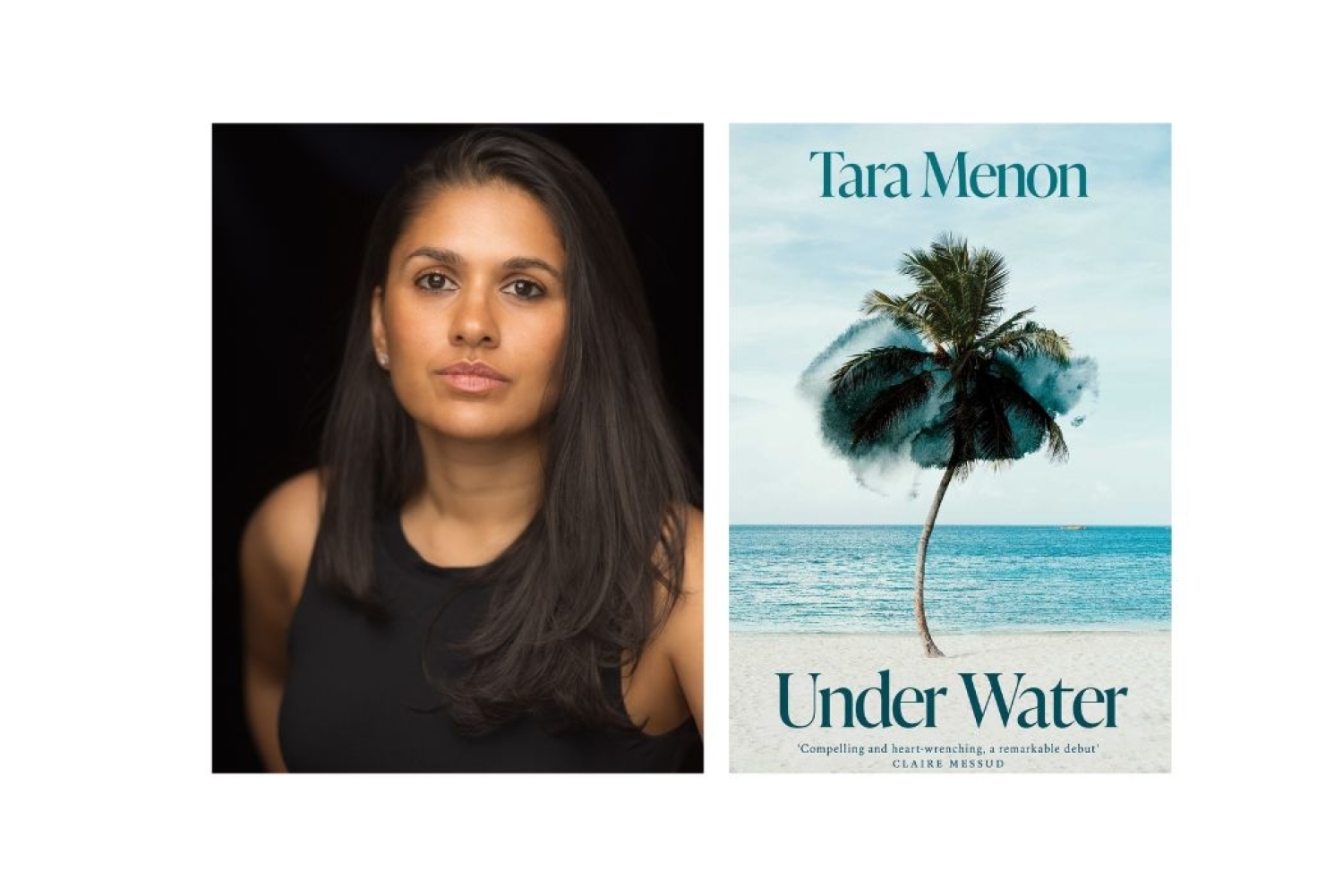
In Under Water, Tara Menon traces the aftereffects of the loss of friendship through the life of Marissa, whose childhood is shaped by grief and the sea. We follow Marissa’s life in Thailand, where her father works as a marine biologist, as well as her intense bond with her friend Arielle, amidst the natural world and its wonders. Their shared childhood of discovery and wonderment is shattered when Arielle loses her life to a devastating wave.
Drawing from her experiences of witnessing the aftermath of the 2004 Indian Ocean tsunami and Hurricane Sandy, Tara anchors the novel in questions of how people experience catastrophe differently. Combining rigorous research on marine life with a desire to take friendship and its grief seriously, she tells a story where personal loss mirrors the fragility of the natural world.
The Roots
In 2004, when the Indian Ocean tsunami hit, I was a teenager living in Singapore. It was Boxing Day, right in the middle of Christmas holidays, and in a typical year, my family and I would have been on holiday in Thailand. I don’t remember why but we were not that year. The tsunami claimed 230,000 lives. It’s a staggering number. People at my school lost a sibling, a parent. In the aftermath, I met survivors from Banda Aceh, Indonesia, one of the worst-affected areas, who spoke about their experiences losing their family, their homes, and their schools. The tsunami has haunted my imagination since. In 2012, when Hurricane Sandy hit, I was a graduate student in New York. With several days of warning, I sheltered at home uptown: we never lost power, school was cancelled, and we had every possible comfort. It felt like a holiday. In the aftermath, I volunteered in Chinatown distributing basic goods like batteries, canned food, and bottled water to residents living on the upper floors of public housing buildings. I was struck by the disparity between downtown powerless life and uptown brunch fun. But I also found myself thinking about disparities between responses (material and emotional) between natural disasters across the world.
The Ocean as A Central Theme
I was lucky to have a childhood that included many trips to the beaches and coral reefs of Southeast Asia and Australia. I wanted to capture both the tranquillity and the majesty of the reefs that I saw up close. I drew from personal experience, but I also did a lot of research. I read books and scientific papers about manta rays, I consulted wildlife guides, interviewed marine biologists, watched nature documentaries about ocean life, and I read accounts of nineteenth-century ocean voyages. I wanted to really understand the marine life I was writing about, and not make any mistakes. And separately, when I wrote the sentences that depict scenes that take place underwater, I thought about the non-fiction writers who write so beautifully about nature: Rachel Carson, Peter Godfrey Smith, Patrick Svensson, Annie Dillard, and so many more.
The Role of Grief
When I was a teenager one of my closest friends lost one of her best friends, a friend she had known since she was a young child. I had never met the girl who died, but I felt devastated watching my friend grieve. I soon understood that some types of grief were understood and socially acceptable such as a parent or grandparent or sibling. But there were neither clear parameters for mourning a friend, nor many cultural representations of this type of loss. People seemed to think that losing a friend was something you could, maybe even should, move on from relatively quickly. I found this strange. My friendships, especially with women, and especially with women I’ve known since childhood, are some of the most serious relationships of my life. I wrote the novel partly because I wanted to take seriously the idea that grief for a friend could be both devastating and lasting.
Friendship as the Subject
I think of their friendship as being the main subject of the book so in a way I can’t imagine any part of this book without Arielle in it. But I also wanted the main social relation between these two women, Marissa’s grief for Arielle, to function as a metaphor for how we might grieve for the loss of the natural world. Also, paradoxically, I was able to explore a young woman’s loneliness and isolation because there was a time in her life when she was not at all lonely.
Words Neeraja Srinivasan
Date 11.3.2026