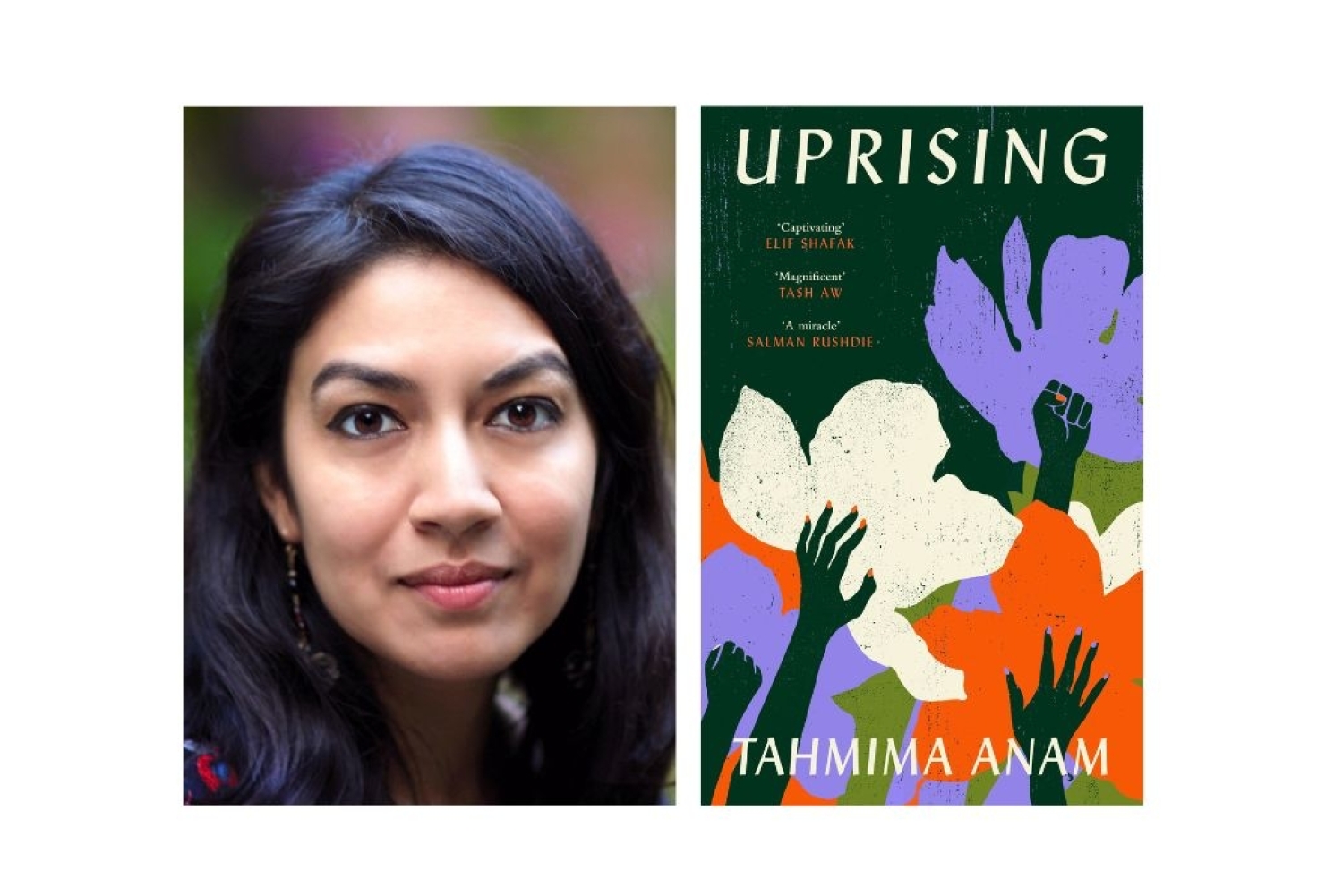
Photo Credits Abeer-Hoque
Photo Credits Abeer-Hoque
For her latest novel, Uprising, Tahmima Anam set out to write a story of female empowerment by imagining women in the worst of possible circumstances, trapped within cycles of violence from which it seemed there may never be an escape. What emerged is a powerful story of resistance and liberation, centred on women who begin with none of the freedoms that allow for self-actualisation and gradually learn to claim them for themselves.
At the heart of the novel lies a meditation on freedom, defined by Tahmima as ‘the ability to have dominion over one's body, one's thoughts, and one's way of being in the world.’ The spirit of protest and resistance come alive in this story about an island where a group of children witness their mothers living lives of cruelty and servitude, where they are bought and sold, with no agency over their own lives. Among the novel’s most intriguing figures is Amma, who was once sold into slavery herself, and now exercises control over the women on the island. Disruption ensues when a new, educated woman from the city is forcibly brought to the island. The result is a dark but ultimately exhilarating journey towards freedom.
What drew you to the idea for Uprising and its premise? Take us to the roots of its creation.
I wanted to write a story of female empowerment. I tried to think of a situation in which women were in the worst of possible circumstances, trapped within cycles of violence from which it seemed there may never be an escape. And then, I wanted to take these women and give them a journey of revolution and liberation.
Since the book revolves around female power and resistance, what is your approach to writing female characters? How do you ensure you don’t give into tropes and stereotypes?
I don’t approach writing women any differently than I approach writing men, which is to say, that in order to create characters that seem real, one must think of them as complicated beings with at times contradictory traits. One must think of the many ways in which they have been created; by history, by class, by their personal circumstances. And one must approach every character, no matter how flawed, with empathy.
I am intrigued by the character of Amma; what does she represent?
Amma represents the fact that patriarchy is a system that is perpetuated by men and women, that cycles of violence lead to more violence, and that at times the ones committing the greatest crimes against women are women themselves. And Amma doesn’t see herself as a villain, she sees herself as a mother figure to the women.
What does freedom mean to you? And why is it at the centre of this novel?
Freedom is the ability to have dominion over one’s body, one’s thoughts, and one’s way of being in the world. At the start of the story, the women have none of these forms of self-actualisation, and by the end, they are able to claim some of these freedoms for themselves. I found this journey to be personally very inspiring for me to write, and I hope readers will be similarly inspired by reading it.
Were there any challenges you faced while writing this story?
I struggled with how dark some of the themes had become. On the one hand, I wanted to be unflinching in my gaze. On the other hand, in order to write the story, I had to live within its reality for quite some time, and this was difficult. But by the time I got to the end, I felt quite exhilarated, because I was able to take these women on a journey towards freedom.
What are you working on currently and what’s the future looking like?
I’m working on another novel, but it’s top secret, so you’ll have to wait and see!
Words Neeraja Srinivasan
Date 4.6.2026