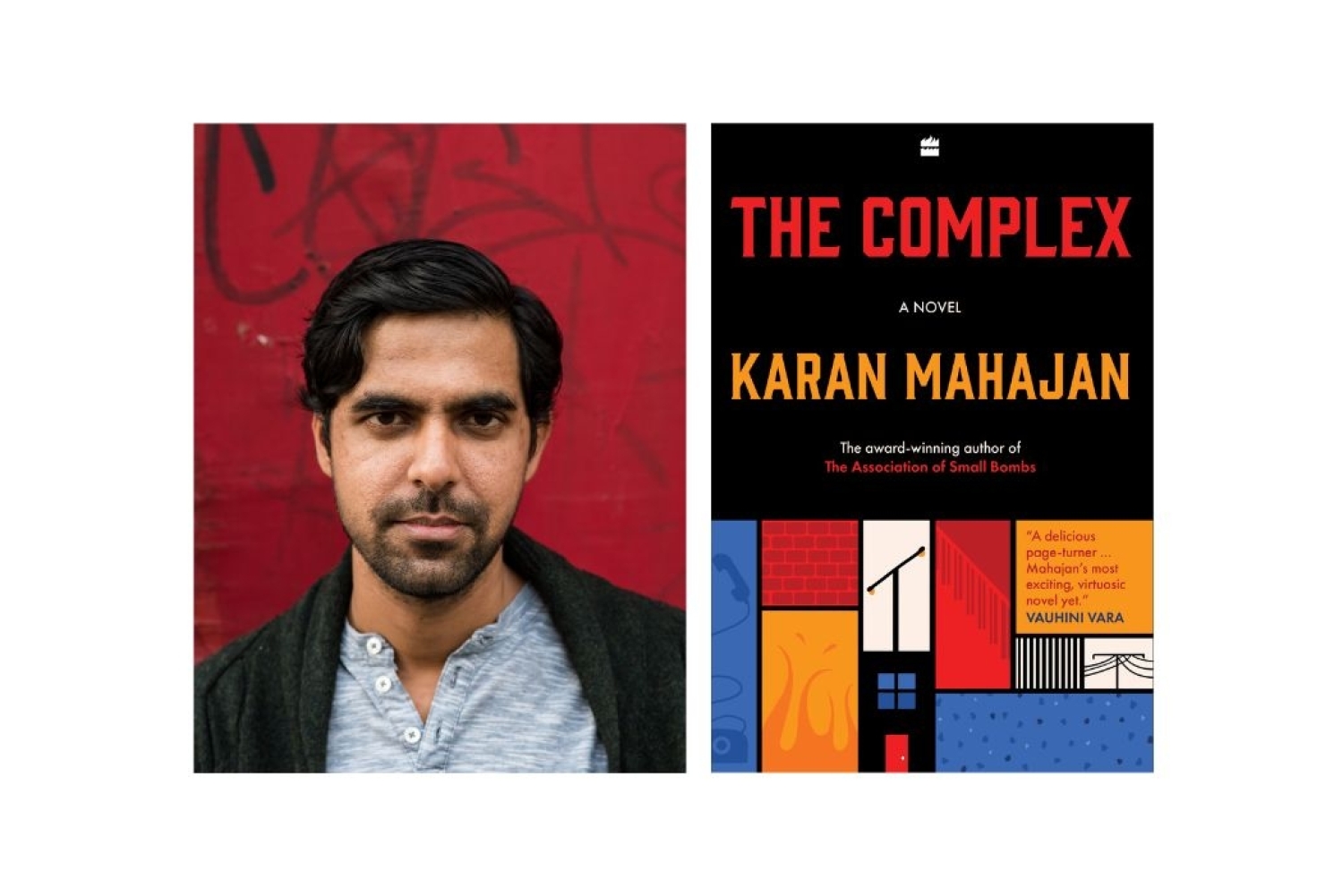
The Indian family rarely exists in isolation. Their histories, relationships and the cities they live in, all come into play over time, in defining a family for who they are. In The Complex, Karan Mahajan, author of the acclaimed novels Family Planning and The Association of Small Bombs, the latter a finalist for the National Book Award delves into the grammar of family life in The Complex, through a sprawling family saga that comes to life against the social and political landscape of Delhi. The family at the centre of the novel are hungry for influence in an India pre-liberalisation, on the brink of transformation. Karan speaks to us about his relationship with Delhi, his writing process and why this book is important in today’s landscape of contemporary literary fiction.
For Karan, Delhi is an extension of himself and the background of his unconscious. In The Complex, the city is presented in all its mid to late 1980s mixed economy glory, with ‘crumbling colonnaded markets and tight colonies not yet flooded by foreign cars.’ Several real political events intersect with the novel, including the 1984 anti-Sikh riots, the Mandal Commission protests and the first Rath Yatra. Curious to see how these moments might have played out on a deep and intimate level, such as that of the family and colony in Delhi, Karan undertook extensive research, speaking to those who lived through these realities and trawling through newspaper archives. The result is an ambitious portrait of a nation negotiating modernity and tradition, and the perplexing complexities of family life.
What drew you to writing a family saga? How did this story find you?
I find it impossible to write about characters without immediately locating them within a web of relationships. This is even truer when I write about characters living in Delhi, a city I associate with family. So what was initially to be the story of a woman suspended mentally between the US and India expanded into the complex tale of an entire clan’s rise and fall.
Since the book takes place in Delhi, what is your relationship with the city? And what role does the city play in the story itself?
I grew up in Delhi and am extremely attached to its landscape; it is an extension of myself, the background of my unconscious. In The Complex, the city is presented in all its mid to late 1980s mixed economy glory, with crumbling colonnaded markets and tight colonies not yet flooded by foreign cars.
“I find it impossible to write about characters without immediately locating them within a web of relationships. ”
Is any part of the story inspired by real events? Where did you look for inspiration and research, especially on the political drama aspect of the story?
Several real political events intersect with the novel: the 1984 anti-Sikh riots, the Mandal Commission protests, and the first rath yatra. These events ‘inspired’ the novel in the sense that I was curious to see how they might have played out on the level of the family and the colony in Delhi. Before I sat down to write those sections, I did extensive research: talking to individuals who had been there, reading historical accounts, trawling through newspaper archives.
The novel spans decades of change in India. How did you approach writing that transformation across generations?
It’s actually quite difficult to remember how attitudes change from decade to decade. The key is to follow the organic growth of the character over time–the micro-changes that make a person’s transformation seem inevitable in retrospect.
According to you, why is this book important in today’s landscape of contemporary literary fiction?
The Complex is an honest account of the perplexing complexities of family life in a nation torn between modernity and tradition.
What are you working on currently and what’s next?
I’m working on several novels or novellas. Most focused, one way or another, on migration; as well as a screenplay and a handful of short stories. I like to keep busy!
Words Neeraja Srinivasan
Date 2.6.2026