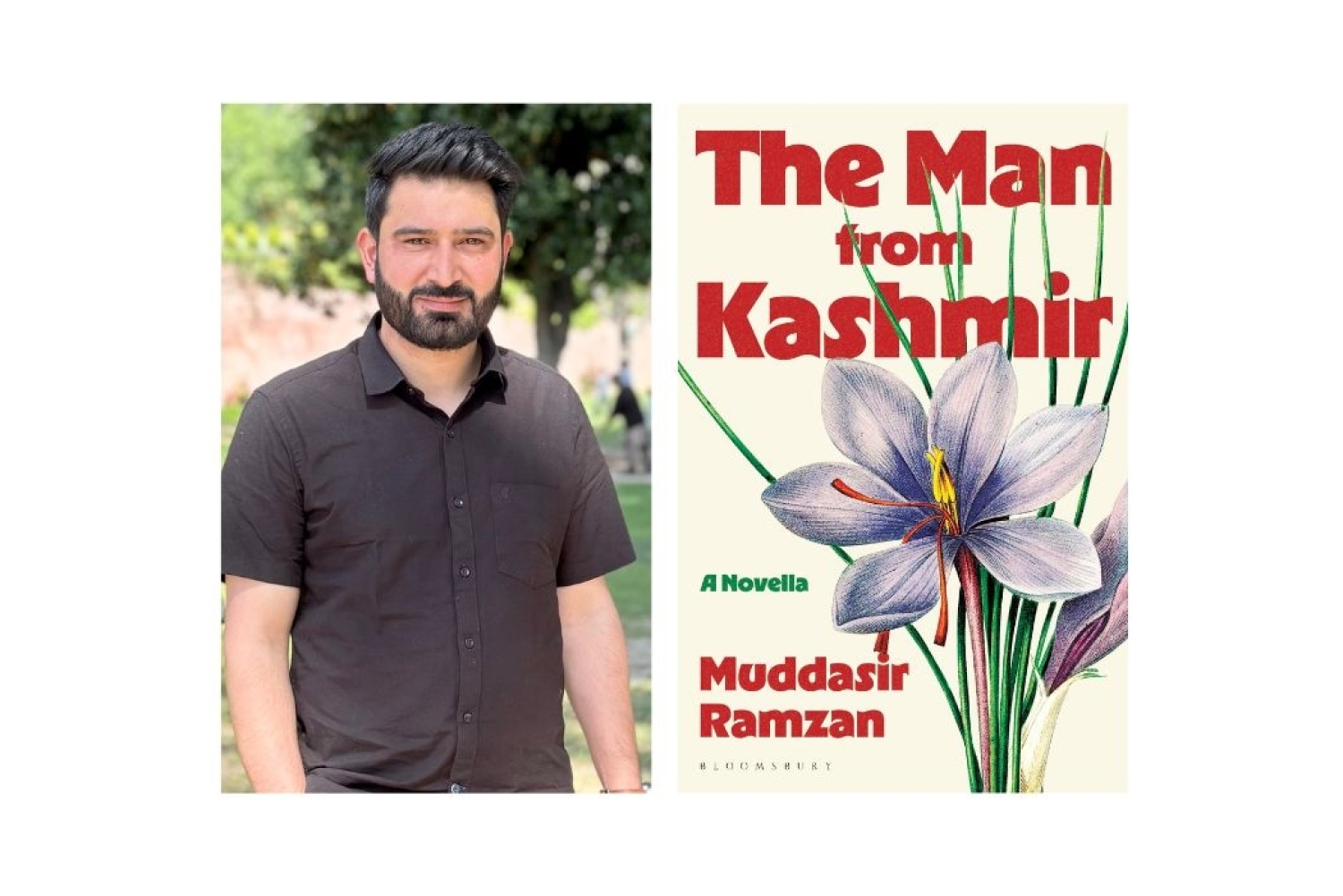
Muddasir Ramzan, in his debut book The Man from Kashmir, crafts a fractured, unrelenting portrait of life in the fictional town of Poshmarg, a place imagined around a haunting etymology that translates to the ‘meadow of death.’ Refusing conventional structure, the story takes the form of a novella that unfolds through overlapping voices and interrupted chronologies, shaped by what the author calls a ‘deliberate embrace of fragmentation and polyphony.’ Drawing from the daily realities of Kashmir, the story examines complicity, and tenderness in a hyper-militarised landscape. For Muddasir, these moments of softness are an act of resistance, reclaiming humanity against violence and attempts at erasure.
How did you arrive at the form of a novella? Take us to the roots of the inception of this story.
Honestly, I didn’t set out to write a novella; the form found me. I simply began writing: scene by scene, voice by voice. Drafts evolved into experiments. I found myself pushing against conventional structure, experimenting with syntax, interrupting chronologies, and allowing disparate voices to overlap. What emerged was a deliberate embrace of fragmentation and polyphony, not as avant-garde stylistic flourishes, but as narrative necessities. The narrative required a sprint: tight, unyielding, almost fragmented. At its root, the novella grew from a desire to take moments of profound rupture, both historical and deeply personal, and hold them under a magnifying glass until the glass itself cracks. No distractions. No exit.
I want to understand your choice to situate the story in a fictional town. Tell us a little about that and what role it played in your storytelling.
The town is called Poshmarg. A name derived from Persian, roughly translating to ‘one who wears death’ or ‘the meadow of death.’ I wanted to construct a world around that haunting etymology while grounding it in the visceral, daily realities of Kashmir. A real geopolitical location comes heavily laden with fixed maps, established histories, and perhaps unintended loyalties. A fictionalised topography offered me something far more valuable; a liminal space familiar enough to feel raw and recognisable, yet sufficiently unmoored to function as a microcosm.
In Poshmarg, the landscape is active: the fog doesn’t just roll in; it conspires. By fictionalising the town, I freed the setting from the passive role of mere background. It became an antagonist in its own right: unpredictable, suffocating, and deeply complicit. You don’t just live in Poshmarg; it lives through you, eroding you.
Many of your characters are forced to make difficult choices just to survive. What drew you to those kinds of stories?
A desire for psychological verisimilitude. As a Kashmiri, I have lived with the persistent awareness of how much transpires around us, daily, hourly, and how easily these lived experiences risk being erased or flattened. When the luxury of moral absolutes is stripped away by political or existential circumstance, what remains of the human interior? That question haunts my work.
I am drawn to the grey zones of the human condition, where the instinct for survival intersects with the horror of complicity. These narratives interest me not because they offer consumable tragedy, but because they force an ethical pause. They compel the reader to ask: What would I do? Not in theory, not from a position of safety, but in the blinding heat of the crisis. Literature/Fiction is the rarest space for truth.
What is your writing process? Where do you write from, mentally and physically?
My life oscillates between reading, research, teaching, and writing, though not always in that order. Mentally, I write from a position of interrogation. I almost always begin with an obsession or a question to which I do not possess the answer. I use the draft not to explain or moralise, but as an exploratory probe to uncover contradictions. Physically, I write wherever I can claim a temporary sanctuary of silence. That might be at a late-night desk, in the early morning calm, or during the stolen intervals between teaching hours. But the true location is an internal orientation: a state of alert stillness.
The key for me lies in the separation of creative states. Creation is wild, messy, associative, and reckless; it requires a complete suspension of inhibition. Revision, conversely, is forensic, cold-eyed, surgical, and slow. If you attempt to draft and edit simultaneously, you strangle the work in its infancy. I let the first draft burn hot and unstructured. Only after it has cooled do I return to the page with a scalpel.
Amid all the violence and uncertainty, there are still moments of tenderness. Why was it important to hold on to those moments?
Because this is a story about ordinary human beings. People who happen to be born in Poshmarg, rather than people whose primary identity is merely ‘subjects of a conflict zone.’ In a hyper-militarized or traumatized landscape, tenderness is not a luxury, nor is it a mere intermission between brutalities. It is an act of resistance. To share a meal, to hold a gaze, to whisper something soft when the structural reality demands absolute calloused hardness; those minute gestures reclaim a sliver of stolen agency. They serve as a reminder that no regime, no systemic crisis, and no historical erasure can fully expunge the human necessity to love and be loved.
What are you working on currently and what’s next?
Besides other things, I am currently navigating the early, formative stages of a longer work of fiction. This seeks to delve deeply into the volatile interplay between oral historiographies and literature. I am fascinated by how unrecorded stories, those fragile narratives transmitted solely through speech, ancestral memory, and strategic silences; press against, disrupt, and complicate the polished, institutionalized surfaces of written history. What is gained in translation, and what gets fractured in the archive? That tension is where I want to live next.
Words Neeraja Srinivasan
Date 26.5.2026