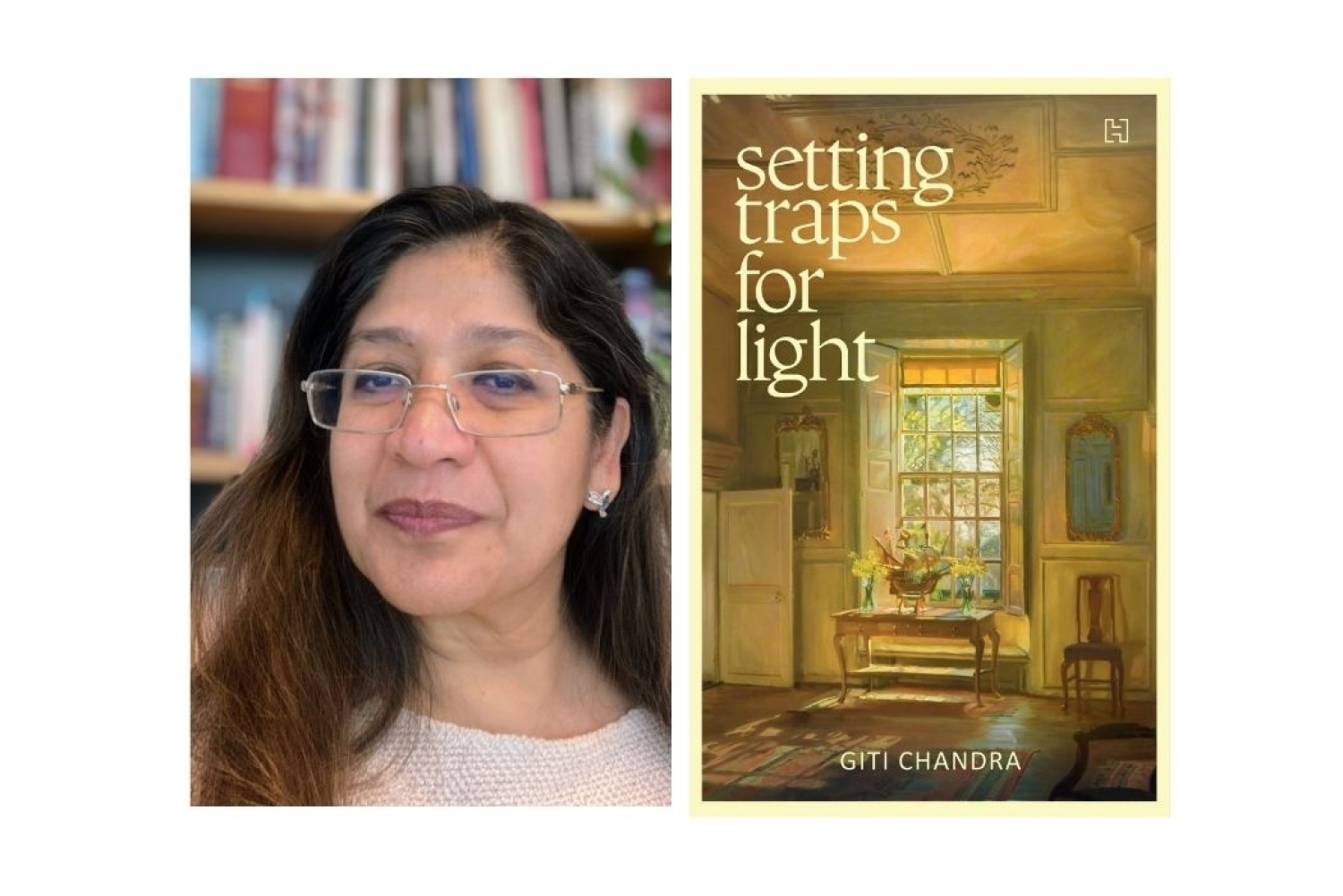
Giti Chandra, in her poetry collection Setting Traps for Light, writes about the nuances and shades of everyday life, battling with how to find the light in troubled times. Inspired by photographing the way light hits objects and specific techniques of painting light, her poems are meditations on courage, beauty, and resilience. Stemming from a lifelong love for language, rhythm, imagery, and music, the collection reflects her belief that the world is much bigger than our sorrows. In this conversation, she discusses observation, inspiration, and the quest for courage that shapes her work.
Tell us about the creation of the collection in Setting Traps for Light. How did it all start?
One of the connections that I can think of is how I respond to images. As with everyone else with a phone camera in my hand available at all times, I take a lot of random pictures, and often these are just of the way that light hits objects. I´ve also been learning to paint in what is called the ‘old masters’ technique, which essentially aims at painting light. And together these practices have really focused for me not just how I see and reproduce light, but how this is also the process of looking at life itself; the nuances, the shades, and more and more in these troubled times, how to find the light. A lot of my poems in this collection are about courage and what inspires it; how we find it in the most unexpected places, and how we can make the quest for courage a practice in everyday living. Hence, the idea of setting traps for light.
What is your relationship with poetry and what is it about the form that interests you?
This is such a good question. I grew up in a household full of people who really enjoyed language; full of idiomatic usage, metaphors, interesting ways of speaking, what Charlotte Bronte calls ‘the gift of narrative.’ And so I think my relationship to language is in large measure my relationship with the world itself. I also grew up in a family full of readers and I cannot remember a time when I did not have a book in my hand, so a lot of my writing has to do with the words of writers in my head. In that sense, I love certain kinds of form that speak to me; I like rhymes, I like rhythm, I like imagery and symbolism and hearing the sounds of words as music. This might have a lot to do with the fact that I have been musically trained since I was a child, and been a functioning musician for most of my adult life. While I am not a strong follower of certain set forms of poetry [the sonnet, the villanelle, etc] I do, naturally and intentionally, weave my poetry out of rhymes, rhythms, imagery, sounds, and so on.
There are moments of beauty and pleasure even within sadness. Why is that important to you?
I think I use images or moments of beauty to think about truth. I realise this sounds a little Keatsian, and in some sense it is. There is beauty in finding and accessing truth, but there is also a sense in which we find things beautiful when we can empathise with them, when something resonates within ourselves. Beauty is not merely aesthetic. I do also value sheer aesthetic beauty. There is a way in which it lifts your spirits when you are sad or low and there is no shame in that, as I say in my book. Finding beauty even in the midst of sadness is a way of acknowledging that the world is much bigger than your sorrow.
Where do you look for inspiration? And how do you approach observation while writing?
I take a lot of pictures of landscapes and if I cannot immediately find the poem in the vision in front of me I turn to the pictures when I´m looking for inspiration. And the truth is that more often than not, I really have no idea where the image will lead me. I might be looking at some landscape photograph in which the sea was an interesting colour, for instance, and I might begin the poem with a line about that colour, but where that observation will take me through other parts of the photograph is so unpredictable. Often, I am surprised to see what the photograph has managed to draw out of me, things I didn't know were there until I see them on the page.
What does the title Setting Traps for Light mean to you?
Very specifically, that we need to figure out how to find the light - mostly, in my case, courage, but it could be anything you need - and to teach ourselves how to capture it, make it our own, make it a part of what gets us out of bed every morning, puts us back on our feet after being knocked down, makes us go back to the battle after defeat, allows us to support each other.
What are you working on currently and what’s next?
Well, I am currently working on my next collection of poetry as well as a co-edited collection of essays on decolonising higher education. I’ve just finished two paintings I am happy with and am planning another.
Words Neeraja Srinivasan
Date 21.5.2026