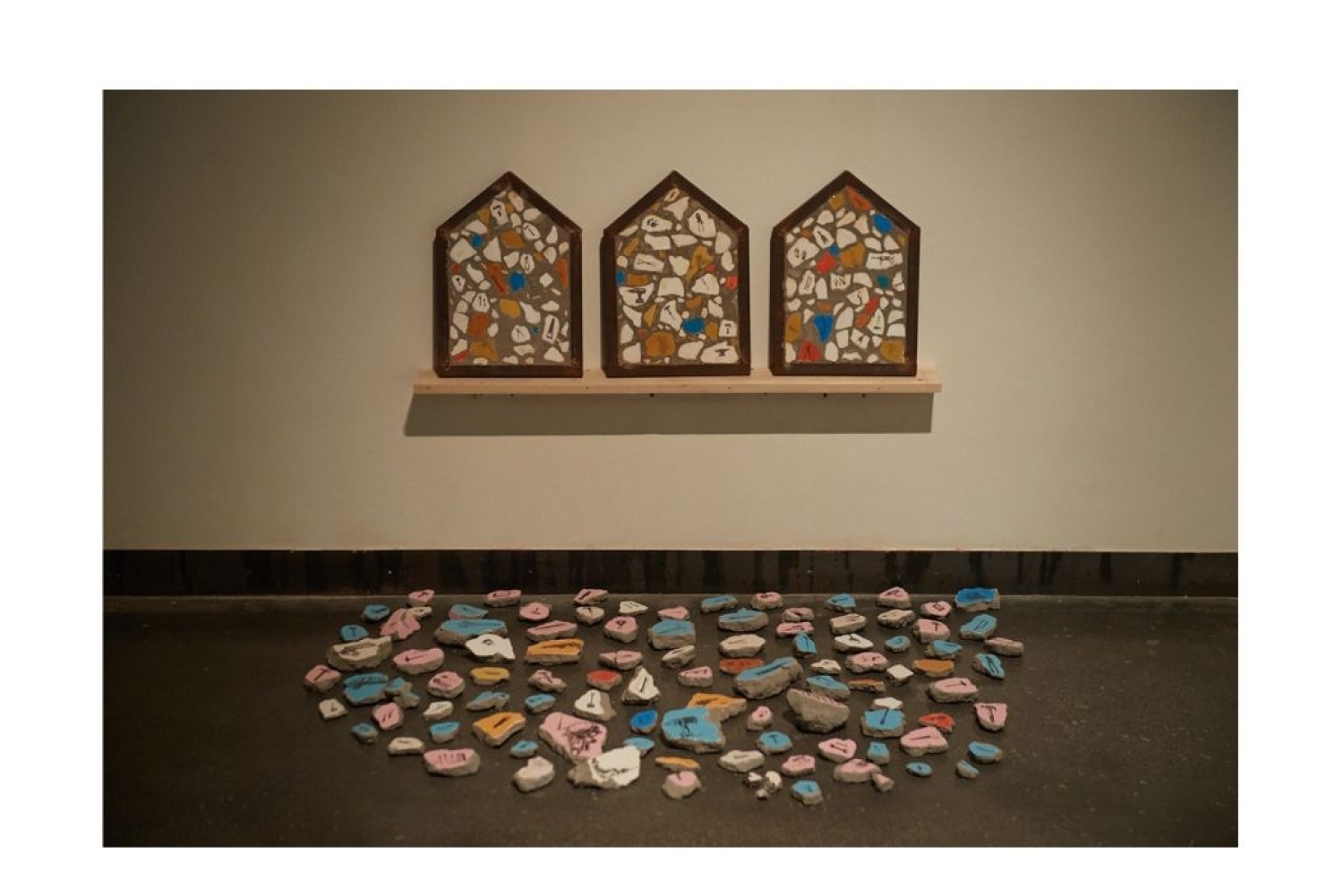
Artist: Birender Yadav
Artist: Birender Yadav
'Birla Academy of Art and Culture announced its 59th Annual Celebrations, which commenced on 9th January and will continue to 8th February 2026, at the Academy’s premises in Kolkata. Since its inception in 1967, the Academy has been dedicated to nurturing and supporting artists, researchers, artisans, and performance-based practitioners across generations.
This year’s highlight exhibition, Zameen, curated by Ina Puri, features works by some of the most influential names in contemporary Indian art – Zarina Hashmi, Shambhavi Singh, Mithu Sen, Riyas Komu, K.R. Sunil, Sumedh Rajendran, Birendra Yadav, V. Vinu, Debasish Mukherjee, Ratheesh T, and Vikrant Bhise.
“At its heart, Zameen centres the artist as a witness to shifting meanings of land and belonging, from Zarina Hashmi to Vikrant Bhise and many others, powerful voices from the hinterlands are coming together for this dialogue.” - Ina Puri, Curator of Zameen.
About Zameen
Land carries deep cultural and emotional significance, anchoring identity, heritage and community ties. In many indigenous and pre-capitalist societies, land was collectively held, embedded in systems of reciprocity and stewardship. With colonisation, industrialisation and capitalist expansion, it has shifted from being a shared sustainer to becoming an asset of ownership, control and speculation. In step with this trend in history is the resurgence of divisive forces across the world today, including in South Asia. Nationalist and majoritarian politics have amplified religious, ethnic and caste identities, and digital media and populist rhetoric have further polarised communities, eroding trust and solidarity. How does an artist, indeed art, respond to the crisis of a weakening collective civic life? Perhaps, as the works in this show suggest, by focusing on individualistic subjectivity and personal narrative that highlight the experience of such asymmetry.
Artist Statements:
Birender Yadav
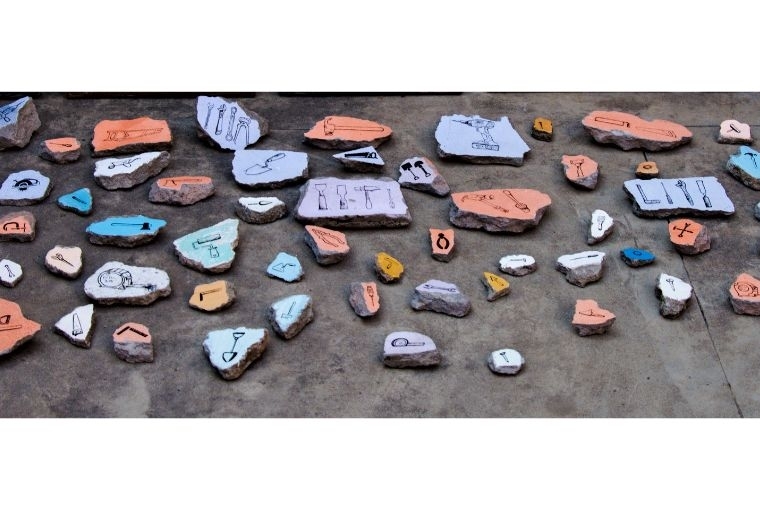
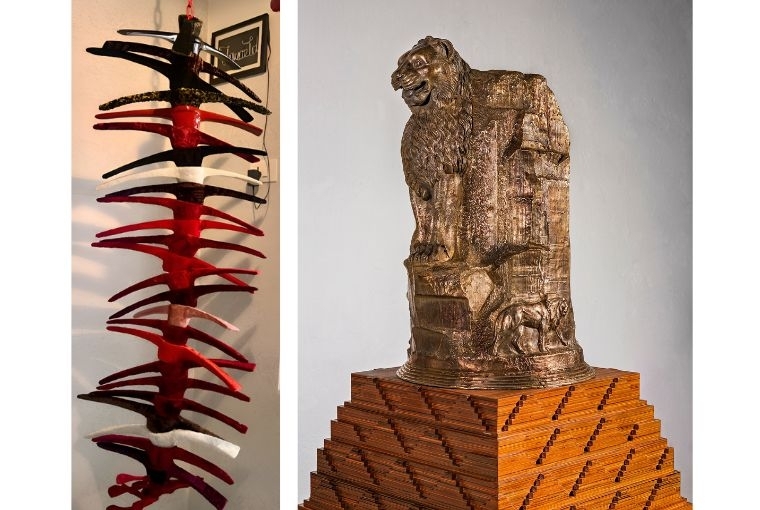
In Debris of Fate (2015), Birender Yadav reassembles construction waste into mosaic-like forms marked with tools of labour. What appears decorative gradually reveals embedded violence, exposing how the built environment carries traces of extraction, oppression, and erasure. Material residue becomes evidence, allowing debris to speak of unequal power and unseen labour.
Debasish Mukherjee
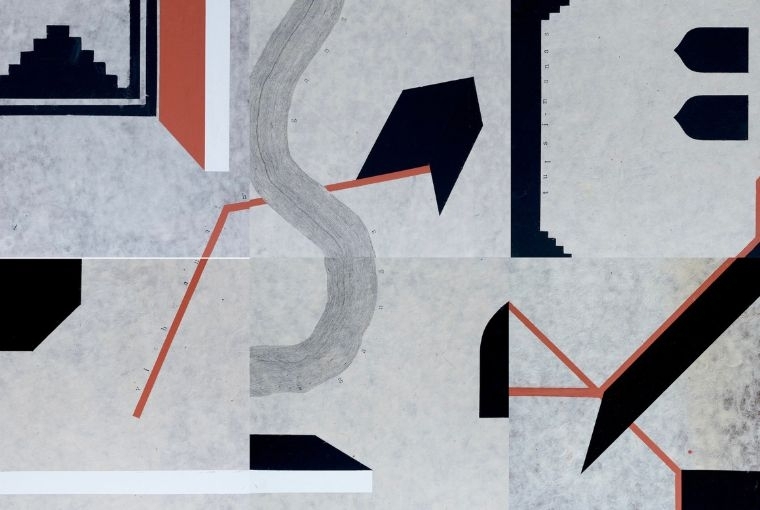
In Forty Five Attempts at Remembering a Familiar Land (2025), Debasish Mukherjee traces the changing landscape of Benares through memory and repetition. Working with rice paper and mixed media, he maps the city as a site of lived intimacy and political transformation, where land persists as origin, imprint, and unstable ground shaped by time.
Zarina Hashmi
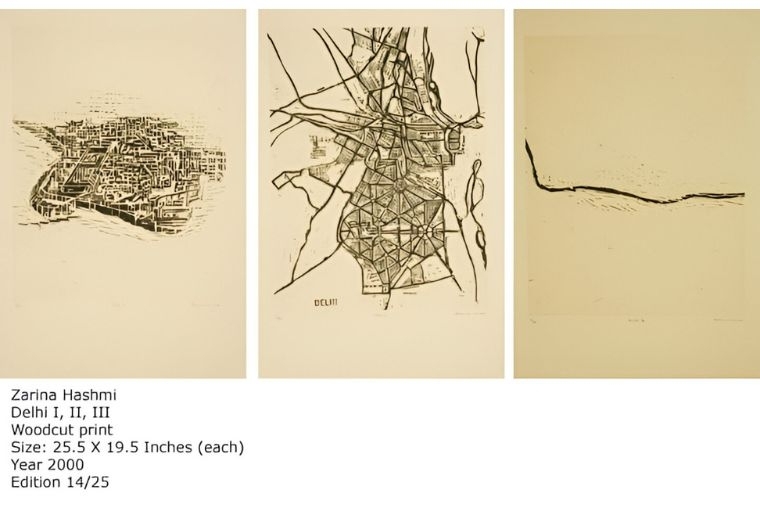
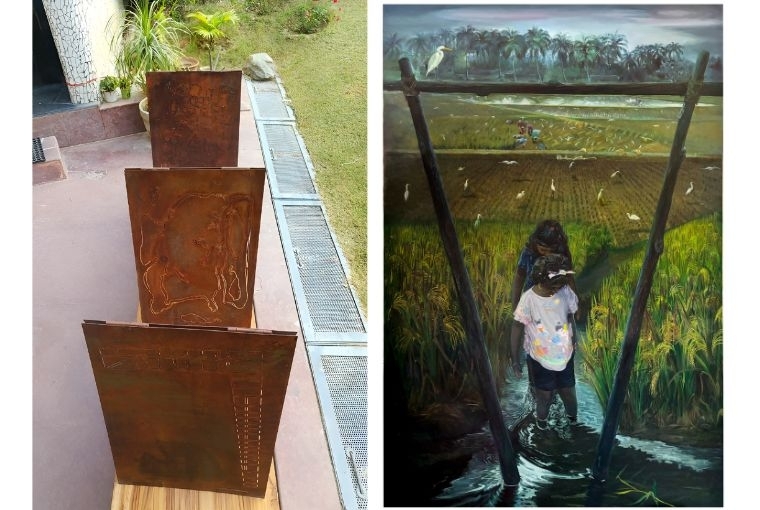
Zarina Hashmi’s In Delhi I, II, III (2000) renders the city as a cartographic abstraction. Incised lines and measured divisions evoke bureaucratic regimes of surveying and ownership, foregrounding displacement and loss. Memory emerges through restraint, absence, and fragmentation, transforming land into an emotional geography shaped by quiet contemplation.
K. R. Sunil
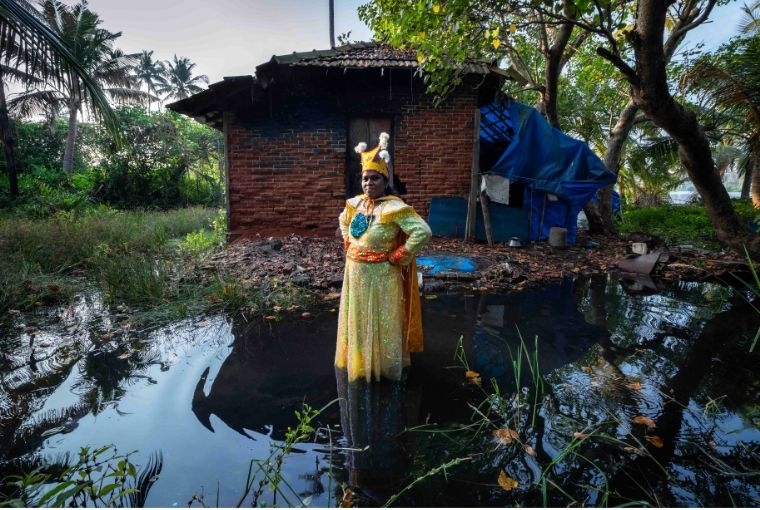
K. R. Sunil’s photographic series documents Chavittu Nadakam performers within their everyday coastal lives. Set against eroding homes and shifting shorelines, the images juxtapose theatrical grandeur with lived vulnerability, registering how climate change reshapes land, memory, and cultural continuity for the last surviving practitioners of the form.
Mithu Sen
In Non-Spinal (2025), Mithu Sen stages the body as a site where land, labour, and power converge. Centred on the pickaxe, the work exposes how tools of survival transform into instruments of control. Strength and collapse coexist, revealing endurance as a condition shaped by asymmetrical systems.
Riyas Komu
Riyas Komu engages with water and stepwells as architectural and ecological forms of memory. Digging into the earth rather than rising above it, his work reflects on sustenance, endurance, and survival, treating water as an archive and a promise amid growing environmental uncertainty.
V. Vinu
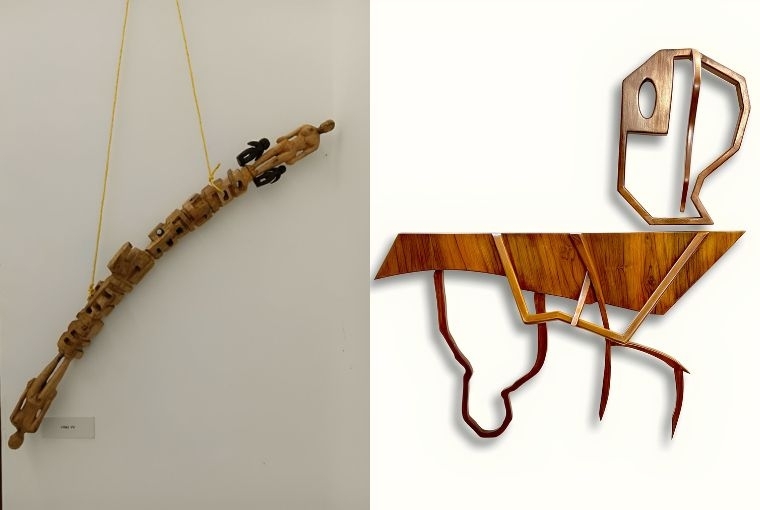
In The Ocean of Sorrow, VV. Vinu carves language directly into wood, rendering grief as a material form. Drawing on the Malayalam phrase Sankadakkadal, the work treats the sea as a metaphor for depth, loss, and continuity, examining fundamental human conditions shaped by land, water, and memory.
Sumedh Rajendran
In Water Marks, Sumedh Rajendran considers landscape and body as parallel sites shaped by time and struggle. Gestures of myth and faith blur under monumental structures, while residual pigments in wood remain as traces—marks carried across skin, earth, and memory.
Shambhavi Singh
Drawing on ancestral memory, Shambhavi Singh treats land as inheritance rather than property. Soil carries genealogy, ritual, and care, where loss signals a rupture of dignity. Preserved through duty, land becomes a living archive of family, labour, and memory across generations.
Ratheesh T
Kerala’s paddy fields remember hunger, debt, and caste violence. Tenant farmers fed landlords with borrowed grain, starved their families, and buried children into inherited labour. Resistance began with education, not land. Today, refined language masks old hierarchies, but the struggle for dignity and shared humanity continues.
Vikrant Bhise
Rooted in Ambedkarite thought, Vikrant Bhise’s work reflects the resilience of marginalised and nomadic communities denied belonging within their own land. Through wandering figures and enduring landscapes, he transforms displacement into defiance where books, memory, and mountains become witnesses to a continuing struggle for dignity and identity.
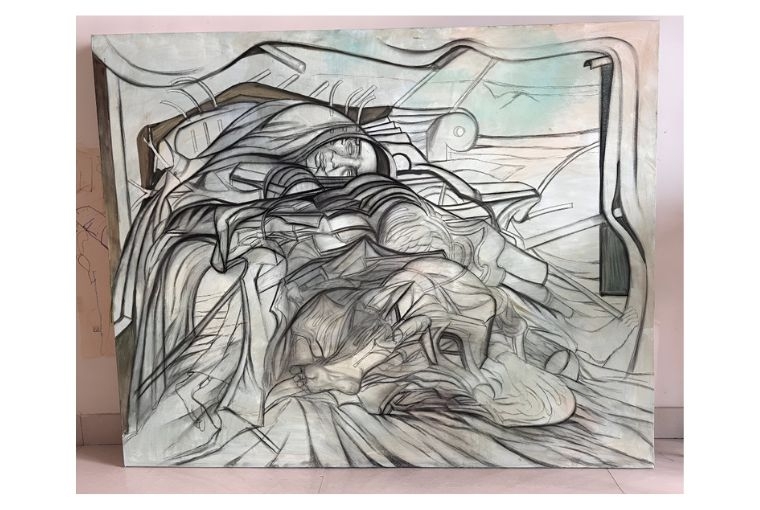
‘Zameen’ at Birla Academy of Art and Culture, Kolkata, on display until 8th February.
Date 19.1.2026