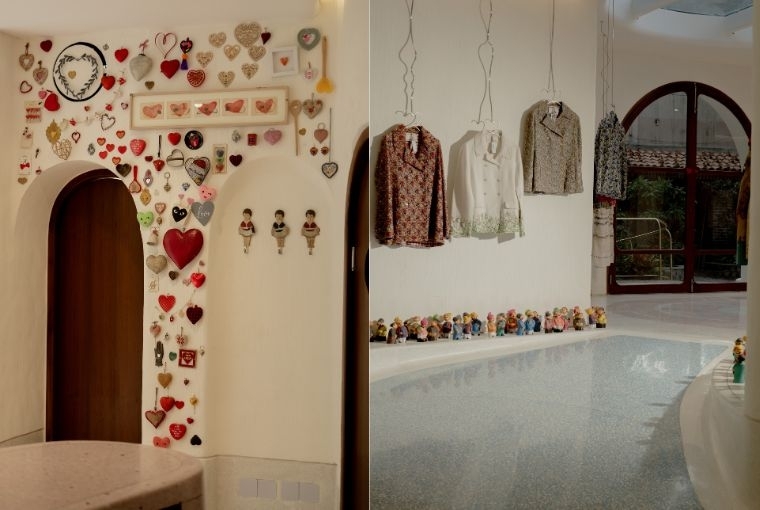
There is a certain kind of magic péro has always kept just out of reach, tucked into a stitch, a heart-shaped button, a scrap of Bandhani that shows up season after season like an old friend. Now, after seventeen years of shows that lasted fifteen days and homes borrowed from multi-designer stores, that magic has an address of its own. Delhi's new péro flagship, fittingly named pérodise, is built the way péro builds its clothes, stone, brick, wood, metal and terrazzo layered together with the same attention once reserved for textile and thread. There are no sharp edges here, only curves, warmth, and a heart-and-wing motif running all over the space. We're in conversation with founder Aneeth Arora, who tells us what it means to finally give péro's whimsical world a home.
You have always approached péro as a world that goes beyond the clothes, so what did you want this first flagship in Delhi to say about that world?
The initial few discussions were actually not at all about how the space will look. It was more about what I want it to be in terms of an experience, and how I did not want it to be very transactional. I like how we mix things in our clothes and how we make all the experiences olfactory. That was my first criteria for this space as well, that in some way péro's whimsical world will be there. But of course, since it's a retail space, it should not overpower the product, because that should be seen, which we've not been able to do in so many years. All we've done is shows, which last for fifteen days, and then we've just been with multi-designer outlets. So that was the criteria. Eventually, the look and feel of the space started falling into place. But we knew very early on that it has to be an experience, and not just a space where people come and buy things.
There is a strong sense of layering in the store, through the stone, brick, wood, metal, terrazzo and the many handcrafted details. Was the idea to almost build the space the way you would build a péro garment, with different materials, textures and skills coming together?
It's like something as simple as keeping things curved. There are no sharp edges in this entire space. Everything is curved, which gives a sense of warmth. So when I say that it has to be an olfactory experience, this is the sensory part of it. The space is not just about displaying product; it is also about telling stories, and putting out our archives where people can see things they have not witnessed in all these years. The whole attention to detail that we show in our clothing is something I wanted in the space, through the different materials that we've used, and in multilayered clothing, the way we do our clothes, where many textiles and craft techniques from different parts of India come together in one piece of clothing.
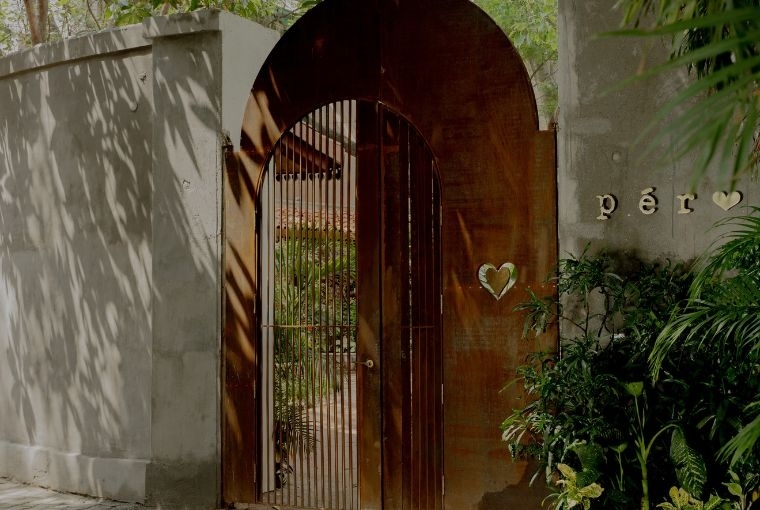
I love that so much of the detailing has a story behind it, from the stone excavated from the site to the elements sourced from artisans across India. How important was it for you that the making of the store also reflected péro's relationship with craft and its community of makers?
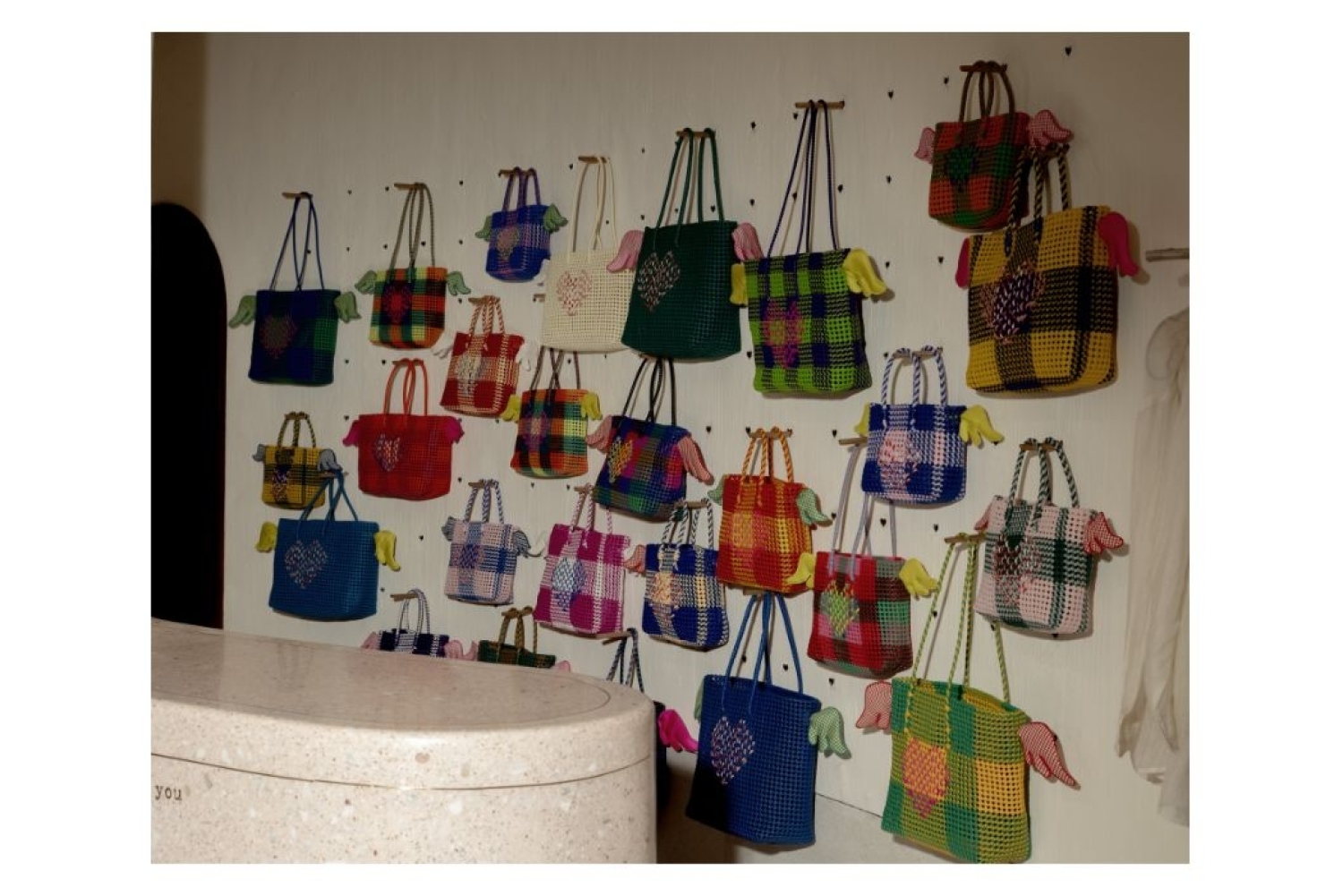
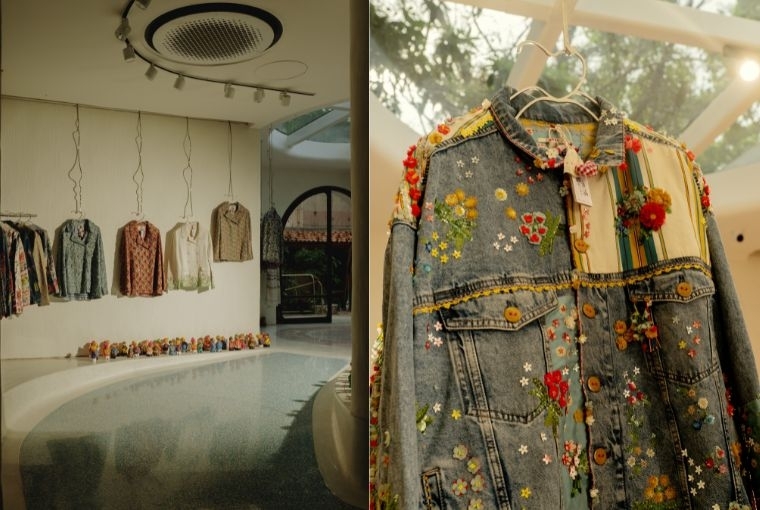
For example, the terracotta tiles that went on the canopies were made in Odisha by the potters. And terrazzo is a fully hand technique, where the material is laid on the floor by hand. There are agencies in Delhi who do that, it's very old-school. It was also personalised to an extent. We created blown-glass hearts, which were inlaid in the flooring. Even the hangers were developed with a metal craftsperson; they were hand-finished. And there is a motif of heart and wings running all across the space, because, as you know, we're calling it Paradise. It gives the feel of angels in paradise, where we have these little heart motifs with wings.
And why paradise: over the years, the word péro has become synonymous with love. When we started our Insta page, we called it "I love péro," and people resonated with that. They started writing to us saying "I love péro," and eventually we started reciprocating that love by telling them "we péro you." So for us, péro became synonymous with love. There is a lot of emphasis on love, which is why paradise. It's almost like a place of love, not just in the literal use of hearts in places, but also in the love that we put into making the space, the love we put into making our clothes, and the love we get back from people. Love is the underlying feature of the space.
You have also imagined the store as something that can shift into an exhibition or gallery-like space and host conversations and creative evenings. What kind of life do you hope the space will have beyond retail?
The way the space is designed, it can be completely devoid of the rails that display clothing, and it could just be an open gallery. The idea is to collaborate with artists, where we could turn it into a gallery, and it also has a central podium, so if we have any talks, people can sit all around. The space is designed so that it's always an interaction between outside and inside, where inside is just about these natural materials, and outside is a lot about greenery. The doors are folding doors, and they can open up to the outside, so the space becomes seamless, and if there's a talk or an event, people can just sit all around the space and enjoy the experience we are bringing to them.
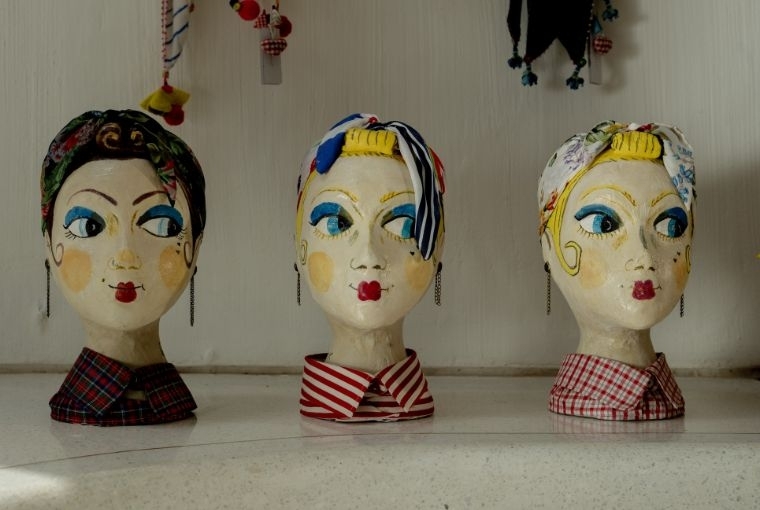
The heart has always been such a quiet but recognisable part of the péro universe, and here it appears through the space as well. After all these years, what does creating this little ‘pérodise’ in Delhi mean to you personally?
It's given us a place to express ourselves. It is devoid of seasons. We can tell our story the way we want to. The things we've been doing season after season are driven by orders, and by having to match one piece with the other. But this gives us the freedom of expression, in the sense that even if there are one-offs, we'll get a place to display them. There is a whole lot of learning from the past seventeen years, which we'll now be able to show to the world through our space. I think it is devoid of any rules. Like our clothes, we want the space to be timeless, and what we display there will become things that people can keep coming back to. It will not be trend-driven or season-driven. So we will open up a lot of our archives, and sometimes even look back at a collection from the past that people wanted us to do again. Basically, it just gives us a lot of freedom, in the sense that we do not have to worry about what we are showcasing. We can just do whatever we wish to do in the space.
What’s the collection on stands in the store right now?
Right now, since we are in September, and anyway, the idea for the space was not to be so bound by seasons. I've been wanting to showcase péro Classics, that we keep doing season after season, but as a part of an ongoing line. So we've pulled out all those classics, and this rail will be perennial at the store, where anytime people want to buy péro Classics, they will be there. So we will definitely be opening with that.
Then there is another line we do, called Limited Edition. These are highly worked-upon jackets that we do, one every season, and then we keep adding them to our Limited Edition. They only come out once a year, when we do a tour with these jackets. But at pérodise, it is going to be a permanent feature, where we'll always have a rack of our Limited Edition jackets, which people will not find in any other stores. So these two are the things which are apart from the ongoing season that we'll have.
Like I said, we keep adding these permanent properties. Like we did Dot, which was only about Bandhani, and we do Bandhani every season. So there will be a rack of Dot anytime you walk into the store, because Bandhani is a very important technique that we work with. Like this, there will be things which are timeless and perennial. And there will be a small section of the current season, right now it will be Doodles, but eventually it will be the Fall/Winter line that we showcased at Fashion Week.
Are you nervous for this new chapter?
There is this thing that people always mistake about me: that I am shy. I'm not shy. I really like to tell my story to people and talk to them. I always say that I don't want to be the face of the brand, but I would love to be the voice, because no one else can tell the story better. So I'm actually enjoying the space.
We are excited. It feels like the beginning of a new journey for us. I actually enjoy meeting people and telling them the story of péro. I have always said that I may not want to be the face of the brand, but I would love to be its voice, because no one can tell its story better. We have already started having meetings at pérodise, and I am really enjoying being in the space. More than feeling intimidated, I am excited for people to come in, experience it, and become part of this new chapter with us.
Will pérodise expand to other cities?
We have always grown very organically, so we don't really work with a five-year plan. Even with pérodise, there was never any pressure to have our own store; it happened when the time and the space felt right. The journey has started, and if we find the right space in another city, at the right time, we would be very happy to create another pérodise. At the same time, we have wonderful relationships with our retail partners in India and overseas, many of whom we have worked with for seventeen years, so there is no pressure to have many stores of our own. For now, we are enjoying this new chapter and allowing it to grow as organically as péro always has. Never say never.
Words Hansika Lohani
Date 2.9.2026