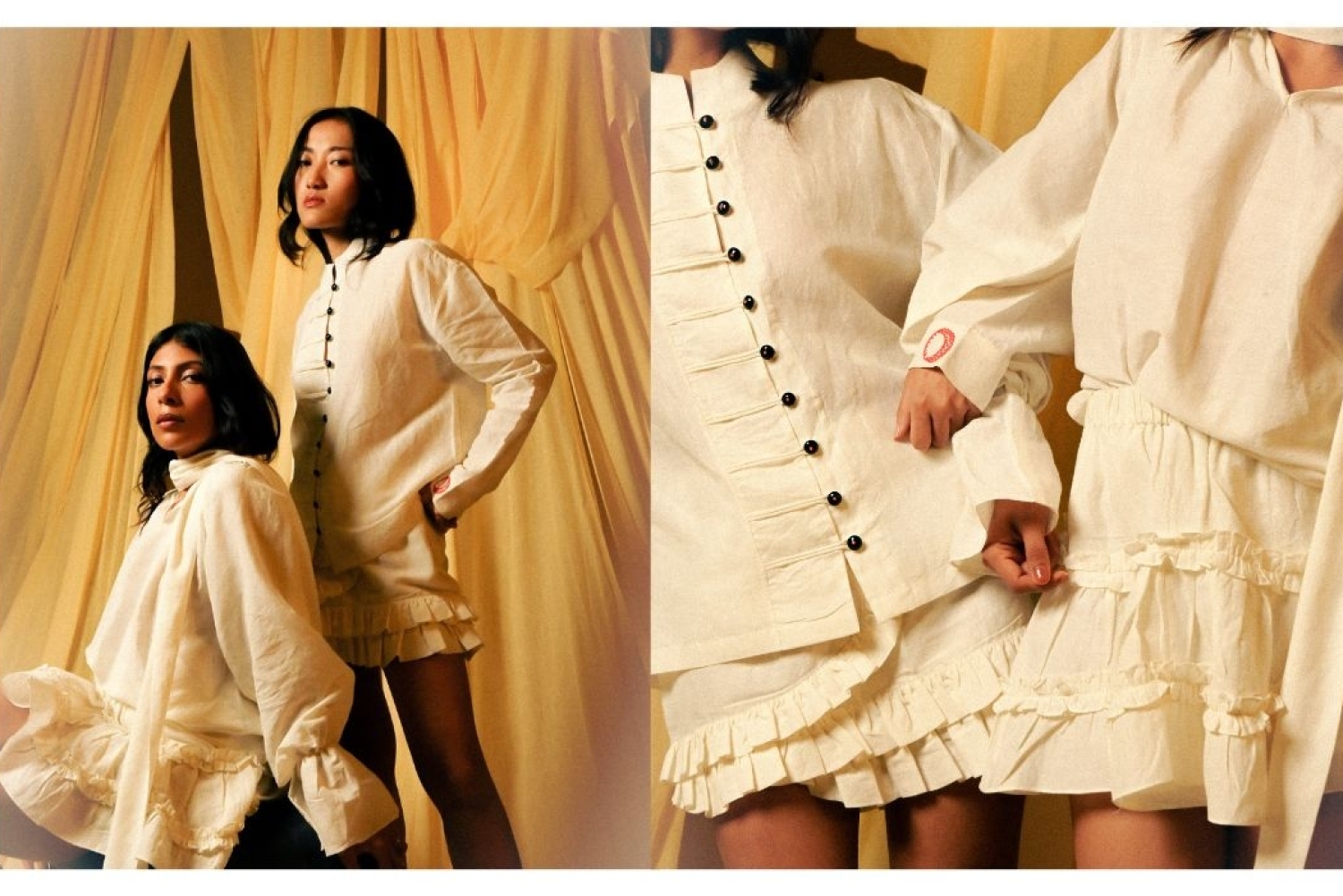
A contemporary label based in Delhi, Acid Moons was founded on the belief that craft has the power to hold stories of people and community. Their debut womenswear collection was made in collaboration with the Phulia cooperative in West Bengal, whose weavers are descendants of families displaced from Tangail during the Partition of 1947 and the Bangladesh Liberation War of 1971. Carrying no looms or cloth, they brought with them generations of weaving knowledge that would eventually shape the Phulia Tangail tradition, one of India's most significant handloom legacies. The collection reimagines their handwoven linen in contemporary silhouettes, allowing a cloth traditionally associated with drape to take on different forms while retaining the breathability and longevity that only handloom weaving can produce.
The story behind the label is also personal. The founder, Kareena Oberoi’s own family was displaced from Lahore during Partition, forced to leave everything behind and begin again. Working with weavers whose histories echo similar experiences of displacement makes these garments an ideal illustration of the fact that, even the simplest things in life, like the garments we wear, are carriers of history and meaning.
Personal Inheritance as a Foundation
For me, inheritance is about what we carry with us in the form of who we become. Acid Moons, at its core, has always been inspired by my personal inheritance and history, and has evolved as I have. I tend to filter every outward experience through an inner spark that is sometimes a roaring fire and sometimes only an ember. Before designing any collection, I disappear into my family archives to see if I can pick out influences from a different era and understand how they intertwined with people's lives, knowingly or unknowingly. I build a sort of board with silhouettes, places, people, and even the little things most would ignore, like hairstyles. It becomes a somewhat obsessive exercise, but I suppose that's how I make sense of the world.
The last collection we did, Continuous Flourishment, held a provenance that tied back to my mother's outfits from the time she started dressing herself until she was my age. We are byproducts of our upbringing. I always saw my father as a feminist before the definition existed, my mother as a fierce, independent working woman, my maternal grandfather in the Indian Navy and later the British Merchant Navy, and my paternal grandfather who built a successful business after arriving in India with nothing to his name. I see myself in each of them, yet I stand on my own. I want my brand to do the same, which is why I chose not to name it eponymously.
A Cross-Border Conversation About Ownership
Interestingly enough, when we first started working with the Phulia weavers, it was almost impossible for people in India to access the same cloth for the Indian market that they were primarily producing for export. But the weavers were incredibly receptive to making the material work for us in whatever thread count we wanted.
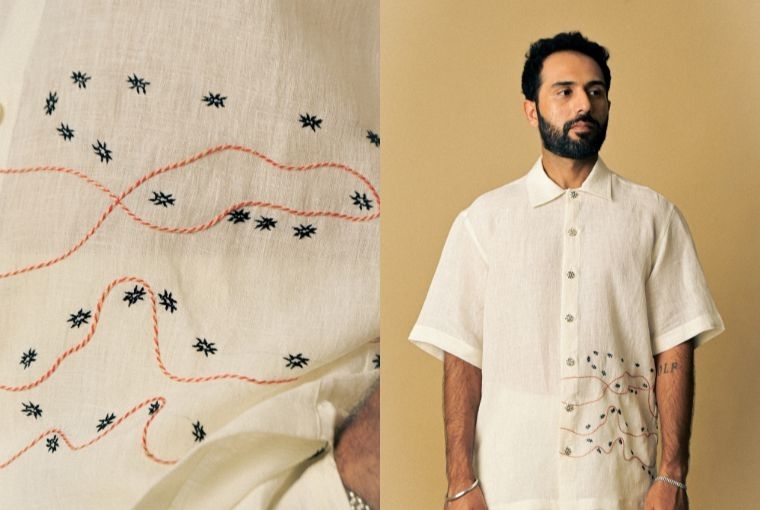
The whole idea materialised through looking at their complicated history of crossing borders, rebuilding lives, and still choosing to make something beautiful. Their resilience became just as important to us as the fabric itself. The famous Dhakai muslin that comes from the region has been a lifelong fascination for us. The finesse of the textile and the possibilities for contemporising it are truly what we're after.
The Creative Process
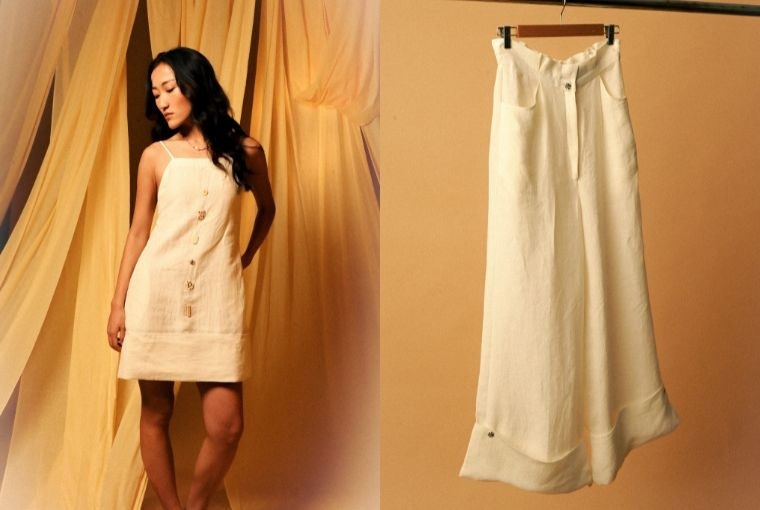
The creative process took us back to the time of Josephine Baker and the many admirers of Dhaka muslin. We looked deeply at how traditional muslin was draped, folded, pin-tucked, and allowed to move so beautifully with the body. Historically, it was woven into the daily lives of royalty, yet it always retained a remarkable sense of ease. We always begin with the textile. Once we had perfected the fabric, we started developing silhouettes we genuinely wanted to see people wearing today. The technicalities of the fabric never posed much trouble because the weavers were creative partners in the process rather than mere onlookers.
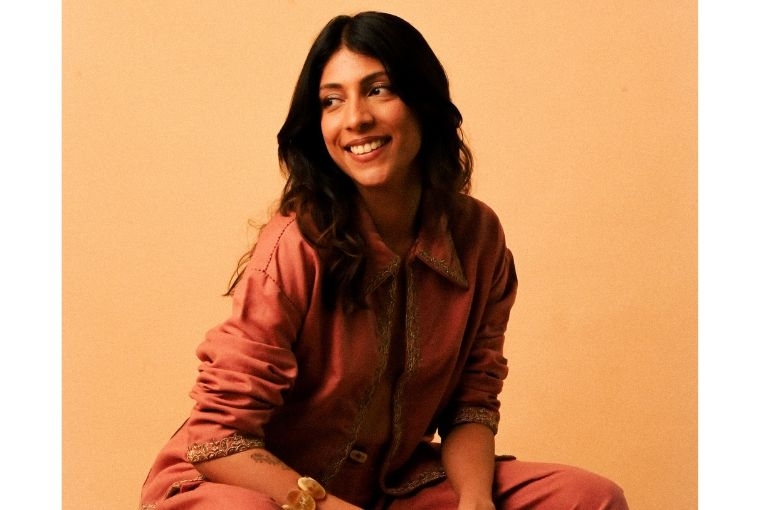
Founder, Kareena Oberoi
Technical Challenges
The technical challenges were multiple. The first was the sheer finesse of the fabric itself, which made hand embroidery incredibly difficult. The lightness of the weave and its air pockets made the textile behave almost like a living entity, one that required constant care and attention while working with it. The light at the end of the tunnel was that these very challenges created the quality we fell in love with. The fabric drapes in a way that feels almost angelic, and that softness and movement became one of its greatest strengths.
This is an article from the August EZ. For more such stories, read the EZ here.
Words Neeraja Srinivasan
Date 15.8.2026
Creative Direction & Design Kareena Oberoi / Acid Moons
Photography Keith Ezekiel Joy
Styling Vasavi
Hair Madhu
Makeup Joy Goswami
Models Maongka / Kareena
Textile Development Phulia Tangail Weavers, West Bengal
Hand Embroidery Acid Moons Artisan Partners
Production Acid Moons