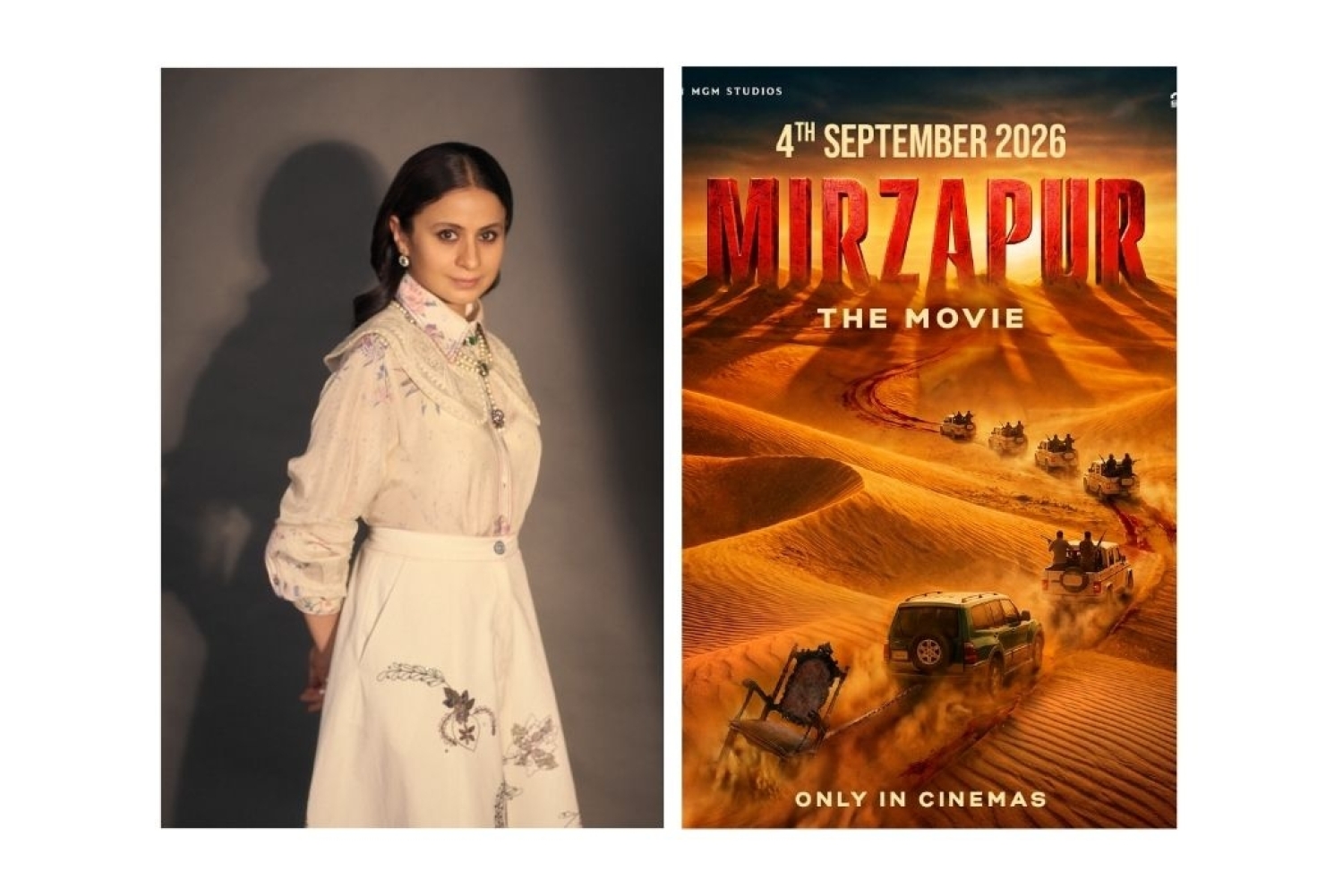
Rasika Dugal's relationship with cinema began in Jamshedpur, shaped by a childhood of watching films on VCR, tracking liquid at the ready to clear up prints. Theatre visits were rare events, and functioned as excursions with family friends where knowing the owners might land you balcony seats.
The shift came at Lady Shri Ram College. A workshop screened clips from Pather Panchali and something changed. ‘I had never seen cinema like that before and it piqued my curiosity.’ she recalls. Attending film club screenings, using theatre as a tool to fit into the big city, trips to Mandi House and India Habitat Centre during holidays, a banned print of Fire watched by fifty girls crammed into a room in the Delhi heat are what come to mind when she recalls her first memories of acting. Still she says, ‘I never thought acting could be a profession for me because nobody around me had done it.’
Today, Rasika is known for performances that treat women as complicated, flawed, human characters such as Beena Tripathi in Mirzapur, Neeti Singh in Delhi Crime, Savita Kapoor in A Suitable Boy and many more. With the Mirzapur universe now making the leap from streaming to cinema screens later this year, her journey enters a new, exciting phase.
Many of the roles you gravitate towards treat women as multi-dimensional characters. How important is that gaze to you when you read a script?
You can only make an assessment of that gaze. You can never be completely sure. As an audience member you view something through your experiences and prejudices. Similarly, when I read a script, I bring my lens and my hopes of how I want the world to be. Sometimes you find that alignment with the director and the team and sometimes you do not, in that filmmaking is such a collaborative exercise. It is like a team sport where everyone has to be in sync, but each person also brings their own ambitions and perspectives. When you read a script, the intent is always to choose something that aligns with you, but it is still a leap of faith. The visualisation may exceed your expectations, or disappoint you, because it is not fully in your control.
Similarly, a lot of your characters display a certain level of moral ambiguity. What has playing these complex characters taught you?
It has been interesting to get to know myself through these characters. We often live our lives believing we are a certain way because we practice one side of ourselves more than others, which can come from conditioning, and our environment. Getting the opportunity to explore aspects I do not necessarily practice in life has shown me that I am more than I think I am. It has also made me realize how easy it actually is to understand other people if you make that effort.
Sometimes when you are struggling to understand a character at first glance, and suddenly something clicks and falls into place, it is magical. You wonder how you reached that place, and it is comforting because it makes you realize people are not as mysterious or different as we think. Even if that happens once in a project, I feel I have gained more than I asked for because it is not easy to achieve.
With Neeti Singh from Delhi Crime, I often feel she takes me back to the kind of person I used to be. I am fond of her, though that can be a little problematic because you cannot be too in love with the character you play. I have always been interested in women like her who might seem ordinary but whose stories are absolutely worth telling.
“Getting the opportunity to explore aspects I do not necessarily practice in life has shown me that I am more than I think I am. It has also made me realize how easy it actually is to understand other people if you make that effort.”
How do you think the move from OTT viewing to the collective experience of a cinema hall will change how the Mirzapur universe is felt by audiences?
I am curious. I have not thought about it too much because how audiences perceive something is so far out of your control that it is sometimes better not to dwell on it. I am excited that a series is being made into a film in this way for perhaps the first time in our country, and that I get to be part of that. It feels like something people may talk about years later, and I am grateful I will have been part of that moment. Audiences are always full of surprises. Sometimes things you worked very hard on go unnoticed, and sometimes something you did not think much about affects someone deeply. I am curious to see how people respond.
Do you have any rituals before doing a scene?
I do not really have a fixed pattern. Every character has been different. One challenge when you return to a character is that it is no longer just your experience of the character. After a season releases, everyone has an opinion. You have spoken about it, heard feedback, read reviews. It becomes a shared experience. Initially I wondered how I could forget all that and go back to what I felt in season one. Then, I realized I cannot forget what I know. It is better to accept the feedback and work with it, rather than try to erase it.
For Delhi Crime, I do have a ritual. I shadow a police officer before every season. It began as research to get protocol right, but she ended up informing the character so much more than my own experiences could. I met her again before season two when she had been promoted, just like Neeti Singh. And I met her again before season three as well. I have seen her change as a police officer, I have seen myself change, and I have seen the character evolve. It has been a beautiful process.
When you look at your early work in contrast to your recent performances, what is something about your acting that has fundamentally changed, and what has remained the same?
One thing that has not changed is something I learnt in film school, where we were taught never to tell your co-actor what to do. You accept whatever they give you and respond to that. If someone says a line in rehearsal in a way that sparks something in you and then does it differently in the take, I do not ask them to repeat the earlier version. That moment is gone. Now, I must find a new moment by accepting what is being offered. That has always held me in good stead because it keeps possibilities open. Something that has changed is that experience has made certain things easier. Earlier, I used to find the chaos on set bothersome, as if it was distracting me from what I wanted to achieve. Now, I can include that chaos in what I am trying to do.
What keeps you grounded when you step away from the camera? What does a completely ordinary day look like for you?
I do not know if I am grounded. This career has had so many ups and downs that I have never felt like I was floating in the first place. The desire has always been about personal achievement and getting closer to things I want to do, rather than any idea of glamour. If I have gaps between shoots, I usually try to learn something. I have taken piano lessons, music classes, tried playing sports. I keep trying to build a good reading practice because everything has become so visual and attention spans are short. I also like being inspired by people. If someone inspires me, I kind of obsess over them and follow everything to do with them. Every reel, every news article. So yes, a little bit of all this.
What kind of stories do you feel Indian cinema is still hesitant to tell?
One thing I would really like to see more of, and definitely be a part of, is women doing comedy. We are still in serious dearth of that. I have had small opportunities here and there, but often as the foil rather than carrying the comedic material myself. And I would really love to explore carrying the lightness of the comedic material.
This article is from our latest Bookazine. For more such stories, grab a copy here.
Words Neeraja Srinivasan
Photography Jeet Gohil
Date 5.9.2026