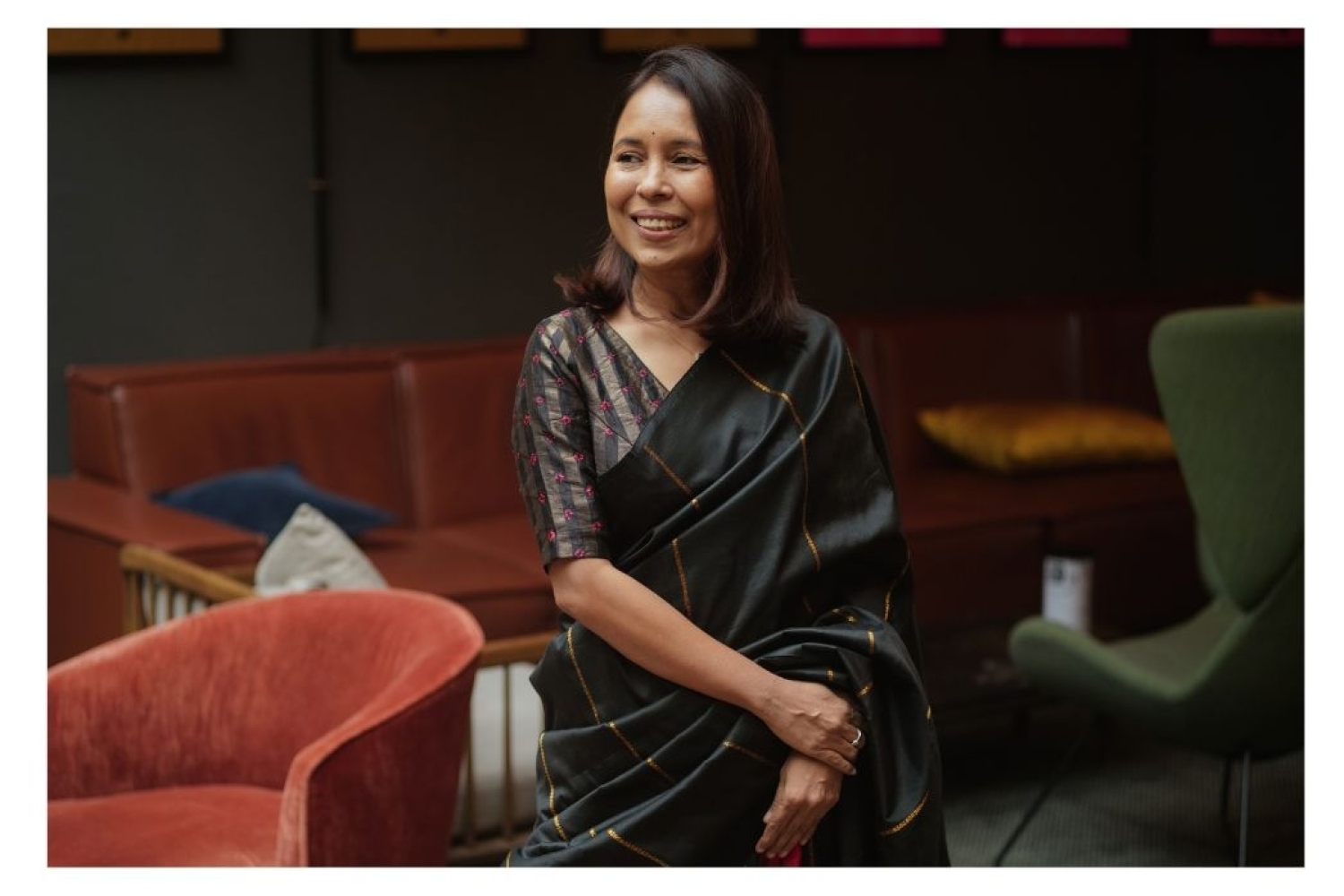
Rima Das has made a distinctive position for herself in contemporary Indian cinema. It is well known that Rima is self-taught and fiercely independent, which has made her one of the most compelling voices in regional filmmaking; creating intimate narratives from her native Assam. Her stories resist both mainstream conventions and arthouse pretensions. And have been shot in her village with non-professional actors, often without scripts and been awarded international acclaim while maintaining an uncompromising commitment to place and process.
Her latest film, Not a Hero, recently received a Crystal Bear Special Mention at the Berlin Film Festival, continuing a run of acclaim that has followed her work across the global festival circuit.
We caught up with Rima, who wrote down her answers with remarkable clarity about the intersection of craft and instinct in her filmmaking. As with her earlier films, Not a Hero refuses the easy romanticism often attached to rural life. Instead, it feels like the work of a filmmaker, increasingly assured in her methods, one who continues to quietly challenge assumptions about how films are made and what they can be.
How have you evolved as a filmmaker across your feature films?
With each film, I am growing and becoming more confident in my craft. I am less focussed on telling a story and more on listening to it. In my early years, I paid close attention to structure and technical precision. Over time, I have learned to trust silence, stillness and the inner world of my characters.
At the same time, when I look back at my earlier work, it gives me a different kind of joy. There was a rawness and innocence in it that felt very pure and instinctive. Today, I may be more aware, more skilled and more deliberate but earlier, I was simply creating without overthinking. Perhaps that freedom made the work feel more authentic. Growth has made me more patient, more grounded in imagination and more attentive to subtle human emotions but I also deeply cherish the honesty and spontaneity of where I began.
You often return to your village as the setting and source of your stories. It seems to have left a deep and lasting impression on you, almost like a place you have never truly left. What keeps drawing you back there creatively and how do you keep finding new stories in the same space without repeating yourself?
It is a mix of destiny and deep love for my land and people. My village shaped my first understanding of love, loss, dignity, community and silence. Even when I am away, it stays with me.
It hurts to see nature fading, old architecture disappearing and culture becoming more about visibility in the market than inner depth. Not everything is gone but the speed of change affects the essence of the place. Through my camera, I try to capture the beauty that remains, the quiet songs of trees, rivers, sun and moon. The village has many layers and the same place feels different as you grow older. When I return to it in my films, I am not repeating it; I am seeing it from a new stage of life. Sometimes it helps me preserve fading memories, sometimes it brings back feelings from childhood that were never fully understood. It is healing but also unsettling that tension keeps drawing me back.
Not a Hero highlights the disparity between an urban and a rural upbringing, the simplicity of village life contrasted with the chaos of capitalism and consumerism. How did the plot first take shape in your mind?
The film began with a simple image, a child standing between two worlds, not fully belonging to either. The story grew from observing contrasts, the noise of the city and the rhythm of the village, ambition and contentment, consumption and connection. I did not want to make a loud statement. I wanted to explore how these forces quietly shape innocence.
The character of Mivan came naturally. At first, I intended to work with professional actors and make a more mature film. But during my visits home, I noticed how quickly children absorb outside influences. What began as a small idea slowly became a deeper journey. Working with children brought new challenges because their personalities were different from those I had worked with before.
Not a Hero was made by listening closely and trusting children, their quiet strength, their courage and their right to choose who they want to become. Mivan did not arrive as a planned character. He came as a presence, restless, observant, quietly hurt. Once he appeared, the film began to grow around him.
The relationship between the boy and his best friend is one of the most moving parts of the film. A scene that really stayed with me is when they tenderly care for their horse, Mai. Could you dwell a little more on that scene and the friendships Mivaan shares with the kids, which becomes the central point in the film?
I grew up with friends of all genders and I have always valued friendship deeply. Sometimes friendship carries a depth that is different from family or romantic relationships. In Not a Hero, Mivan’s bond with Rio and the other children reflects village life, shared joy, tears and play beyond social differences.
The scene where they care for their horse, Mai, is very close to my heart. It reflects a way of living where relationships are not transactional. At that moment, the children are gentle and protective. Mai becomes more than an animal. She represents innocence, shared responsibility and the fragile world the children are trying to protect. Here, heroism is expressed through care, loyalty and quiet love.
What are you trying to say through the title? What do you hope the audience feels or understands when they hear it?
The title is both direct and ironic. We are used to thinking of heroes as people who conquer or dominate. In this film, the protagonist does not achieve dramatic victories.
Mivan does not defeat a villain or prove himself in a grand way. Instead, he learns to pause, to feel and to care. For me, that is a deep form of bravery. Heroism is not always about fighting. Sometimes it is about stepping back, observing and responding with patience and wisdom. I wanted to honour these small inner changes rather than big moments of triumph. Perhaps not being a traditional hero reveals another kind of strength.
You are the writer, director and producer of the film, much like your earlier independent projects, carrying it almost entirely by yourself from idea to final cut. What are the biggest creative and practical challenges of working this way and how do you keep yourself motivated all the way to the finish line?
Working in all these roles is both freeing and exhausting. Creatively, it gives me full freedom and protects the vision of the film but it also comes with great responsibility. I have begun collaborating with other producers who share the workload and help expand the reach and visibility of the film.
What keeps me motivated is the original spark, the first image or emotion that inspired the project. I return to it again and again. For me, filmmaking is not about scale or validation. It is about telling stories that feel alive and meaningful.
This is an article from Platform's Bookazine. For more such stories, grab a copy here.
Words Hansika Lohani
Photography Aditya Varma
Date 10.10.2026