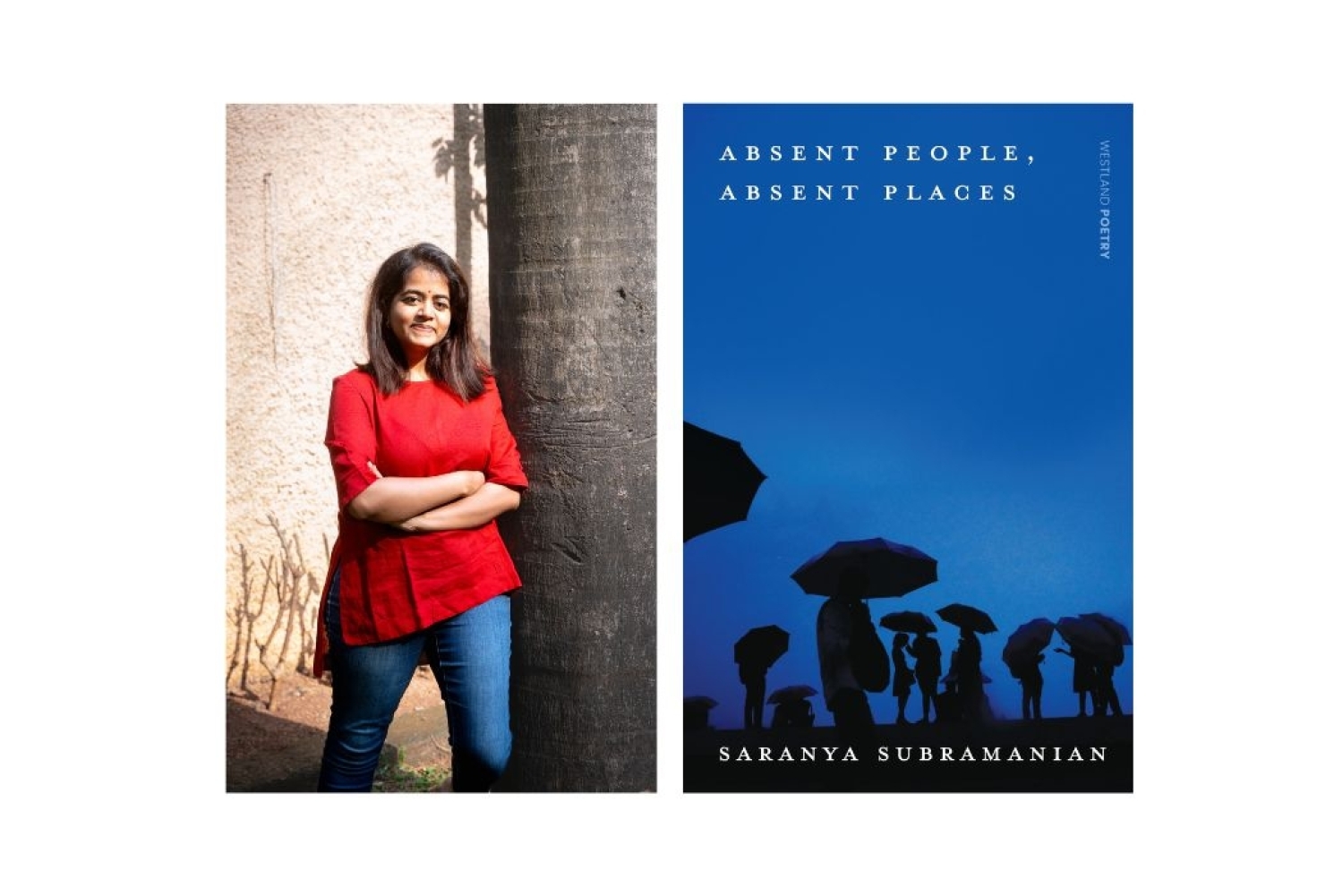
In her debut poetry collection Absent People, Absent Places, Saranya Subramanian writes poems that chronicle people and places she has encountered, acknowledging them as full beings and asserting presence against absence. Written over the past few years, the collection observes absence, fighting absence, finding presence, to presence, which reflects in the skeleton of these poems. From Bombay, where no poet and no place exists in isolation, her work locates the self in time and place, drawing from characters, voices and the city’s literary past. As she says, being in the present is one of the biggest challenges in the new age, but also the most powerful weapon against absence.
The Power of Acknowledging Presence
I wrote a lot of poems between the years of 2020 and 2023 which made their way into this book. I noticed that I was writing a lot of poems, almost chronicling people and places that I had encountered or visited or engaged with in some sort of way. In actually acknowledging them as full beings, or as places that are the products of historical violence, or the products of capital and industry, or the people who make them up who are so easily erased and forgotten, I felt like what I was doing was reminding myself of what makes up people and places.
In doing so, it was kind of antithetical to this idea of being absent, or eroding the self, eroding histories, erasing so many lives, that were becoming really common between the years of 2020 and 2023, both because of the pandemic, and also politically, personally. That is what I looked at presence as. It felt like something that needed to be done, but also something where the simple act of assertion, the simple act of acknowledging what things are like, felt like a really powerful weapon against absence.
Tamil Side-by-Side
I was writing these poems when I was doing my MFA in San Francisco and I was very lucky to be part of a programme that was actually very diverse and accepting of different languages, worlds and belief systems, because that is not something you find in a lot of traditional American MFA programmes. But what I did find was that there was very limited knowledge of literature outside of the United States, which is really unfortunate and tragic. I felt like me and so many international students were hyper aware of world literature. We had not only read our own, but read American, South American, European, Latin American, African, South African and Southeast Asian writers. It just felt like our world was a lot more opened up.
I have very many problems with italicising words that are not in English, with giving footnotes, or giving an asterisk and then explaining it at the bottom. First of all, a poem on a page has to be experienced. It is a two way process. I was also learning my own mother tongue, Tamil, and it is very sad that I had to learn it in the first place. But I do feel like in the time in which I am writing, English is an Indian language, however many people find that controversial. I really think it is, and I think we are delusional if we deny that.
I really wanted to just have all the languages together. At a personal level it is just the way I think and the way that most Indians think. We do not think in one language ever. I am from Bombay, so it is very natural to have words from Hindi, Marathi and Urdu seep into my thoughts and my language, as well as Tamil.
Characters and Inspiration
A lot of the poems in this book came from characters and voices around me, and I felt like those had to make their way into the poems. The poem I'm in an Uber at Two in the Morning and These Are Some Things My Cabbie Tells Me is a very gendered poem because I am a woman in a taxi at two o’clock in the morning and here is a taxi driver, obviously a man, telling me so many things. You may disagree with a lot of it, but you are also in a taxi at two o’clock in the morning so you just become this hearing piece. You let the man talk and you just want to get home safe. Even though you might have things to say, you kind of keep yourself silent.
Another poem is Meenakshi Paati, which comes after Thatha Teaches Me Tamil. She was my Thatha’s paati. She barely studied after the fourth standard, and for her to say something so profound like ‘Pengal udaiya kai thaan nerupada’, which means ‘female hands are themselves are fire’, I thought that deserved its own place on a page. So yes, a lot of voices from different characters have come into these poems.
Writing Bombay
When I was writing these poems, and also when I was running the Bombay Poetry Crawl, as it was gaining momentum I started to realise that I began conflating the self with the place around me. It was no longer that I exist internally and externally there is this city or this world around me. It started to bleed into each other.
That is what I started to write a lot. I start with the I, but I immediately have to locate the I in a time and a place, and that place so often becomes the city of Bombay. Also because of the work I do with the Bombay Poetry Crawl, which is chronically archiving the 20th century poets of Marathi, Urdu and English, and hopefully more languages soon, I started to realise that you cannot look at anything in isolation.
My undergraduate thesis was on Arun Kolatkar, but reading him made me read his contemporaries like Adil Jussawalla, Arvind Krishna Mehrotra and Dilip Chitre. Reading Dilip Chitre made me read the people he translated, including Namdeo Dhasal who was part of the Dalit Panthers, which made me read J.V. Pawar and Arjun Dangle. Namdeo Dhasal’s wife Malika Amar Sheikh was the daughter of Shahir Amar Sheikh, an incredible Lokshahir who was comrades with Anna Bhau Sathe. This led to a legacy of Lokshahirs and traditional Marathi folk forms like Pawara and Lavani becoming prominent in the city of Bombay.
All of these crisscross connections make you realise that no poet and no place exists in isolation. They are all part of some sort of ecosystem. They might not be directly in communication with each other, but they are part of something larger. That is what I started to find solace in with my own writing. I do not exist in isolation. I am very connected to the city. In researching the city’s literary past, I realised that it was very consoling because for the first time I had a poetic vocabulary that felt like it was mine.
Words Neeraja Srinivasan
Date 23.3.2026