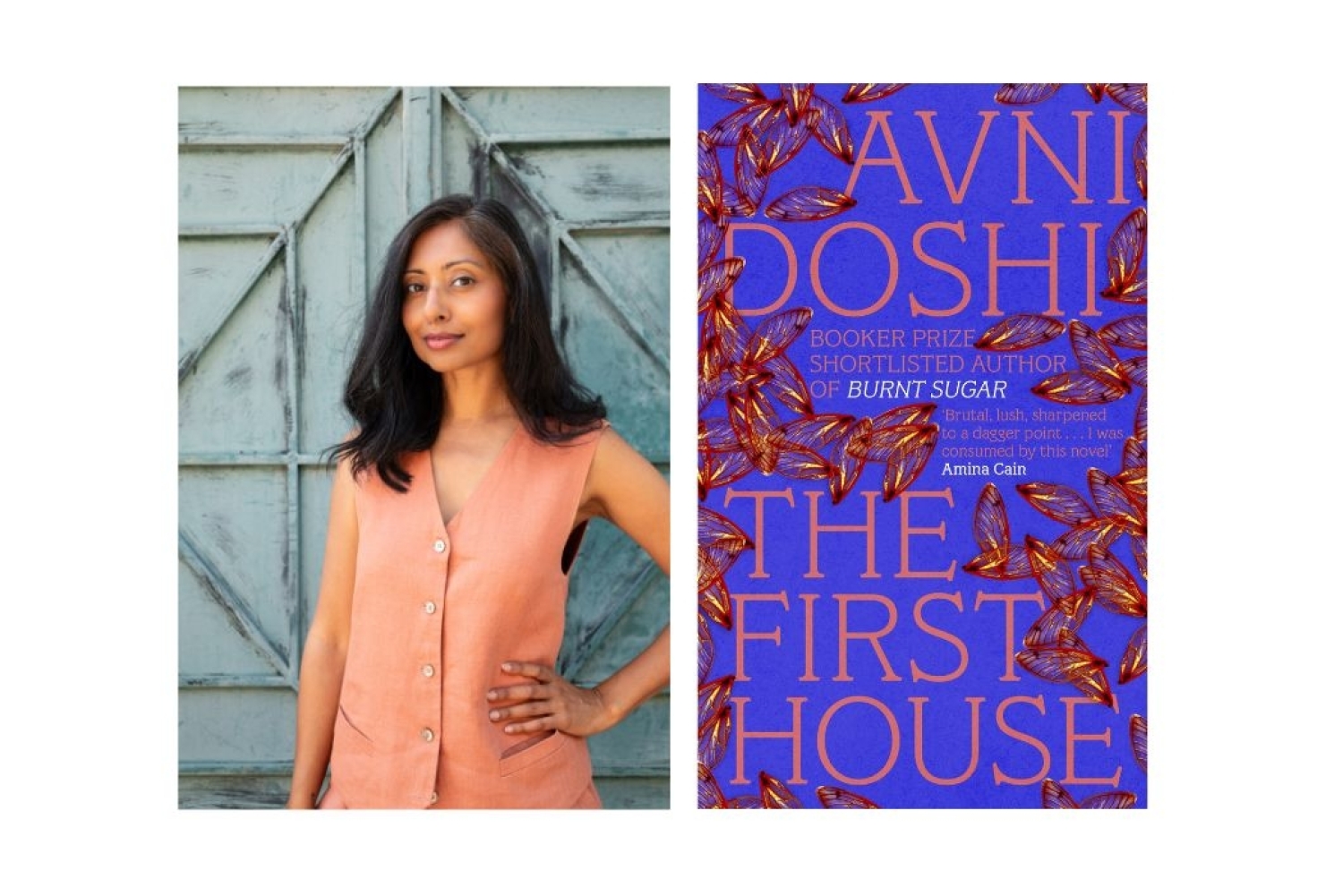
Photo by Aranka Israni
Photo by Aranka Israni
With The First House, Avni Doshi returns to the charged terrain of intimacy, rupture and self-reckoning that marked her acclaimed novel Burnt Sugar. If those books traced collisions between mother and daughter, this new work situates itself at a moment of change or a moment of realisation, the kind of shift that, she notes, centres many of her favourite novels. ‘It can be a subtle shift or a major one, a character entering, or a death.’ Here, the story unfolds around a psychic rupture, where rationality and a scientific way of seeing begins to fail, and the protagonist starts looking for patterns and meaning within the chaos.
Avni has long been drawn to domestic spaces and the intensity of private relationships. The domestic sphere, often dismissed as private and apolitical, is for her where ‘we birth and bring up citizens.’ In The First House, that intimacy becomes a lens through which she explores what it is to know, and to not know. She asks the question of whether a part of the way we love people is by not knowing certain things about them, because to know too much would make the way we live impossible.
Written during what she describes as a midlife moment, the novel emerged alongside personal transition. Living in Dubai, working at home and during a residency at the Alserkal Arts Foundation, she wrote and rewrote the book while wondering whether it was a death or something new being born. That tension between loss and renewal echoes through the story itself. Avni is interested in stories where it’s not tidy at the end, where maybe something is gained, but something irretrievable is lost. Even with rebirth, she reminds us, ‘there’s grief for what has been left behind.’
The theme of rupture runs through your writing. What drew you to moments where life splits and made you want to situate the story there?
I didn’t think of it so consciously in terms of that parallel. I guess I see the way a novel, and a lot of my favourite novels, follow a character at a moment of change or a moment of realisation. It can be a subtle shift or a major one, a character entering, a death. A lot of my favourite novels centre around a shift.
In Burnt Sugar it was the mother and daughter having these collisions throughout the narrator’s life. Here, it’s slightly different. I was really struck by Javier Marías in A Heart So White, where he talks about knowing and not knowing, and how we force ourselves to not know things so that we can function in the world and relate to our loved ones. This idea of not knowing has really stayed with me. Is it possible that part of the way we love people is by not knowing certain things about them? Because to know too much would make the way we live impossible.
How do you approach writing familial and intimate relationships?
I think I only know how to write about deep intimacy. I’ve never tried to write a casual encounter. I’m very drawn to the intensity of intimate relationships and to domestic spaces. We’re trained to believe that domestic spheres and relationships are not as important, that they are private and not connected to wider discourse. But actually, domestic spaces are where we birth and bring up citizens. The private is deeply political. I think I bring that into the writing of intimate relationships. It becomes like a battlefield in a way.
Our most intimate relations see the 360 degree multi-dimensionality of who we are. For me, it’s the perfect place to understand all sides and facets of a character that you wouldn’t necessarily get in a persona driven interaction.
How do you navigate writing complex female characters without falling into tropes?
Amina Cain wrote a novel called Indelicacy, a book I love. I love the character she wrote. She’s complex and completely unapologetic. She doesn’t feel the need to explain herself. I don’t really navigate this space consciously. I just know women really well.
For me, there’s just a character that’s fully realised and three dimensional. If I can feel that this character is living and breathing, then there’s no thought of a trope. I wait for the character to start doing things that are surprising to me on the page. Then I know there’s an autonomous force at work in the novel.
The book blurs lines between magic, realism, myth and metaphor. What drew you to write it that way?
I don’t know if I would place this story in magical realism. I’m a huge fan of it. I’m a huge fan of Marquez, and he’s always in the back of my mind. I was interested in following the line of the character’s experience and being true to her reality. When you reach a point of psychic rupture, rationality and a scientific way of seeing begins to fail. You start looking for patterns and meaning. She [the protagonist], begins to consider astrology, mythology, life cycles, rhythms of nature. It becomes almost deafening, like an orchestra. It becomes the lens through which she views the world. It wasn’t about consciously moving into the magical. It was about the character’s perspective.
Where were you, mentally and physically, while writing this book?
I was reaching a kind of midlife moment. As a parent, you start to feel your time has come and gone and now it’s about your children. There was a sense of a period in my life coming to an end. I was considering whether this was a death or something new being born. I live in Dubai, so I was primarily at home there. I had a residency at the Alserkal Art Foundation, which gave me an office space to work, which was unbelievably valuable with two small children. The major rewrite happened over the summer in the U.S. while staying with my parents.
When was the last time you felt creatively inspired?
I feel maybe that I’m entering the most creative period of my life. Not because I’m making the greatest work, but because I feel moved and inspired by almost everything. Watching my children make art inspired me to take drawing classes, pottery classes. I feel creatively free. A lot of fear has dissipated. I started looking at artwork my paternal grandmother made. She used to draw geometric shapes every day, thousands of them. Something about that landed in me. I feel compelled to find every means of expression. My creative work used to feel like discipline, but now it feels like devotion. There’s more play, more lightness. A lot of what I imagined was serious has fallen away.
Has motherhood changed your creative process?
Ten years ago I would have said two hours is useless for me. Now I can do things in two hours. I’m much more focused. I’m clearer about what kind of art I want to make. I care a lot less what other people think. I used to be very affected by feeling blocked. Now, there’s no block. I can just sit down and write. If it’s bad, I throw it away. But I write anyway.
After Burnt Sugar I stopped writing because I felt I had to finish promotion, and everything else to do with it before starting something new. Now I see that was fear. I want to keep writing, without being held down by perfectionism. I would like to have more of a beginner’s mind.
What do you hope readers take away from this book?
Maybe something about the animacy of the world we live in. The way our environment is constantly speaking to us. The way the world answers the questions we have. I’d be interested to see what comes up for people in terms of noticing patterns in their own lives. How relationships repeat. Where in their lives they are resolved to not know something. When we push knowledge away, it comes knocking at the door.
I’m also interested in stories where it’s not tidy at the end. Maybe something is gained, but something irretrievable is lost. Even with rebirth, there’s grief for what has been left behind. Being an adult means closing certain doors. Midlife is one of those great narrowings. There’s power in the choices you make, but also grief for the dreams that will never be.
This is an interview from our May 2026 Bookazine, on stands now. For more such stories, grab a copy here.
Words Neeraja Srinivasan
Date 25.7.2026