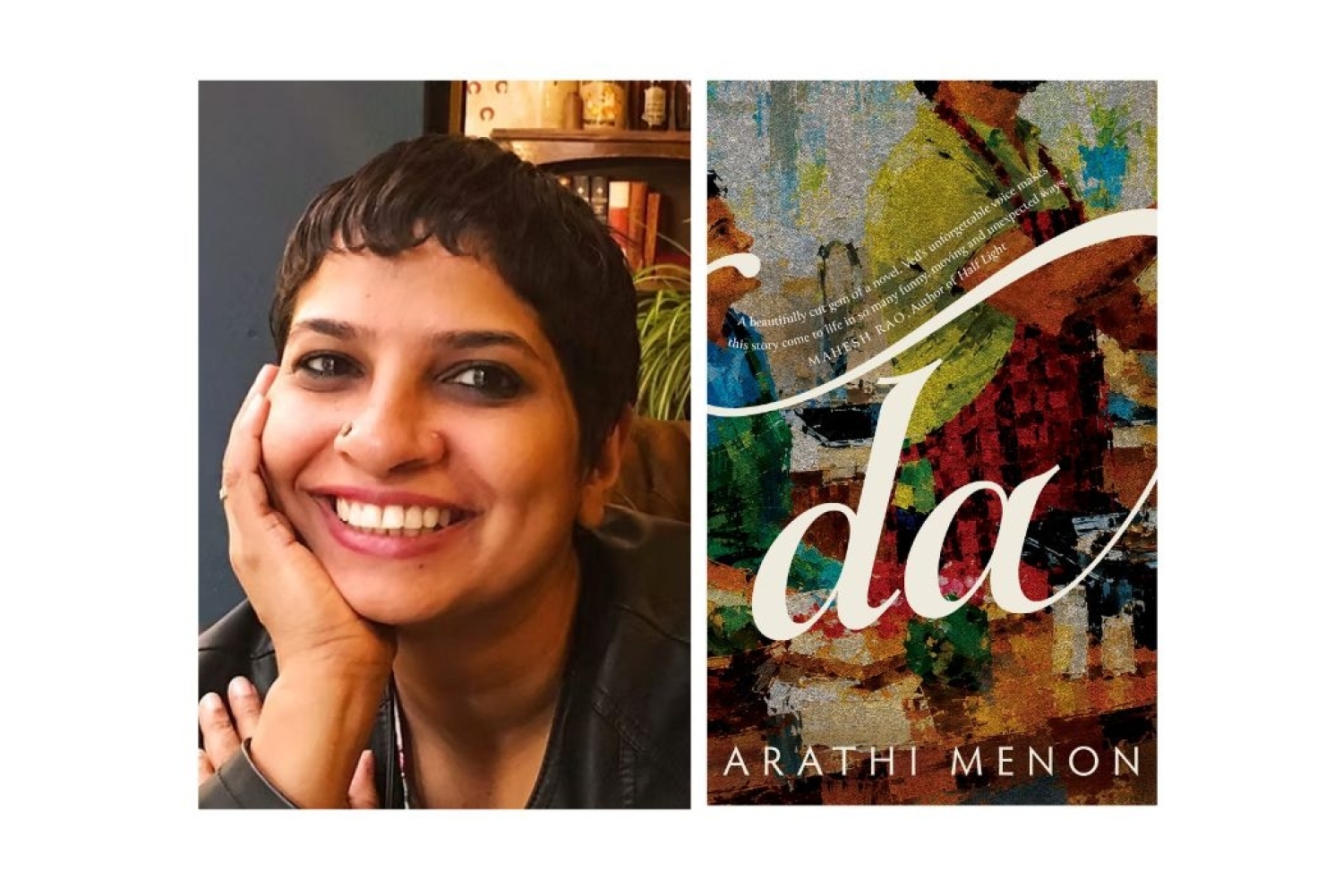
Centred on thirteen-year-old Ved and his adoptive father, Da by Arathi Menon unfolds against the backdrop of the tensions of Section 377. Written over five years and across several drafts, the narrative emerged after Arathi discovered that the story had to be told from the perspective of the son, Ved, placing the child at the centre. It gradually transformed into something broader: a novel about family, tenderness and the ways love persists in the face of prejudice.
Refusing easy labels, Arathi describes it simply as ‘a story about the love between a father and a son,’ one that happens to unfold within a deeply political moment in contemporary India. In this conversation, Arathi reflects on the long journey leading up to Da, finding Ved's distinctive voice after multiple drafts, researching the perspective of a teenage boy, drawing from the lived realities of queer people around her, and why she believes the novel is, above all else, simply a story about love.
What was your early relationship with writing and how did this story find you?
I think like a lot of people I've always wanted to be an author. And, you know, but you come from a middle class family. So they ask you to do it as a hobby. You can write it on the side, but get a job, get a master's, that sort of thing. I was always writing, but I wrote seriously, around 10 years ago, when I went through a divorce. And then I was looking for a book which speaks to someone like me, an urban Indian cosmopolitan. I had just gone through a divorce and I couldn't find anything in the Indian context. So, I wrote a book called Leaving Home with Half a Fridge, which Pan Macmillan picked up and published. It was a memoir and I wrote for someone like me, and I still get emails about it.
And then I was looking at writing seriously, I was writing every day. I got an opportunity to do a course at the University of East Anglia; where I did my master's in prose fiction. I was working on this ‘literary debut’, like they say, and the idea of Da was there. It took me almost five years to write it. Because Da and Ved came to me like a vision out of a mist. I knew exactly what their characters were.
But when I began writing it, it was quite hard. I did four drafts, I wrote it in third person. And it didn't work. I tried writing it from Da's viewpoint, which was like one sinkhole, really dark and depressing, and I'm not a gay man. Then I tried one where I alternated narratives, one chapter Da, one chapter Ved. And as Ved's voice developed, I was thinking this is it. Finally, in my fourth draft, I got Ved's voice. And I knew this was right. I think that happens sometimes to writers, you get obsessed with an idea, and you can't let it go.
Between all this, I published one little children's book, which was fun to write through all this darkness. After Da was written, I sent it out to a lot of literary agents. I was in the UK then. And they all said no, they all said we love the writing, but the story doesn't feel relevant. They said send us your next book. So, lots and lots and lots of rejection. And then there was this publisher in the UK called Fly on the Wall Press, an indie publisher. They're a political publisher, a publisher with a conscience. I thought to myself, oh, maybe they may like this. And I sent it to Isabelle Kenyon, who is my publisher, and she loved the book.
Isabelle had a contact in Pan Macmillan India; she sent them the book, and they loved it. And they said, we are ready to welcome Aarathi back into the Pan family. And I was like, oh, yay!
That's amazing. What was your process of writing a novel centered around a child and his perspective?
It was very, very hard, because I mean, I was 13 many, many moons ago, and I'm not a little boy. I did a lot of research, reams and reams of research, not just on the political context, but also on narratives of 13-year-old boys and things like that. Like two books I definitely referenced, This Boy's Life by Tobias Wolf and the other was Catcher in the Rye, where Ved is the polar opposite of Holden.
And the other thing was politically, I had so much information, but I couldn't use any of it, because he's a 13-year-old boy, and it's his viewpoint. But it formed a sort of bedrock. And then the best part, when I look back on a 13-year-old boy's voice, it allowed me to be experimental. It allowed me to bring in so many facets of his life. He's not just obsessed with his dad's sexuality, he's obsessed about his own sexuality, about food, about masturbation. There are lots and lots of little things I could bring in, which I feel helped the story breathe a bit. It brought lightness and brought in humour, which was very important.
It also took away adult preachy-ness, which, in Da's narrative, would creep in, and then I would take it out, and it would creep in again, because I think adults are more judgy that way.
How did the father-son relationship develop?
I think I'll have to go back a little bit on it, because when I was growing up, Section 377 was still at play. And we'd go on marches saying repeal Section 377 and we're all from these ordinary families who've never been into police lockups and things like that. It was quite scary to be on the edges of the law. And also, personally, I had two male friends, who really suffered at the hands of the law because when you look at societal prejudice and state oppression, it's a really hard thing to fight against. And we lost one of them and the other one still struggles to this day.
I saw this pain, and I couldn't do anything with it. I mean, I still can't do anything with it. But if they read what I wrote about that pain, maybe they’ll know I saw that. And so I was quite clear that I wanted a male perspective.
I wanted to also situate the story in our family structure because when you speak to LGBT+ people, a lot of them are rejected by family. It's almost always the first betrayal. And then you have to go out, find chosen families. I wanted to bring out that ordinary love between a father and a son. I had a fantastic father, so I could tap into that sort of unconditional love. It is an extraordinary relationship. But the love in itself is quite pure. It's quite simple. It's what a parent has for a child, or a child has for a parent in this instance.
“For me, stories have opened my mind, brought in perspectives I would never have imagined. It has taken me to places I've never been. ”
Could you tell us about the choice of setting the book in 2013, before the decriminalisation of Section 377?
There were two reasons I did that. One is that I wanted the story to feel very now, to have that urgency to take a reader along that journey of prejudice, pain, love, the resilience of folk, that sort of thing. And the other reason is, though now Section 377 has been repealed, prejudice hasn't been repealed and people's closed viewpoints haven't been repealed. Like in 2023, someone put in a petition in the Supreme Court to legalise same sex marriage. If you look at the chatter around it on social media, in certain online forums, etc., it's exactly the same kind of prejudice. And so I feel the story even today is so, so real.
Was there a narrative gap that you were trying to fill with this kind of story? Or what do you hope this story brings to the space of queer literature, even globally?
I think it's an interesting question. But the thing is, I didn't think of it as queer literature when I wrote it. I just thought of it as a story. And, you know, I am not queer, I'm not a gay man, but I can speak about a little boy's journey. When I wrote the story, I wrote it as a story without thinking of any other labels and tags. And the thing is, I'm a lifelong reader. For me, stories have opened my mind, brought in perspectives I would never have imagined. It has taken me to places I've never been. And I think that's what it is, you know. It is just a simple story about the love between a father and a son. And it is situated in a very political context.
I do think it's important to have more stories on queer literature and things like that, different perspectives, because I've been getting so much feedback on that. The head teacher of a school wrote to me saying that she loved it, and that homosexuality is something we all pretend we know, and then cover it with a carpet. But this really opened her eyes to what is happening, the pain. And it was something she had never even thought of addressing. Or even my mother, for example. She read it, and she was very quiet. She loved it. Then two days later, she tells me, ‘They didn't do anything wrong, right? They just loved who they wanted to.’ And I knew she had never even thought of something like that. It's opening those kinds of doors.
I'm also getting a lot of messages, emails from the queer community. There was a person who was transitioning male to female, and they wrote to me saying that, ‘I was a son a long time ago. And, you know, I feel seen and thank you for that.’ Sonal is such a minor character. To think that someone saw that and it helped them feel validated in a certain sense, that yes, this was my pain and someone knew how tough it was. Those things are amazing.
What's the future looking like?
I'm working on a book about a dysfunctional couple and love. It's about questioning heteronormative relationships, that sort of thing. Hopefully it won't take me five years to write. I'm also working on another children's book.
I write every day. I have a full time job. So I have to write around the margins of work. And I'm quite committed to it since it is something I know I'll do my whole life. And hopefully there'll be more books and more readers, so that's like a non-negotiable in my life.
Words Neeraja Srinivasan
Date 27.7.2026