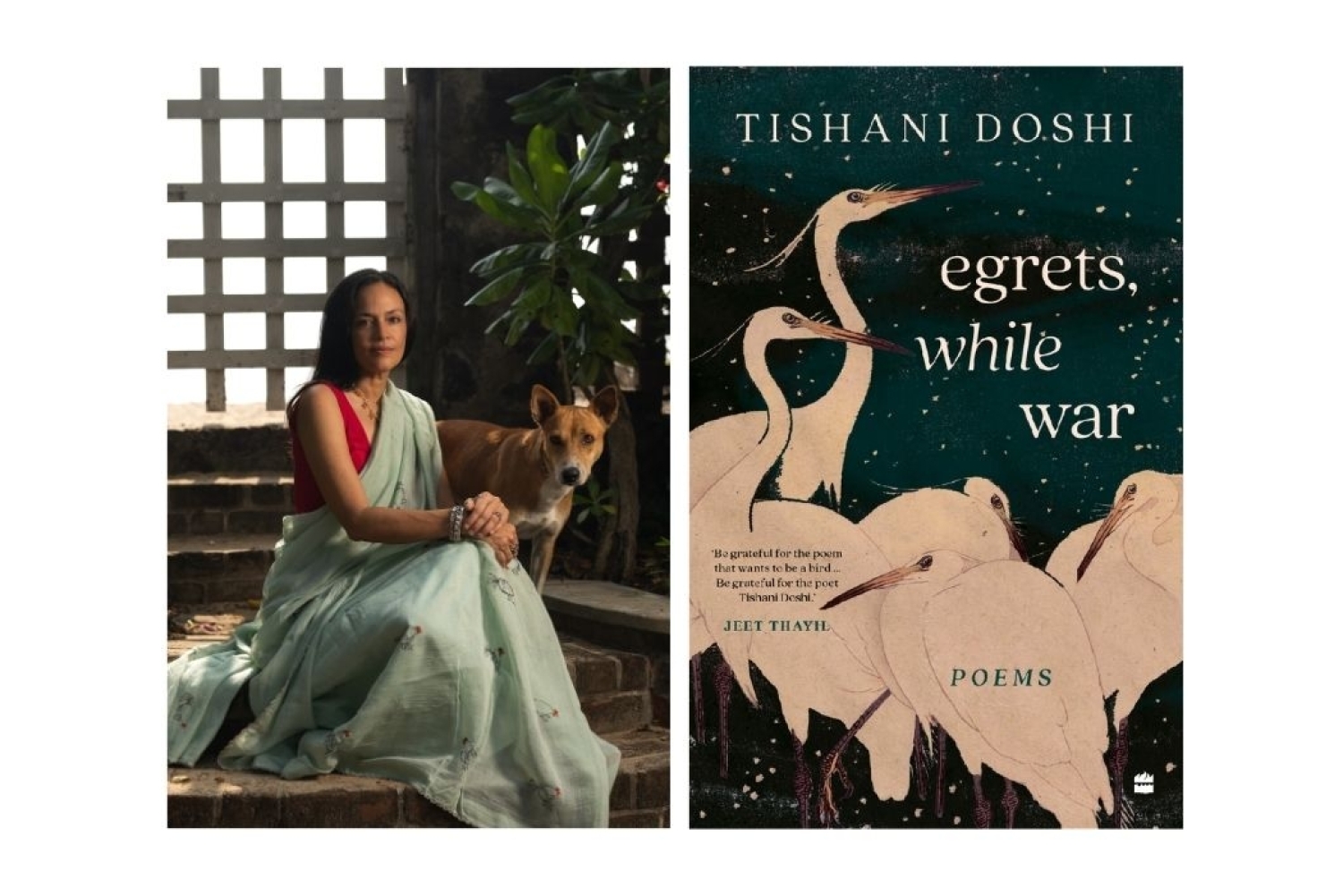
The first time I encountered Tishani Doshi’s work was at the Hindu Lit For Life Festival in Chennai, my hometown, when I was around fifteen. I attended her session with my grandmother and was immediately charmed by the grace of her speech and her easy command of language. Afterwards, I stood in line to get Tishani’s autograph, desperate to hold on to a small piece of that encounter. Although too young to fully make sense of her words, I cherished the way she articulated her sentences on stage, the precision of her thought, and the lightness of perspective she brought to the room. Now, eight years later, at twenty-three, Tishani’s poems bring the same lightness to my being. Reading her work as an adult, I often return to that memory. What I could only intuit then, I can appreciate more fully now; few writers have accompanied such different stages of my life with equal grace.
Egrets, While War, her newest poetry collection, unfurled and swept me along immediately. These poems are dotted with themes of environmental loss, ancestral memory and the human cost of conflict, and were written during the pandemic, after which most of us went in search of much-needed hope and optimism. We were, however, plunged into more violence, destruction, death and even the possibility of another World War. In that vein, through these poems, Tishani asks, ‘What does it mean to be alive, to love, to go through griefs while wars continue to rage?’
What is the significance of the egret, or of birds in general, in your poems? What do they signify and what inspired them? Tell us about this creative choice.
It was not so much a choice to include birds in this collection but that they began to slowly populate the poems. At first, it was the birds I was seeing around me, in the garden, in the streets: orioles, kingfishers, peacocks, pigeons, egrets, crows. Then there were the birds I could not see, but I could hear: koels, the brainfever bird, birds that had vanished because of human doing; the dodo, the passenger pigeon. Literary birds, like the krauncha from the Ramayana, the chatak, who subsists only on raindrops, the albatross from the Ancient Mariner... Birds connect worlds: sky to earth, deep time to our time, and watching the egrets in my garden [which forms the title poem], I saw how they are descendants of dinosaurs, and it was this stunning moment of being connected to deep time, the ancient past. Lyric poetry deals very much with the realm of time, the transcending of it, the stilling of it, and birds are perfect vehicles of this.
Can you take me behind the scenes of your poems? How do they start and eventually come to life?
Most of my poems begin in images. There’s an abiding image, which works as a trigger for the poem. It’s hard to know when that image gets embedded in the body or consciousness; sometimes it feels immediate, other times it surfaces much later and the poem seems to come from there. Sometimes the image is something observed in nature, in the street, or a reflection. Sometimes, an image from the newspapers. I’m particularly interested in how we give power to images in this moment when we are saturated with images so as to be almost desensitised by them, and how poetry functions as a way to do this.
“Ultimately, constructing language in a particular way is also a way of positioning the self in the world. Sometimes you are at a distance from the world, sometimes you are close, balances change, but the voice is something that remains yours and is carried along across time. ”
There is also the repeated motif of war in this collection, which is more a reality than simply a motif these days. What did it mean for you to juxtapose these poems against the possibility of war?
I began writing these poems soon after COVID when I think most people were hoping to re-enter the world in a more optimistic way. And instead, we are now plunged into one conflict after another. Russia/Ukraine, Israel/Gaza, civil war in Sudan, Iran… essentially, we have been living in a time of war ever since the pandemic lifted and as a writer it feels natural to write about the times we are going through, and so it’s not a motif so much as a reality. Ordinary life goes on alongside war. What does it mean to be alive, to love, to go through grief while wars continue to rage?
I also wanted to ask about the presence of environmental loss. Did you turn to any other nature/environment writers’ work as you worked on these poems?
I’ve been reading many environmental texts for some years now as I’ve been teaching a course called ecopoetics at NYU Abu Dhabi, where I am a visiting professor. One of the great inspirations for me are the Tamil Sangam poets, who organized their landscape into five thinnais two thousand years ago, and wrote the most luminous love poems which seem to spring directly from the land. The connecting of our inner emotional zones to the outer ecological zones is something the Sangam poets understood, and so I’ve been reading not just translations of these poems, but the scholarship around this, alongside many texts about walking. I’m an avid walker and for me, walking is part of the process of writing a poem. The body keeps a kind of beat when walking, which is very beneficial for the birthing of a poem.
When you read some of your earlier poems in contrast to more recent ones, what is one thing about your writing that has fundamentally changed and what has remained the same?
I’m still fundamentally interested in what language can do sonically to create power and meaning. How words can connect inner and outer worlds. Ultimately, constructing language in a particular way is also a way of positioning the self in the world. Sometimes you are at a distance from the world, sometimes you are close, balances change, but the voice is something that remains yours and is carried along across time.
Where were you as you wrote this collection, both mentally and physically?
Everywhere, nowhere, somewhere.
What keeps you grounded when you step away from writing? What does an ordinary day in your life look like?
The perfect days for me are always in my home with my dogs on the beach, my husband working in his room down the hall from mine, no commitments or concerns, except what to cook for dinner. The wonderful luxury of staying still, and knowing you have day upon day to return to whatever this thing is you are making with words.
What are you working on currently and what’s next?
I’m working on a few performance pieces, one is a collaboration with the artist Olivia Fraser. There’s also a film-for-performance/spoken word piece, Egrets, While War, I’ve created which is a companion piece for the book. I’ve also got non-fiction ideas, but that’s for when I’m staying still again.
This is an excerpt from the July EZ. For more such stories, read the EZ here.
Words Neeraja Srinivasan
Date 16.7.2026