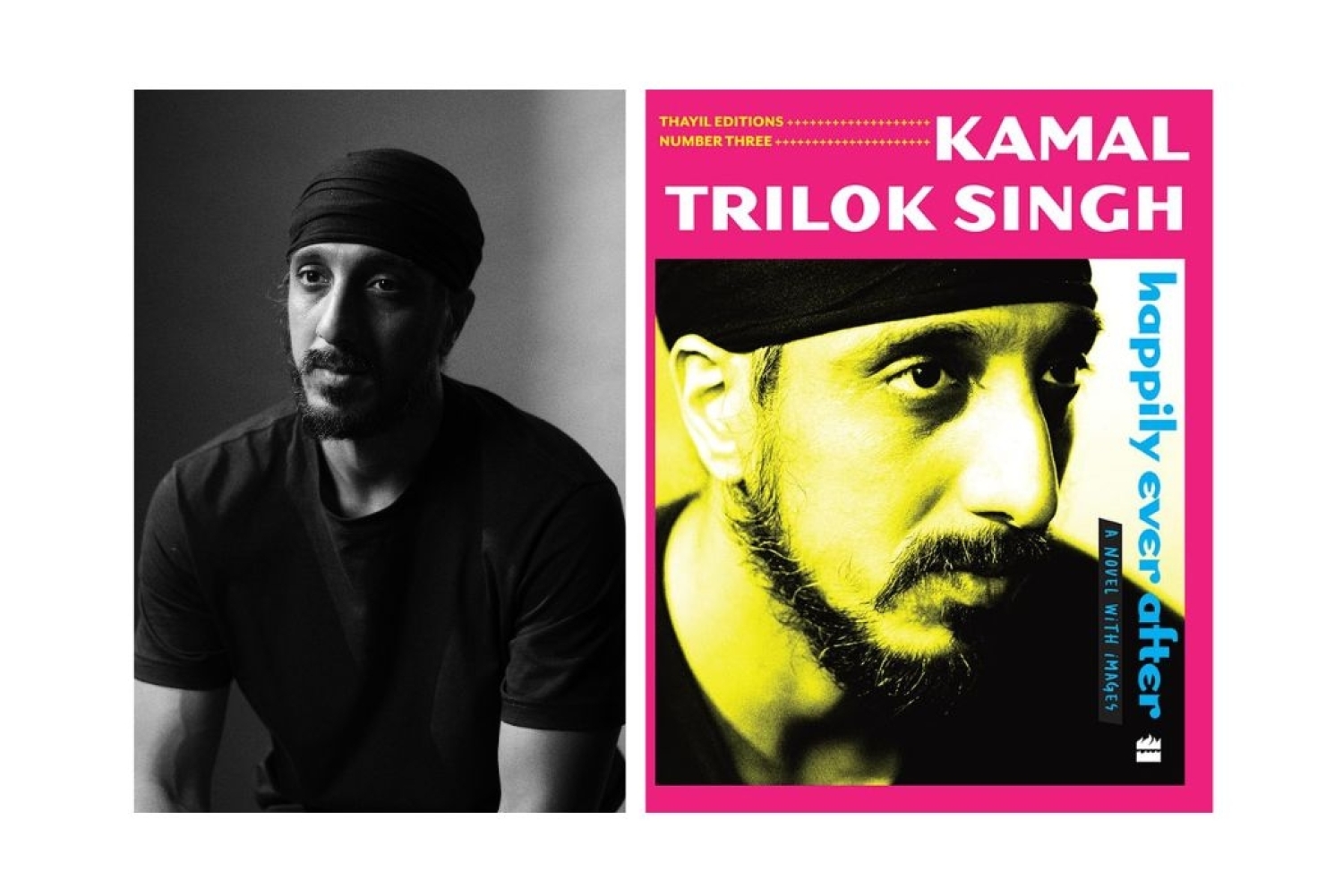
Photo by Vishesh Anand [Studio in Grey]
Photo by Vishesh Anand [Studio in Grey]
For about two decades, writing remained the one constant in Kamal Trilok Singh’s life. Before his debut book, happily ever after: A Novel with Images, introduced him to readers as a fiction writer, he was known for his sharp, satirical voice in stand-up comedy. But beneath the performances, the jokes and the observations, there was always the act of writing, a way to ‘make sense, metabolise the feeling-too-much side of myself, which is pretty much the only side I have’. And this deep-rooted relationship with writing eventually carried into fiction.
The third and latest title in Jeet Thayil’s curated Thayil Editions series, happily ever after enters the complicated interiors of a marriage through the voice of an unnamed woman reflecting on love, violence, tenderness, and everything that exists between them. The novella is a departure from typical ideas of romance and resolution and is written as a restless stream of memory and emotion. The book also carries the visual language of the Thayil Editions, weaving Kamal’s photographs into its pages.
In my conversation with him, Kamal speaks about the unexpected origins of the novel, finding his narrator through a chance encounter, writing through instinct rather than structure, and why love, much like life, is rarely as simple as a happily ever after.
You've worked in stand-up comedy and now, fiction. What has your relationship with writing been like, and how did your first novel find its way to you?
Stand-up was me trying to fill a void that's existed forever. It was a way to be seen, acknowledged. Just something that allowed me an outlet. But like a lot of things from my past, I have a tendency to sabotage my own progress, and I did that with stand-up too. So, that was that. But through all of it though, nearly two decades now, writing was always the one constant. It's the thing that stayed. So my relationship with writing is one of survival. I drift into really dark places when I am not writing. It's the thing that roots me, and let’s not have it wrong, it's not a purpose, or meaning, or anything profound like that. It's just how I make sense, metabolise the feeling-too-much side of myself, which is pretty much the only side I have. What runs in my head, what keeps me up, what troubles me, the answer to what now every morning, that's writing. The act of it. The doing of it. That's my relationship with it. Not the identity of it.
I am not a writer. I am a fella who happens to write. That's it. As for how the book found me. I'd been working on a novel for about a decade. So one Friday I spoke to my ex-boss, Neale Murray. I told him, I know you're friends with a few writers, and I want you to introduce me to them. Now… I thought he'd speak to someone over the weekend, and then get back to me. Instead he picked up the phone right there, and called Jeet Thayil, and handed it to me. Said, here, talk to him, tell him whatever it is you want. So I spoke to Jeet that Friday evening. He asked for a few pages. I remember sitting at a cafe that evening, going through the first chapter, and I emailed it to him. Monday morning Jeet called. We met the same evening, and that was how it started. Then it continued. Jeet and his friend Anil Kably were organising a lit festival in Mumbai that same year, and they put me on the line-up. And then Jeet asked me to write a novel for his imprint, a new one, separate from what I'd been working on. That became happily ever after. So I guess nearly two decades of writing, and then a run of sheer dumb luck and knowing the right people at the right time is how the book happened.
The prose is intensely interior. The narrator metabolises the world she describes. Did you begin with these images, or did they emerge as you wrote the emotional state of the character?
I had nothing to begin with. Like I said, I was asked to write this, and I missed my first three-month deadline. I didn't have a single word.
The day I was supposed to submit the novel, I told Jeet I hadn't been able to write at all, and that I was sorry if I was putting him in a bind. To my surprise he gave me another three months, said, write something now. Luckily that same day was also my last day at my job, which I'd quit to be able to write more. So here I was, with an opportunity and nothing to write.
Then one evening at Carter Road, I saw a girl in a car, crying hysterically, howling, and she stuck with me. I was like, who is she, where is she coming from, what has happened to her. That was in essence the beginning of the book. In fact the very first draft doesn't begin at the bar, it begins with the drive. In later versions the drive moved to the middle of the novella.
So I had no images, no idea, and honestly I never have a structure, or a clue as to where I am going. Not even an ending. I just let the character drive it all. That's how this one worked too. It was just the unnamed narrator, and the night, step by step, moment by moment. All I knew by the middle of the draft was that there'd be a rebellious end. Like she leaves, or whatever. But as I kept writing I realised it was me, the fella writing, trying to force that exit. The narrator, in the honesty of her voice, in the way she was coming out of me, wasn't going to leave. A part of her wanted to. She did. But she wasn't going to.
In the end I stuck with what she wanted, and what naturally flowed out of me. I could have, maybe should have, forced an exit out of it. It's perhaps better for the both of them. But I didn't.
This is also a novel with images. What role does ‘the visual’ play for your text?
The images came later. Way later. In fact when Jeet asked me to do some images, I wasn't really up for it. I felt it'd dilute the text somehow. But I am glad he pushed, and that I clicked some, and that they're a part of it. And I am glad I didn't choose to photograph a bar, or the drive. I think it's the ordinariness of the images. The almost domestic quality to them. That's why I've started to not hate them. It'd be dishonest of me to imply anything more, as to what role the visual plays in my text. It was never planned. I am not a very visual person. It just happened.
At its heart, the book is about the emotional architecture of a marriage. How do you want to represent love and marriage differently through this novel?
Love and marriage are such inherently subjective relationships, and equally dynamic. And like I mentioned, I never really have any idea where I am going with a story. It's just the character that drives everything. In this case, now when I look back at the book from some distance, I feel the way these two individuals are, in happily ever after, they're almost bound to suffer. Whether they're together or not. It's really the architecture of their personalities. And maybe wanting to be witnessed, just that much, is enough for them.
Another thing that lingered with me was that they weren't dishonest with each other. But it just feels like even their honesty wasn't enough. And that shatters this whole idea of honesty as a guarantee for a happy relationship. I think if you're not equipped to handle the interiorities of your partner, you're going to have a tough time navigating love and marriage. And if both individuals happen to be immensely interior people, the feel-too-much kind, I think it can get doubly difficult. Because it can start to feel like a weight very quickly.
happily ever after is a part of Jeet Thayil's curated Thayil Editions. What did that mean to you, especially as a debut author?
I've always liked Jeet's writing. I remember reading Narcopolis and being blown to bits by it. It was the first time I felt like an Indian writer was saying, I am going to take risks. It reminded me so much of (William) Burroughs. And then the first time we met, I remember talking to him at length about (Yukio) Mishima. Finding so much in common, because we both loved him so much.
So a debut on his imprint was just perfect. And not just because it's him. It's the freedom he extended in terms of the content. The risks he's ready to take. His unrelenting belief in standing by what I wrote. And of course, as a debut on Jeet's imprint, you're taken more seriously. It's like Jeet saying, Here, I present this to you. Read it. It’s worth your time. That just matters.
What is the main feeling or message you want readers to walk away with as they turn their last page?
That life will always be messy. So will love. So will marriage. That if you have someone who can hold your mess and still be present, count yourself lucky. Love is not a constant. People make mistakes. Let them. Eventually we'll all be dead, and none of this will matter one bit. So take what you get.
Where do you see your writing going next in your career?
I write every day. Without fail. Beyond that, I don't know where I am going next. And I've made a sort of peace with that.
Words Nidhi Soni
Date 22.7.2026