Since I was young, my relatives who live in the mountains, specifically in the Western Ghats that cradle Kotagiri in Tamil Nadu, made it abundantly clear to me that mountain life is fundamentally different from life on the mainland. In the mountains, there is no choice but to live in constant conversation with nature, to become friends with rivers, trees, flowers, and hills. It is a way of life that demands an immense capacity for empathy towards the landscape itself.
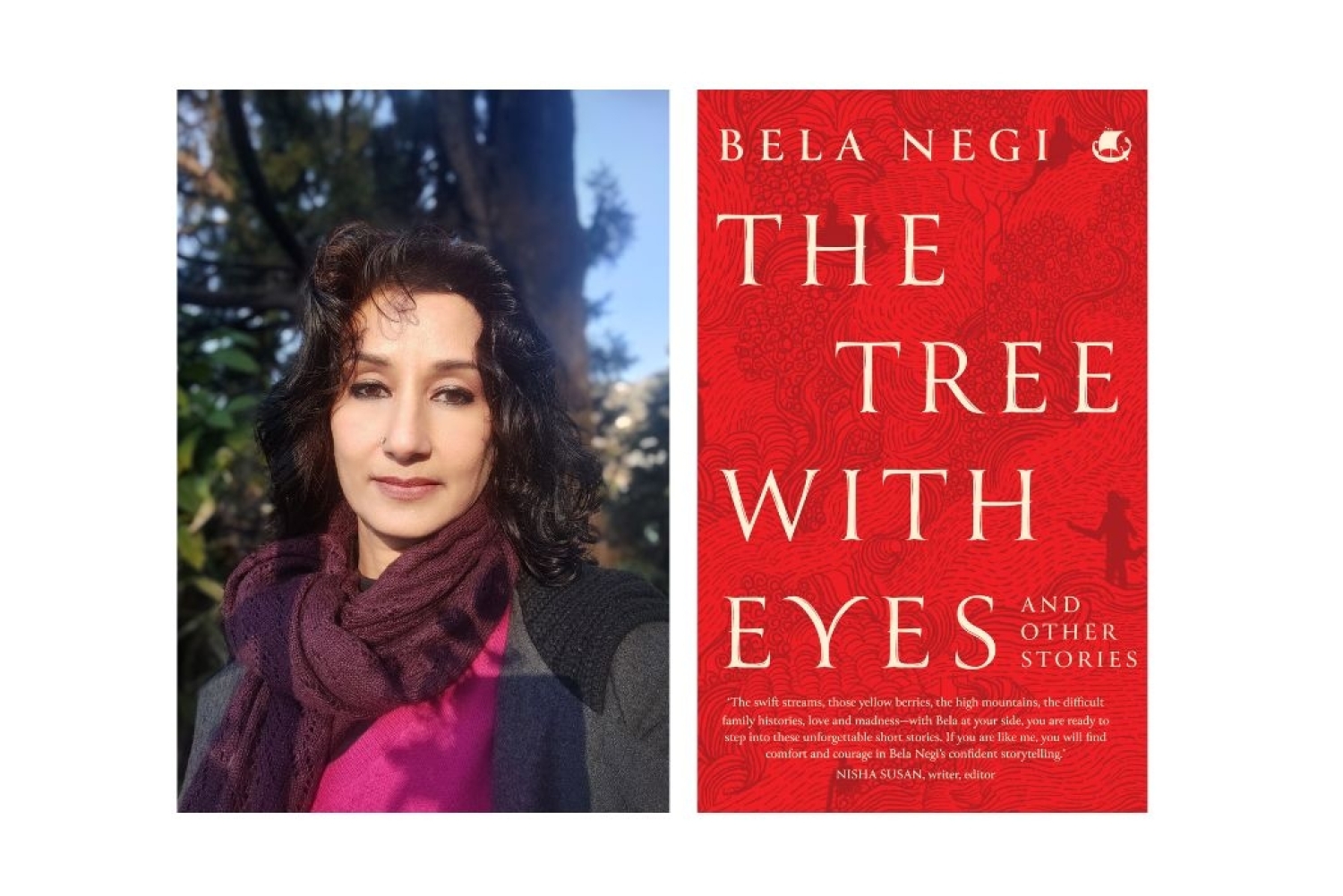
This empathy finds place in Bela Negi’s short stories, hewn from the heart of the Western Himalayas. Her work, The Tree With Eyes And Other Stories, came from the author’s desire to give a voice to the experience of the mountains, and these short stories emerged as a way to document the forgotten struggles and lives of people living there. Coupled with nostalgia and a desire to hold onto the tales she had heard from her parents during childhood, Bela draws characters whose lives in the mountains are shaped by ecological change and says, ‘In some of my stories an aspect of the environment is highlighted and becomes one of the central characters.’
How does the mountain landscape pervade into your writing? In what ways are the two [the landscape itself and your words] connected?
The beauty of the mountains can be overwhelming and foreboding in turn, with the landscape mirroring the wounds of loss, the wounds of development, the wounds of a people who feel a loss in political relevance. In some of my stories an aspect of the environment is highlighted and becomes one of the central characters, responding, reflecting and interacting with the other characters, a tree becomes a friend, a river a destroyer, the fog a villainous ally. At times the rugged beauty of the Himalayas with its inherent harshness and bleakness becomes a visual representation of the internal mindscape of the characters.
The wide-open vista of the mountains surely cannot have a single meaning; the sight of its majestic grandeur can serve both as a liberator and a penitentiary, offering solace or causing oppression as the case may be. The intention is not merely to highlight the projection of a character’s feeling onto the landscape, but to also underline an instinctive understanding that human fate is tied up irrevocably with the fate of nature, a connection which is mystical and very real at the same time.
What draws you to the form of the short story? What does it allow you to communicate that filmmaking or longform writing often might not?
What draws me to the short story is its ability to capture a moment of revelation without having to explain an entire life around it. A short story can enter a character's world at a precise point of tension, illuminate something essential, and then leave. That compression creates a particular kind of intensity. For a brief moment, the reader is invited to look into another life, and then the window closes, leaving behind an impression that can linger long after the story ends. Film is an extraordinary medium, but it is tied to the visible and audible world. Longform fiction, meanwhile, often asks for a broader architecture of plot, character development, and resolution. The short story occupies a fascinating space between the two. It allows for ambiguity, suggestion, and silence. It can gesture toward lives that extend far beyond the page without having to map them completely.
Grief and loneliness run gently through these stories; how has your understanding of these emotions evolved through writing this collection?
Grief and loneliness can be quiet companions in people's lives. They do not need to exist in a dramatic form but can settle into the rhythms of everyday existence. These feelings can exist in families, friendships, marriages, and crowded rooms, often arising from the feeling of being unseen or unable to fully share one's inner life. And it is the hidden emotional landscapes that I have tried to explore, with the understanding that these feelings are part of what makes us human. They shape us, deepen us, and occasionally open us to forms of empathy and understanding that might otherwise remain inaccessible.
Many of the stories also take place in surroundings undergoing change. What does the idea of ‘home’ mean to you?
The idea of ‘home’ is complex, it is memories, nostalgia, relationships, and world views. The mountains are undergoing change at a rapid pace, not only physically but everyday rhythms of life are also shifting. At its core the collection explores a sense of emotional loss that people from the mountains experience when they are forced to leave home, where leaving may not necessarily mean going away. The idea of leaving and returning runs as an undercurrent in many of the stories.
What are you working on currently and what is the future looking like?
I am working on fiction, long and short format. I am also working towards giving cinematic expression to some of the stories in this collection and other scripts that I have developed.
Words Neeraja Srinivasan
Date 13.7.2026