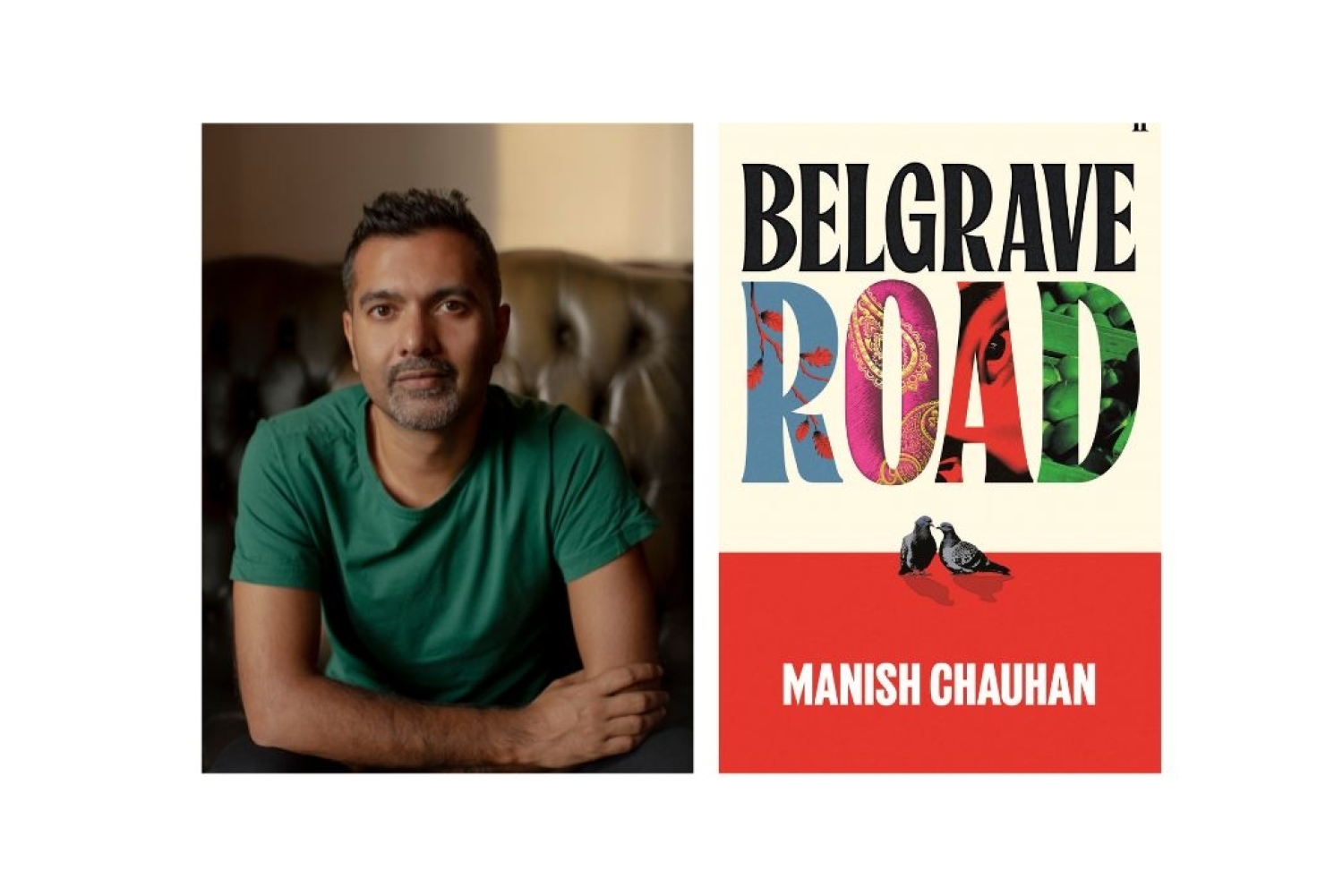
Photography Kat Green
Photography Kat Green
Manish Chauhan’s debut novel, Belgrave Road, was born from two things. The first was that he met a young woman who had come to England following an arranged marriage. He didn’t know much about her, other than that she wasn’t particularly educated and that she didn’t have any family of her own in England. They had a very brief conversation, but over the days that followed, he found himself thinking about her, or rather the idea of her. What would happen if she decided she didn’t like being married or living in Leicester? Would she be able to get a divorce? Would she be able to fend for herself? Perhaps she would simply grin and bear it, the way so many others before her had? What might become of her life?
The second thing that happened around that time was that he found himself reading a lot about the migrant crossings that were taking place between Africa and Europe. He became interested in exploring the reasons that compel people to flee their home countries. How might it be to end up in Leicester as a grown up? How might a person carry the experience of a migrant crossing with them through their lives?
As the son of immigrants himself, he found both stories equally compelling and, after some time, found that the narratives began to speak to each other. From here, the idea for the novel was born.
Shaping the Protagonist
My father made a similar journey to England as Mira in the novel and I have often wondered what it might have been like to find oneself in a new place where one doesn’t know anybody or really understand their language. By language, I mean the language of family, the rules that underpin how it functions and how the family members communicate. I wanted Mira’s experience to reflect this. Over the course of my life, I have met many people, especially women, who have had arranged marriages, and I have been lucky enough to speak with them about their experiences. One thing that always comes up is the sense of fear they felt, and a kind of acceptance that often accompanied it. I knew before I began writing the novel that Mira’s inner world would contract and become more guarded and private as the novel went on, even as her outer world expanded. I imagined her as two balloons, one inside the other, contracting and expanding depending on the situation.
Inspirations
All one has to do is to stand in the middle of Belgrave Road on a Saturday afternoon and watch people come and go and the stories begin to unfurl of their own accord. I feel immensely lucky to have grown up in a city like Leicester which is teeming with the world and full of people who are striving to make successes in their lives. Perhaps this is why, despite having left Leicester to pursue university many years ago, the city continues to inspire me. I still have family who live in the city and I visit very often. Whenever we’re all together, I listen to their stories and wonder whether any of those will grow into something bigger. Other inspiration comes in the form of other writers, of which there are many! Doris Lessing, J M Coetzee, Alice Munro, Jhumpa Lahiri, Rohinton Mistry, Rachel Cusk, each of whom writes clear, intelligent, searching prose that reads like silk and feels like a warm hug. Between them they write about the personal and the political
and offer the world, both domestic and global, extra dimensions. They each possess the ability to make the ordinary appear extraordinary through their words.
Romance in Everyday Spaces
We are so used to seeing love blossom in glitzy foreign lands, through films, books and TV, that I have always found myself keenly interested in the reverse, and in what happens inside houses, kitchens, unknown towns and backstreets, where nobody seeks to look. I am a true believer that small ‘domestic’ settings can be as potent and as interesting as their bigger, glamorous counterparts, and a true reflection of the wider world. Leicester felt like the perfect location in this regard – a heady melting pot of people and cultures that, if one looks closely enough, offers up a million stories. For Belgrave Road in particular, I wanted to write about two people whose lives are beginning to feel claustrophobic. They don’t have the means to afford physical freedom, and what little freedom they do possess has to be developed within the confines of their homes and work settings. This in turn was useful in generating tension, which is the cornerstone of all fiction. The question I repeatedly asked myself was: How does a person escape from a place they feel trapped in when they really can’t?
This article is from the January EZ. For more such stories, read the EZ here.
Words Neeraja Srinivasan
Date 2.2.2026