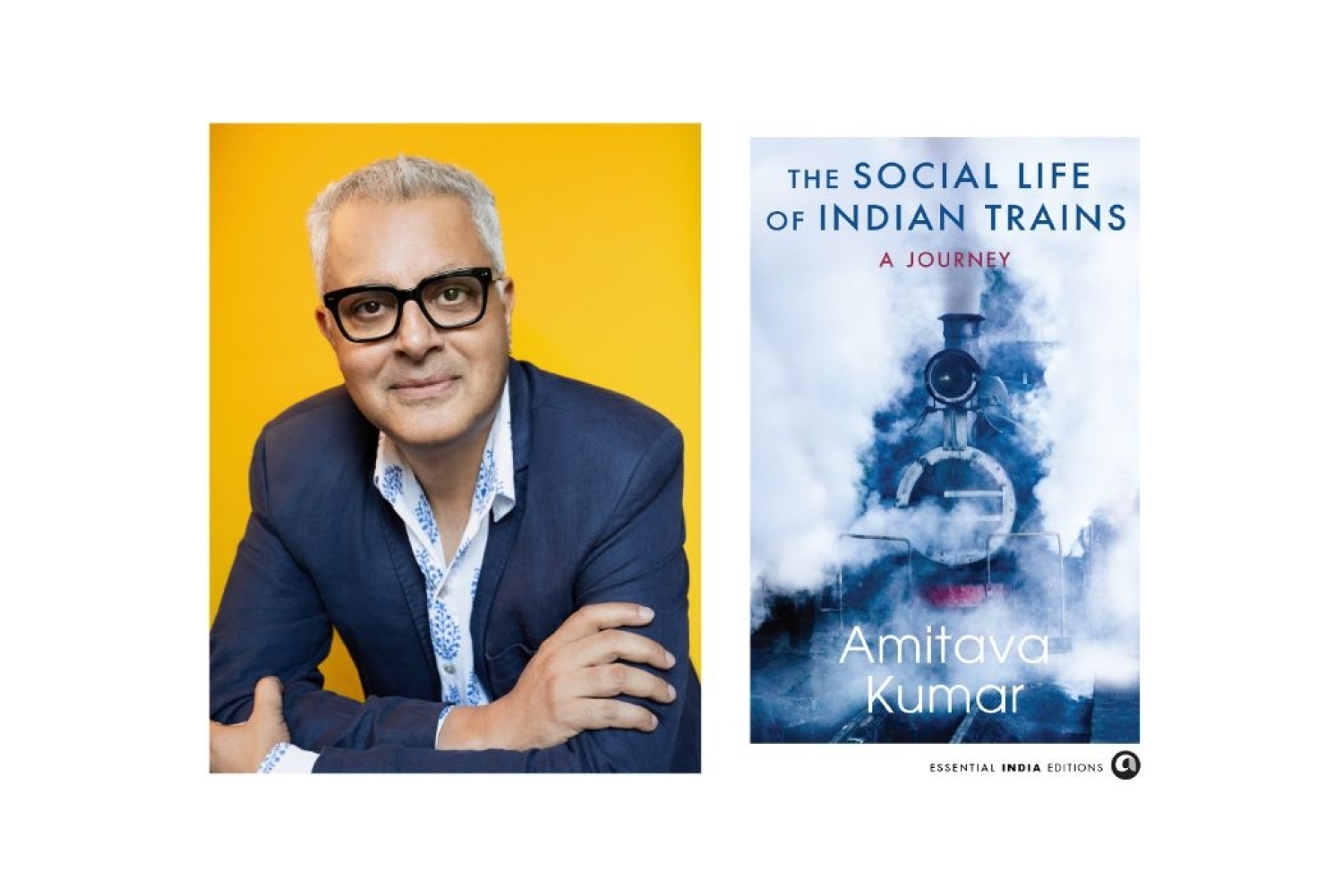
Photo Credits Beowulf Sheehan
Photo Credits Beowulf Sheehan
Amitava Kumar traces his earliest motivation to research trains all the way back to Attenborough’s film, where the Ben Kingsley character sets out on a journey to discover India with a notebook open, busy taking notes.
In this interview, he speaks to us about trains as a way of telling India’s story, and about all the journeys that shaped his new book. Kumar reflects on travelling on many routes as an attempt to see, to observe and to find out what it is that he can think about the country, from the Himsagar Express to the toy train to Darjeeling, these slow and nostalgic journeys made him realise that the journey itself is important.
What first drew you to trains as a way of telling India’s story?
It seems foolish or at least unfashionable to link anything with Mahatma Gandhi these days, but my excuse is that it was the fake Mahatma, the Gandhi on the screen, in Mahatma Attenborough’s film that might have first motivated me. In the film Gandhi, we see the Ben Kingsley character in trains. He has set out on a journey to discover India. You see him with a notebook open in one of the scenes. While his wife nods in sleep next to him, he is busy taking notes.
How did travelling on so many routes change the way you think about the country?
I wouldn’t call it change in the way I think about the country; instead, it was an attempt to see, to observe and take notes. Maybe I should say I wanted to find out what it is that I can think about the country. During the journey on the Himsagar Express, I found that it was often difficult to talk to many people because they were all on their phones, watching reels or serials.
Was there a particular train journey that stayed with you long after it ended?
The journey on the toy train to Darjeeling was a journey of nostalgia. It took me back to the time when I was a child. The train was very slow. I would say that its charm was threatened by the discomfort it produced in me. But there were times during that journey when I began to think that perhaps it is good to slow down. If I had chosen a faster mode of transport, I’d have arrived quicker at my destination and then gone on to do other things. The journey itself would not have been the most important thing, and that would have been a loss.
While writing this book, what surprised you most about the Indian Railways?
One small discovery that I made during my research about the railways was about runaway children. This is unique to India. Did you know that anywhere between 70,000 to 120,000 runway children arrive on Indian railway platforms each year? At the British Library in London I found a book in which the authors (Malcolm Harper and Lalitha Iyer) had offered a line that I immediately noted down: 'If you want to get away, to be free, to see life beyond the narrow confines of a small community, or merely to hide and disappear into the masses of India, you take the train.'
Did travelling by the train and researching them intimately have an effect on your own writing?
No, the travel gave me things to write about but the way in which I write about them, the matter of style, is something that I have been working on for a long time. That has been a longer journey, with many stations along the way.
In what ways do you think trains shape our everyday lives?
I think for folks like those who visit your wonderful platform (no pun intended, haha), locals play a part in their lives, in places like Delhi and Mumbai. Maybe? But by and large, trains are more and more for the poor in India. And that is why, if you leave out the new luxury superfasts, the condition of the trains is so very bad. The country gets a massive amount of revenue from the masses who use the railways but it caters to the demands of the affluent few. For the less affluent, the trains are all have when they need to get to any place where there is a hospital, and if they have to take their belongings or their products, not to mention when they need to travel to a distant place of employment.
What are you working on next, what’s the future looking like?
I am writing a big book on India.
Words Neeraja Srinivasan
Date 22.1.2026