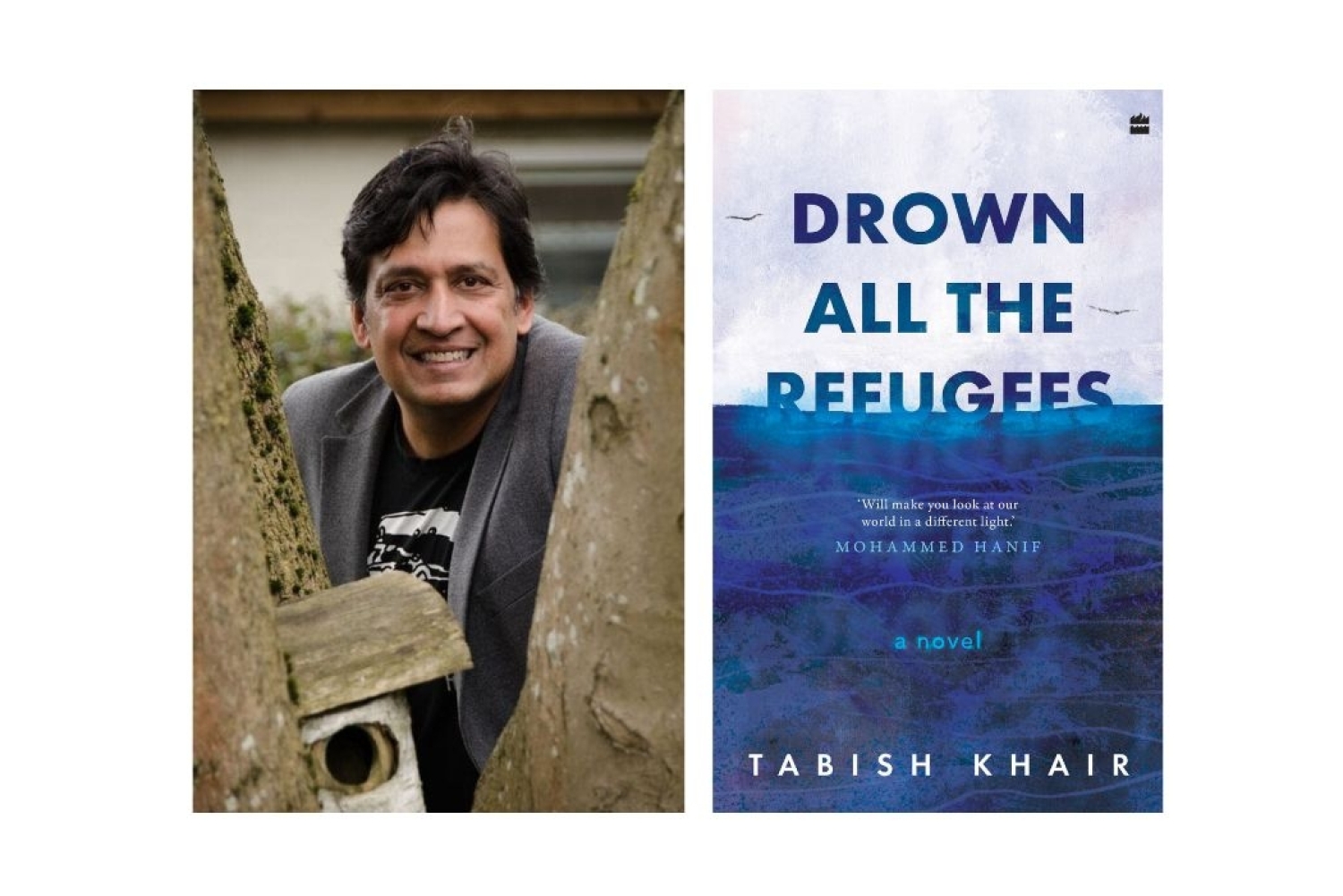
The genre of gothic horror comes to life in Tabish Khair’s recent novel, Drown All the Refugees. The overwhelming presence of migration in contemporary life finds place in this story of movement, refuge, homelessness, return and violence. It is a story of violence under cover, and according to him, buried violence or crime always erupts in the gothic register, hence drawing him to the tradition. Through the doorway of the occult, he examines what is left behind, what returns, and the realities we try hardest to evade, all as a result of displacement. The plot follows a narrator whose life is inevitably entangled in the horrors of displacement through his Palestinian boyfriend Abdul, and his childhood best friend Pedro. Mystery enters the plot when Pedro’s mother goes in search of him, only to find a shell of the person he used to be.
When asked what first sparked the novel, his answer is revealing. Rather than pointing to a single image or moment, he gestures towards the overwhelming presence of migration in contemporary life. 'I suppose it would be easier to list the images or questions, or news reports , that do not point at migration, refuge, homelessness, return, violence to the weak, and similar matters.' The problem, he suggests, is not a lack of evidence. 'Unfortunately, we live in a world that teems with such images, and they seem to cause us so little discomfort.' That observation lies at the heart of Drown All the Refugees, a novel that follows a narrator whose life has been shaped by displacement and its consequences. Through the story of a missing migrant and an uncanny return, he explores not only migration itself but also what remains in its wake.
Importantly, the novel is not interested in eliciting easy sympathy. Tabish is wary of pity as a response to suffering. 'Pity is like charity. We do it for ourselves. It is better than nothing, but it is not the solution.' In his view, pity often becomes a way of avoiding deeper engagement with structural injustice. 'Often, it does not even really address the problem. It essentially makes us feel good about ourselves and superior to those we pity.' This rejection of pity also shapes the novel's approach to readers. Rather than positioning migrants and refugees as passive recipients of compassion, the book pushes beyond the emotional satisfaction of feeling sorry for others.
He has described the novel as being concerned with those who are left behind. 'We do have some novels that explore the struggle to find refuge, the fraught journey, the challenges of a new life elsewhere. But I was as interested in what is left behind, and what, if anything, returns.' The question of return becomes particularly significant in a story where the past refuses to stay buried. This concern led him towards the Gothic. While migration is often represented through realism, he felt another literary tradition was better suited to the themes he wanted to explore. 'This is a story about violence being done under cover, so to say, violence that we try to bury and evade.' Such violence, he argues, has a tendency to resurface. 'And such buried violence or crime always erupts in gothic fiction.' His preference for the Gothic is also tied to its ability to preserve contradiction and unease. 'That is why I prefer the gothicised tradition to the magical realist one: in the latter, the contrasts and contradictions, the difference and precarity, can often be smoothened by "naturally" merging the fantastic with the real.' In Drown All the Refugees, the supernatural becomes a way of examining histories that societies would rather forget. They illuminate the occult-like elements of political realities, exposing the violence that often remains hidden beneath public narratives about borders, belonging and nationhood.
For all its engagement with urgent political questions, Tabish’s own writing process remains remarkably straightforward. Asked how he writes, he responds simply: 'Whenever I can, between paid work and domestic rituals.' The answer reflects a matter-of-fact attitude that also runs through his discussion of literature. There is a sustained commitment to examining the world as it exists, especially the lives that are frequently ignored or overlooked.
When readers finish Drown All the Refugees, his hopes for them are modest but significant. 'I hope they are thinking about those less fortunate than themselves, and those different from them.' It is a statement that captures the ethical centre of the novel. At a time when stories of displacement risk becoming familiar enough to fade into the background, Khair's fiction insists on paying attention. As for what comes next, Tabish is currently preparing his first New and Selected Short Stories for publication and working on 'a political crime novel set in Denmark, where I have been living for years now, though I remain an Indian citizen.' The questions that shape Drown All the Refugees remain pressing. They are, after all, the questions of the world we inhabit.
Words Neeraja Srinivasan
Date 23.6.2026