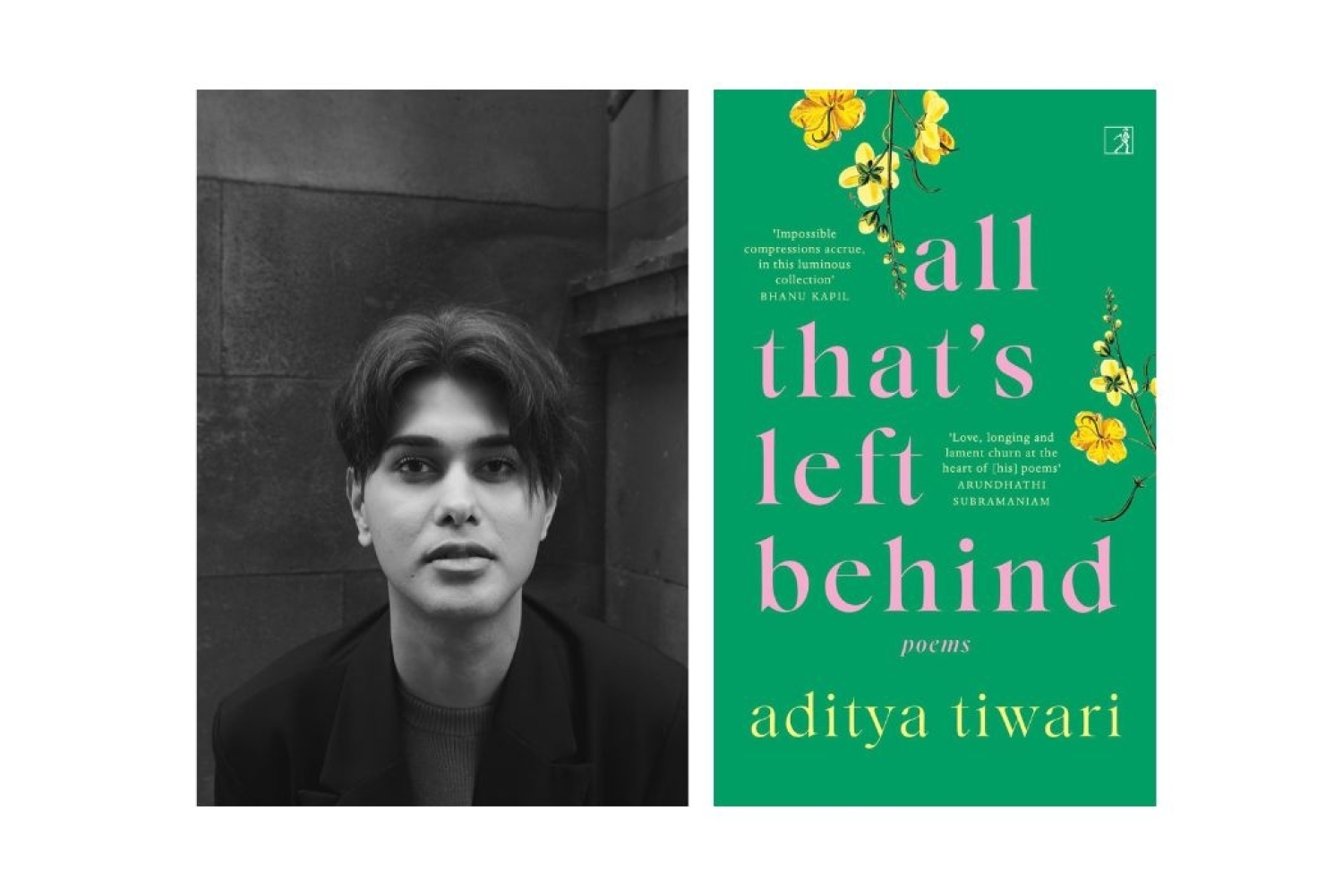
A person lives through so many versions of themselves through the course of life. What remains of us from each of these versions? For Aditya Tiwari, that question sits at the heart of All That's Left Behind, a poetry collection featuring meditations on grief, migration, queer life, family, and belonging. The poem uses metaphors and objects to capture emotions, and Aditya says ‘I trust objects in a way I don't always trust abstractions. If I write “grief” I've handed the reader a word they already know.’ Which is why, the smell of khas from a desert cooler in May, the sound of rain against a railway platform, an old black Bajaj scooter, a mango tree, and many more objects find space in this collection. Through these living archives, Aditya explores how ‘the things we lose don't actually disappear. They simply change form.' Jabalpur, his 'emotional and imaginative homeland,' remains central to this work, as do questions of absence, desire, and connection. In this conversation, he reflects on writing as a way of thinking, trusting the image over explanation, and asking, after love, grief, migration, or even a lifetime itself, what remains, and in what shape?
The Connecting Thread
The poems in All That's Left Behind are connected by an interest in what remains. I keep thinking of my neighbour who died and left behind a pack of cigarettes, some gold bangles, yesterday's newspapers, and four dead flowers in a vase. The list of what she left is also a kind of portrait of her. Maybe that's where the book begins, in that instinct to look at what remains after a person, a place, or a version of yourself has gone.
I didn't set out with a theme. I set out with a feeling I couldn't shake: that the things we lose don't actually disappear. They simply change form. A person becomes a smell. A city becomes a reflex. A relationship becomes the way you hold your coffee cup at 2 a.m. I've spent much of my adult life in transit–India, Britain, America, elsewhere, and every departure teaches you something about what you're carrying and what you're leaving behind. Slowly, I realised the collection was asking a single question: after love, grief, migration, or even a lifetime itself, what remains, and in what shape?
Creation Of A Poem
Most of my poems begin with an image or a sensory experience rather than an idea. It might be the smell of khas from a desert cooler in May, the particular peep peep peep of my mother's TVS scooty turning into our lane in Jabalpur, or the sound of rain against a railway platform. I usually write quickly when something arrives. Several poems in this collection began on my phone; on trains, in hotel rooms, or in the middle of the night when a line demanded attention. The first draft is instinctive. The real work comes later.
After some distance, I return to the poem and try to separate what is genuinely there from what I merely thought I felt. Revision is where the poem discovers its shape. I pay close attention to rhythm, line breaks, and the emotional pressure of each image. Often, the smallest change, a parenthesis, a line break, a single word, can transform the poem. The final stage is reading aloud. If the poem doesn't breathe properly, it isn't finished. I want the language to feel inevitable rather than clever.
Finding Significance In Objects
I trust objects in a way I don't always trust abstractions. If I write ‘grief,’ I've handed the reader a word they already know. But if I write about my father's black Bajaj scooter carrying a family of four through a Jabalpur monsoon, you've entered something specific. That's where emotional truth lives. Objects also hold time in remarkable ways. My mother's old scooty carries the sound of her returning home from work. A trench coat preserves a particular version of my mother. A mango tree remembers summers that no longer exist. They become living archives. Many of these objects are also distinctly middle-class and central Indian. The Bajaj scooter, the cooler, the kaner flower, and glasses of aam panna. They're not incidental details. They carry entire histories of class, place, and belonging. Through them, I can write about larger emotions without naming them directly.
Jabalpur Stays Central
Jabalpur is my emotional and imaginative homeland. It's where I first learned how to see the world. The Narmada River that appears in these poems isn't a symbol to me. It's a river I've sat beside since childhood. The city holds the smell of summer afternoons, the sound of trains, my parents at an age before I fully understood them as people, and the complicated experience of growing up queer in a place that had very little language for queerness. Distance sharpened my relationship with the city. When I lived abroad, I found myself seeing Jabalpur more clearly than when I actually lived there. I could suddenly remember the alleyways, the dogs watching the clouds before a storm, the smell of wet earth after the first rain. Exile made me precise. I often say that Jabalpur is the original world. Everything else I've lived through is measured against it.
Writing as Connection
As a queer person growing up in a small city in central India, I often felt absent from the literature I was reading. I rarely encountered lives that resembled my own. There's a line in the collection: ‘No poets wrote me into existence. No sonnets for boys like me.’ Part of why I write is to answer that absence. But writing is also how I think. I don't fully understand what I believe or feel until I write about it. The poem becomes the place where the thinking happens. Putting words into the world is an act of connection. Poetry begins in solitude but ultimately belongs to readers. What moves me most is when someone tells me they recognised a part of their own life in a poem. The details may be mine, but the emotions belong to all of us.
Trusting The Image
My first book was a debut in every sense. It was discovering a voice and trying to understand what poetry could do. Over the Rainbow was outward-facing, rooted in research and other people's stories. All That's Left Behind is the first book where I allowed myself to go fully inward. I wrote about my family with a depth and honesty I don't think I possessed earlier. I wrote about my father's childhood, about grief, about desire, about queer love without disguise or euphemism. There are poems here I simply couldn't have written at twenty-five because I wasn't yet the person who could hold that material. I also became more comfortable with silence. Earlier, I felt compelled to explain everything. In this collection, I trust the image more. I trust what can be carried by a line break, a fragment of memory, or a single object left behind in a room.
What's Next?
At the moment, I'm still living inside this book. It has been part of my life for years, and publication feels less like an ending than a continuation of that conversation. I'm increasingly drawn to longer forms; essays, memoirs, and hybrid works that bring together personal narrative, history, reportage, and poetry. Many of the questions that animate this collection continue to interest me: memory, migration, queer life in small-town India, and the ways places remain inside us long after we've left them. I'm also reading obsessively, which is usually a sign that something new is taking shape. Right now, I'm interested in archives, oral histories, old maps, and forgotten stories. I don't yet know what form the next project will take, but that's often the most exciting stage, the moment before the work reveals itself.
Words Neeraja Srinivasan
Date 10.6.2026