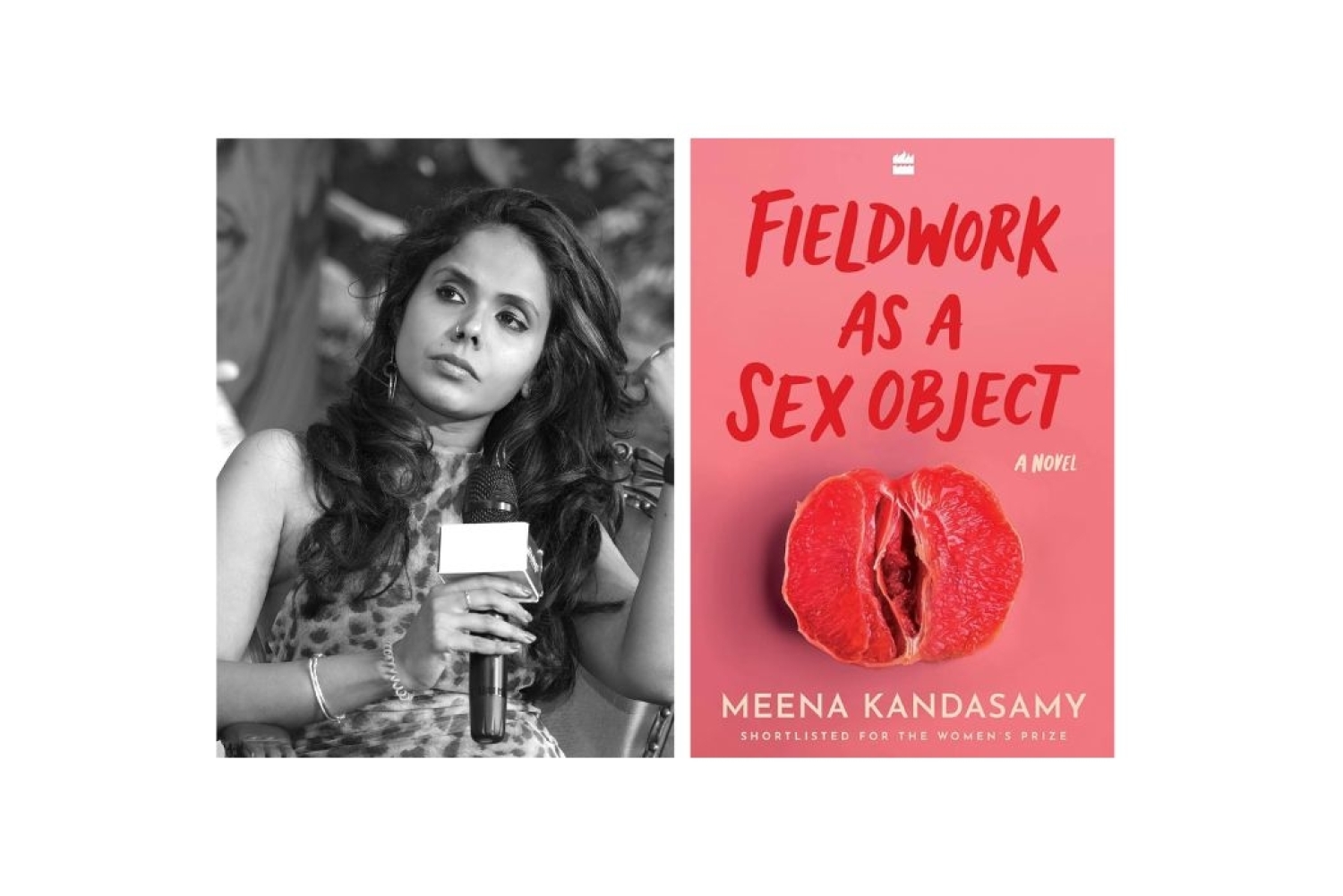
In the recipe for a novel about online misogyny, public annihilation and the violence of being watched, add a measure of institutional politics, a deepfake video and, of course, Amrita Chaturvedi, the protagonist in question, who finds herself at the centre of the very forces of misogyny and harassment she has long spoken against. In the hands of author Meena Kandasamy, all of these components combined make the much awaited Fieldwork as a Sex Object, a biting and humorous novel that uses scandal to illustrate the way the Internet is obsessed with humiliating women. The book highlights the very thin line between understanding and speaking against power, and then being consumed by that very power.
When I hopped onto a Zoom call with Meena mere minutes after closing the last page of the novel, we dove right into the universe that went into building the book. The author of Ms. Militancy, When I Hit You, Exquisite Cadavers and more, spent almost five years on her newest, and arguably fiercest book yet. She could not afford to get bored; which is a philosophy that reflects neatly in the form of the book itself. It is divided into succinct chapters with bizarre, sassy titles that will make you want to stay with Amrita’s story for just a little longer. This is not a book that you simply read. It is a book that reads you right back.
Amy is such a messy protagonist, despite being subjected to immense public violence. She doesn't fall into the familiar trope where a woman must be morally good in order to deserve sympathy. How did you construct her?
There were three reasons behind Amy. The first is my own experience of online violence. Since 2012, I have faced rape threats, acid attack threats, caste abuse and sustained online harassment. People have mocked my appearance, questioned my worth and even dragged my children into it. I have lived with the extremes of online violence for nearly two decades, but I knew I could not simply write my own story. If I wanted to do that, I would have written an essay. Everybody already knows what happened to me.
What interested me was something larger. The internet, and especially the phone, has transformed intimacy. We send images to people we trust. The moment a relationship breaks down, those same images can be weaponised as revenge porn. With AI, they do not even have to be real images anymore. They can be entirely fabricated. I wanted to write a broader story about what happens to women's bodies and women's images. I was also thinking about cases such as the Pollachi sexual assault case and many others where women have endured years of blackmail or have been driven to suicide because intimate images were circulated. The philosophical question behind the novel was: who do we sympathise with? As a society, we are often forgiving of celebrities. We do not apply the same moral standards to them that we apply to our neighbours or our families. The inverse of that question is: will you give solidarity to someone you do not like?
With Amy, I wanted readers to confront that question. People may find her annoying, privileged, vain or attention-seeking. They may find her triggering. But does that mean she deserves less solidarity when she becomes a victim? It is very easy to support the ‘good girl’ victim. Whenever a woman is harmed, we spend a great deal of time proving that she was a good person. At the same time, perpetrators try to assassinate her character and institutions often focus on her moral character rather than the violence committed against her.
Whether you find someone irritating, whether their voice annoys you, whether they trigger you; none of that should determine your capacity for solidarity. I wanted Amy to be absolutely messy. I also wanted her to be privileged because that allows her story to hold up a mirror to readers. How would they respond if the victim came from a marginalised caste background? How would they respond if she were a Muslim woman facing similar forms of online abuse? These things are not hypothetical. We have seen Muslim women being auctioned through hate sites online. This violence is very real. And the broader truth is that no privilege is going to protect you when you're a woman. That is something we all have to accept.
“The digital world is also a place. We spend enormous amounts of time there. We write about cities, rooms, cafés, forests and marketplaces, but we rarely write about the internet as a lived environment.”
Speaking of the digital world, so much of the internet appears in the novel. These moments are fleeting in real life. We scroll past them and move on. How did you translate those fleeting digital experiences into narrative?
The digital world is also a place. We spend enormous amounts of time there. We write about cities, rooms, cafés, forests and marketplaces, but we rarely write about the internet as a lived environment. The internet is an experience. It is a place where people work, socialise, build relationships and spend significant portions of their lives. Yet it remains underexplored in literary fiction, especially when it comes to women's experiences online.
The internet is changing the way we handle life. It is changing the way we look at things. It has cultivated and entrenched very short attention spans. Even when we read a newspaper, we often approach it the way we scroll through a feed. Doomscrolling has become a habit. The digital affects everything, including the kinds of conversations we have.
I wanted to capture that reality. I was also thinking about how to write for readers who inhabit these spaces every day, particularly younger readers whose friendships, conversations and identities are shaped online. That influenced the structure of the novel. The chapters are short. Each section has a hook. Every title functions almost like a YouTube thumbnail, designed to make you click. The titles are deliberately enticing. They draw readers forward in the same way the internet does. That structure reflects the logic of the digital feed itself, which is why it was a fascinating book to write.
That's exactly how the feed works. One moment you're reading about Libra compatibility. The next moment you're looking at handbags. Then you're listening to a song. Then something entirely different appears. The feed is fragmented, constantly shifting and carefully curated. I wanted to capture some of that energy. There was also a practical reason. I spent nearly five years with this novel. Publication alone takes about a year. If I am going to spend that much time with a project, it has to remain interesting to me. I get bored very easily. The novel needed to sustain my curiosity. I had to want to return to it repeatedly over several years. It could not bore me or annoy me. This book allowed me to do that.
I wanted to talk about Nimmi as well. She offers Amy advice, questions her privilege and brings the reality of caste into the narrative. How did you think about those dynamics?
If Amy had been from a lower-caste background, people's first reaction would have been, ‘Of course the lower-caste woman is complaining.’ I have witnessed that dismissal firsthand. When you talk about what is happening to you, there is often an absolute dismissal. But that was not the only reason behind the choice. For me, Nimmi and Amy are equal characters in the novel. Nimmi offers the perfect foil through which to question all of this. Their politics are different. The ways they present themselves are different. Their approaches to the world are different. These were all very thought-through choices.
At the same time, I do not believe caste is the only force operating between them. Their relationship is much more layered than that. There are multiple things going on between these two women, and reducing their differences solely to caste would oversimplify what is happening between them. Nimmi is a foil to Amy, but India [a White female character in the novel] is a foil to Amy as well. The qualities that make Nimmi suspicious of Amy; her performative tendencies, her provocations, her apparent attention-seeking, are the very same qualities Amy sees in India. Amy is irritated by India because she sees her as a white woman who says all the right things and plays to the gallery. She finds her flaky. She finds her performative. What Amy fails to recognise is that she may come across in exactly the same way to other people.
What interested me was that every woman in the novel is genuine in some way. Whatever their flaws, they genuinely believe they are trying to do good. Amy believes that. India believes that. Nimmi believes that. They all think they are contributing meaningfully to change. That is not something we can take away from people simply because they happen to be privileged.
Another thing I noticed is that the novel contains a great deal of anger, but that anger is often filtered through humour. The book is funny, sharp and sometimes savage. How did you use humour to tell such a serious story?
If you cannot cry, you laugh. A lot of the hatred directed at women online is so extreme that your first response is sometimes laughter. It is so horrible that it becomes funny. Amy's humour is partly a survival mechanism. I am not even sure I would call it humour all the time. There is something flirtatious about it as well. Both Amy and Nimmi possess that quality.
Humour can sometimes soften the impact of a story, but it can also heighten it. In this novel, I think it heightens the impact. Amy's concern when she first sees the clip, right as the scandal is about to explode, is the fact that the body in the video does not look like hers. It is ridiculous. She is looking at something that could potentially destroy her life, and her first concern is whether she looks good. But that reaction tells us everything about who Amy is. It is funny, but it is also the nature of the internet. The internet has trained us to curate ourselves obsessively. We take dozens of photographs before posting one. We worry about angles, lighting and appearance. We want to be seen in a particular way. Amy has internalised that logic completely. When she sees the clip, her first instinct is not fear. That moment is humorous, but it also captures something essential about her character and about internet culture more broadly.
“Humour is actually a useful way of understanding because it often reveals character more effectively than anger does. ”
The scandal almost becomes a character in its own right. Every person projects something different onto it. Amy's father sees one thing, her mother sees another, and the meaning of the scandal keeps shifting depending on who is looking at it. Why?
Humour is actually a useful way of understanding that because humour often reveals character more effectively than anger does. The way people respond to the scandal tells you who they are. Amy's response tells you something about vanity, self-curation and identity. Her parents' responses reveal their own fears and assumptions. The scandal becomes a site onto which everybody projects themselves.
The novel has been out only a short while, but readers have already surprised me. Many women are deeply upset by Amy’s actions. Men, interestingly, seem to adore her. The men who have read the novel overwhelmingly love Amy, whereas women are often much more critical of her. That reaction is fascinating because it reveals something about readers themselves. The book becomes a mirror. It is not only about the scandal at its centre. It is about what readers are willing to judge, excuse or forgive. People may be scandalised by Amy's relationships, yet perfectly comfortable with a mother recommending a vibrator to her daughter. Someone else may have the exact opposite reaction. As I say in the novel, this is not just a book you read. It is also a book that reads you.
Moving away from the novel for a moment, you've now been publishing for more than two decades. What is one thing about your writing that has remained the same, and one thing that has changed?
One thing that has remained remarkably consistent is my readership. My core audience has always been young women. When Ms. Militancy was published, they were reading me. When the novels came out, they were reading me. Even now, a large part of my readership consists of college-going women and women in their twenties. That has remained true throughout my career. I do not consciously write for that audience. It simply happens that the themes I am interested in tend to resonate with people at particular moments in their lives. But that demographic has stayed with me.
And what about the writing itself?
What has not changed is my attraction to difficult subjects. Whether it is caste violence, domestic violence, rape, genocide or online abuse, I continue to be drawn to material that is emotionally and politically heavy. Throughout my public life, I have repeatedly chosen difficult topics. That remains constant. What has changed is the world around writing. When I began publishing, social media as we know it did not exist. My first translation came out in the early 2000s. Instagram did not exist. Facebook was not central to people's lives. Twitter was largely text-based. The entire ecosystem was different.
Today, we inhabit an overwhelmingly visual culture. Even when Facebook first appeared, photographs were only one aspect of the platform. Now image-making, self-presentation and visual communication dominate online life. The entire shift has been towards a much more visual form of social media. That has inevitably shaped how books are received and discussed. Books are now competing with an endless stream of digital content. The ways in which information circulates have changed dramatically. The expectations placed on writers have changed as well. Readers encounter literature within a completely different media landscape.
The political concerns may be similar, and the subjects I write about may not have changed very much, but the conditions under which books are read have changed entirely. The digital world now mediates almost everything. Books travel differently. Readers discover them differently. Conversations about them happen differently. The biggest transformation has not necessarily been in the writing itself, but in the environment into which that writing enters. That is perhaps the biggest shift I have witnessed.
Words Neeraja Srinivasan
Date 19.6.2026