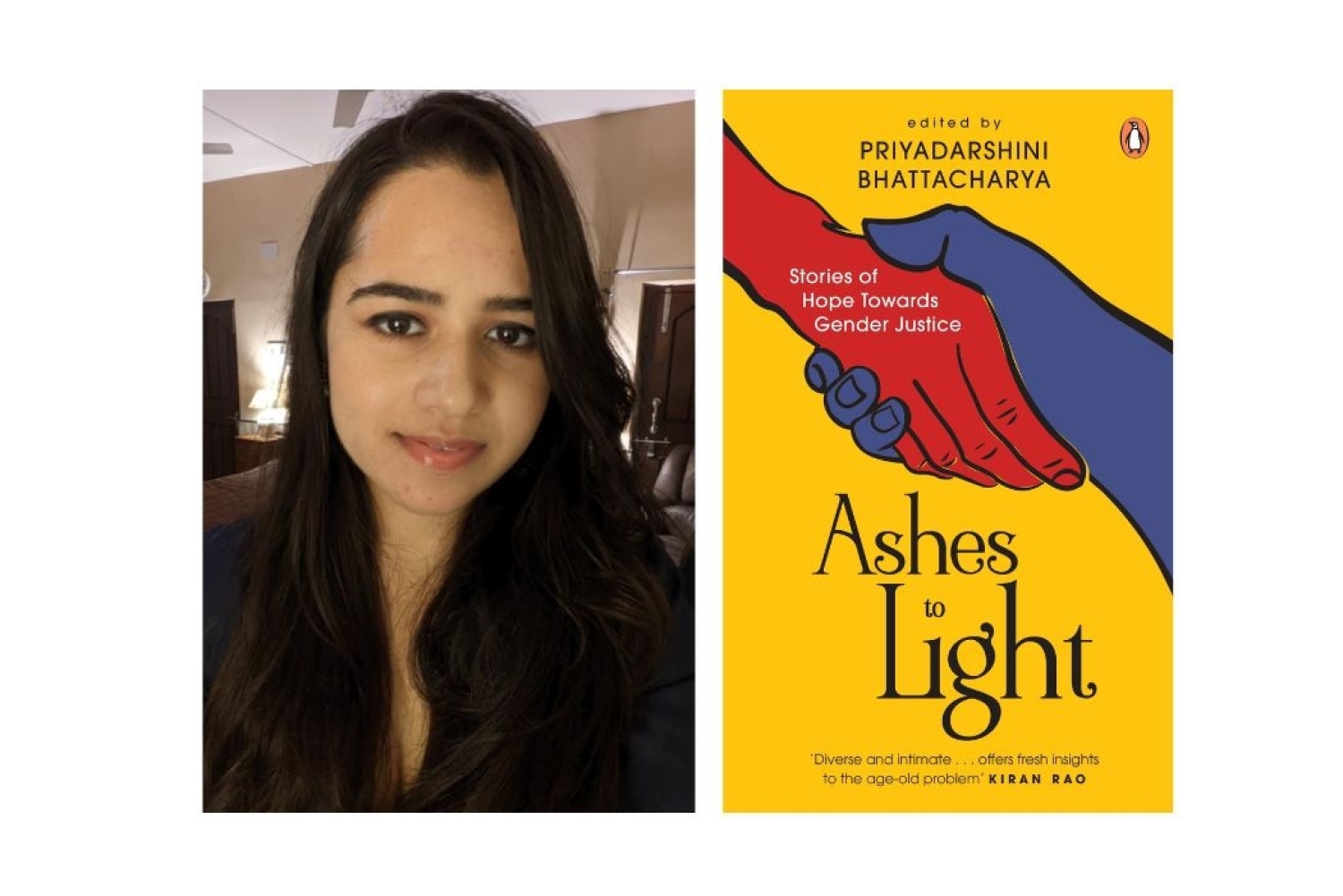
What does it mean to speak about gender without reducing it to a singular idea or fixed certainty? In Ashes to Light edited by Priyadarshini Bhattacharya, an IAS officer, sociologist, and founder of VIRAAM, voices like Deepa Mehta, Kiran Rao, Rahul Bose, Pushpesh Pant, Kiran Bedi, and Adil Hussain come together to explore gender through lived experience. What makes this collection special is its inclusion of writers from diverse backgrounds. It covers cinema, law, literature and activism, proving that there is no singular experience of gender. Priyadarshini ensures that each contributor speaks from a space of their own unique emotions and social settings, allowing for gender to be understood as something constantly negotiated through power, intimacy, care, resistance, and selfhood.
What was your curatorial approach to bringing together the stories and narratives in this collection? According to you, what is the common thread that holds them all together?
My approach was quite simply to bring together perceptive and sensitive voices speaking about gender from within their own lived worlds. There was a conscious intent to move away from treating gender only as a grand ideological or political category, and instead to explore it through the textures of the everyday; through gestures, silences, memories, relationships, workplaces, bodies, anxieties, intimacies, and ordinary negotiations that often go unnoticed.
Coming from a background deeply influenced by everyday anthropology and sociology, I have been interested in how larger structures quietly inhabit mundane life. I wanted this collection to hold stories that examine gender not merely as a polarized political discourse, but as something deeply embodied and experienced. Something that shapes how people move through the world, inhabit spaces, carry vulnerability, power, tenderness, fear, aspiration, or even invisibility.
What binds the collection together, for me, is that each contribution feels almost like a keyhole into a room. A fleeting but intimate glimpse into a particular landscape of gendered experience. Each voice offers a slant, a tilt, a gaze toward realities that are often flattened when seen only through institutional or structural frameworks. There is something quietly subaltern about many of these perspectives: they attend to what is subtle, half-spoken, emotionally sedimented, or socially normalized. In that sense, the anthology became less about constructing a singular argument and more about gathering a community of thoughtful, sensitive observers. And interestingly, that community kept expanding as the project evolved, almost as though one story organically opened the door to another.
In the process of editing this anthology, were there any new realisations that you may have learnt and understood from a different perspective?
One of the most profound realizations I arrived at while editing the anthology was understanding how deeply textured and varied experiences of hurt, vulnerability, and gendered violence can be. I think I began to understand that hurt has its own grammar, that experiences which are unsettling, silencing, or emotionally jarring often communicate themselves in ways that are indirect, quiet, embodied, and deeply personal.
What struck me was that not all violence announces itself dramatically, and therefore not all healing or resolution has to arrive through grand declarations either. Betrayals can be quiet. They can exist in gestures, omissions, atmospheres, everyday condescensions, absences, or accumulated silences. And similarly, resolutions can also be quieter and more intimate than we imagine. Sometimes they lie not in confrontation or spectacle, but in choosing an offbeat path, reclaiming one’s voice gently, refusing certain structures silently, or simply learning to inhabit oneself differently.
The anthology also made me realize how rich and expansive the vocabulary of embodied experience really is. So much of what people carry in relation to gender is felt before it is articulated. There are emotional, sensory, and psychological registers through which people understand power, care, exclusion, intimacy, shame, resilience, or freedom, and these do not always fit neatly into institutional or political language. Editing these voices taught me to pay greater attention to nuance, to pauses, to what remains half-spoken. It expanded my understanding of gender from being merely a framework of analysis to also becoming a deeply lived and affective terrain.
“Gender justice itself is never a finished destination. It is always unfinished, always evolving, always requiring deeper reflection and more inclusive negotiations.”
How crucial was vulnerability and empathy as a form of storytelling within the anthology?
Vulnerability was not consciously employed as a storytelling trope within the anthology. It was never a calculated literary device. The stories are deeply personal, and whenever people write from within their own lived experiences, vulnerability inevitably enters the narrative because they are opening themselves up to observation, interpretation, scrutiny, and sometimes even judgment. That vulnerability, therefore, emerges organically from the act of honest self-expression rather than from any deliberate aesthetic choice.
What was important was authenticity. The contributors were willing to inhabit and articulate emotionally complex spaces without necessarily sanitizing them. We hope readers engage with that openness with sensitivity and respect. Empathy, however, is absolutely central to the anthology. These are writers who are deeply attentive not only to their own inner worlds, but also to the social worlds around them to how spaces are structured, how inequalities are normalized, how dissent emerges, and how people negotiate pain, intimacy, love, and power in everyday life. Their perceptiveness naturally gives rise to empathy. And empathy, to me, is fundamental to storytelling itself. It is the willingness to lean in and genuinely listen to another person’s narrative and emotional framework, even when it differs from one’s own. It is an acknowledgment that another person’s experience possesses legitimacy and meaning, regardless of whether one fully agrees with it. In that sense, empathy becomes not merely an emotion, but an ethical way of reading, listening, and engaging with the world.
Why is hope an important emotion to hold on to while writing about gender justice?
I do not see hope merely as an emotion. I see it as a practice, a conscious and everyday practice of resistance, persistence, and protest. Hope is what one turns to despite structural constraints, despite disappointments, despite inherited inequalities. It is the decision to continue imagining kinder, more dignified, and more humane possibilities even when existing systems appear deeply entrenched.
In that sense, hope is both within and against structures. Social structures can provide stability for some, but they can also bind, constrain, and reproduce hierarchies. Hope becomes important because it allows individuals to negotiate and sometimes transcend those limitations. It creates the possibility of autonomy, dignity, and selfhood even within restrictive conditions. For me, hope is not passive optimism. It is active and ethical. It is embedded in everyday choices, in dissent, in solidarity, in the refusal to normalize cruelty or inequality. It is what enables people to keep engaging with difficult questions without surrendering to cynicism.
And gender justice itself is never a finished destination. It is always unfinished, always evolving, always requiring deeper reflection and more inclusive negotiations. Because it is a continuous process rather than a final achievement, hope becomes indispensable. It gives people the strength to continue the work, to keep questioning, imagining, rebuilding, and moving forward even when progress feels slow or incomplete.
This is an article from the June EZ. For more such stories, read the EZ here.
Words Neeraja Srinivasan
Date 26.6.2026