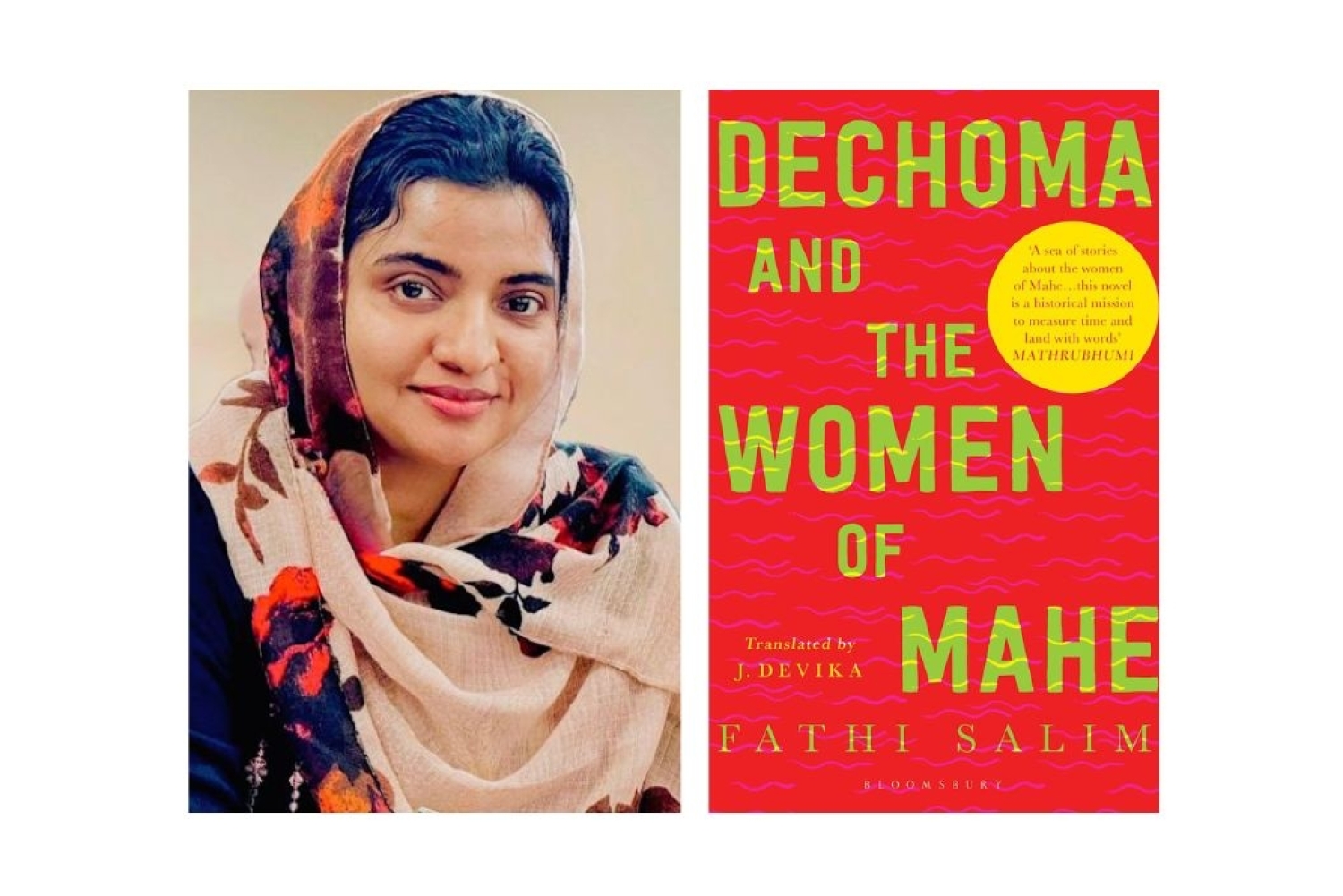
In a story of intergenerational girlhood, Dechoma and the Women of Mahe brings to the forefront a story about the daily lives of women in the matrilineal society of Mahe. The story follows Umaiba, a young girl at the magical threshold of youth, who finds solace in an older woman, Dechoma. As they grapple with the duality of tradition and freedom, Fathi Salim, the author, gives us pockets of tenderness amidst these women who expertly use the landscape of Mahe to build joviality and camaraderie amongst one another.
Dechoma and the Women of Mahe was inspired by Fathi Salim's memories of her grandmother's tharavadu in Mahe, where she watched three generations of women making decisions, showing compassion to one another and settling disputes, all within the confines of home and culture. Those experiences became the foundation for a coming-of-age story set in a matrilineal Muslim community, born from the realization that the contradictions, freedoms and rules of the girlhood that she had been privy to, had rarely found a place in fiction. Through the novel, she discovers the scaffolding of life in Mahe, matriliny, faith and the women who stand for one another, while portraying matriliny not as something extraordinary, but as an ordinary reality that only reveals its uniqueness once you leave it behind.
What first inspired you to write a coming-of-age story set in the matrilineal Muslim community of Mahe?
I wanted to write about ordinariness. Because adolescence is when ‘ordinary’ starts to chafe. These girls inherit power and also inherit its limits. That tension is where the story lives. Mahe’s matrilineal Muslim women raised me, and no one had written about their girlhood. Not as victims, not as relics, just as girls figuring out freedom inside a system built by their grandmothers. So I wrote about Mahe, where a girl inherits land but not the final word. That contradiction is what my book traces.
Girlhood is at the centre of the story. What drew you to this relationship between Dechoma and Umaiba?
That’s a completely different dynamic. 60-year-old servant and a 13-year-old girl. This isn’t ‘girlhood friendship.’ This is intergenerational girlhood, watched and transmitted through labor; it is rare, layered, and political. You’re not writing about two girls. You’re writing one girl becoming, and one woman who remembers becoming, with two different backgrounds. Because in this novel, servant women are the real archivists of girlhood. Sometimes they see what mothers can’t and they have a different bond.
The girl is supervised, remembered, and repeated; usually by older women who work there. I was drawn to Dechoma and Umaiba because they’re at opposite ends of the same sentence. Umaiba is 13, starting to ask ‘whose rules are these?’ Dechoma is 60, and she’s the one who’s been answering that question silently for 60 years. Dechoma doesn’t raise Umaiba. She keeps her secrets, her time. That asymmetry is where girlhood actually gets negotiated. Not in mother-daughter talks, but in the kitchen between a girl and the woman who does household chores. Their connection drew me because it’s not only innocence and wisdom. It’s labor and longing, side by side. I want to write what happens when care and labor are tangled up with love. They aren’t just friends. They’re witnesses to each other’s limits. And that felt like the truest way to write.
Dechoma isn’t Umaiba’s sidekick. She’s the record-keeper. She remembers what the family chooses to forget. That kind of girlhood, the one that sees everything and owns nothing, isn’t written much. I wanted it on the page. They're each other’s first audience, first alibi. I was drawn to that. How class cuts through girlhood, but doesn’t kill the bond.
The novel captures the rhythms of everyday life in Mahe. How important was the landscape in shaping the story?
In this novel landscape dictates rhythm, and rhythm dictates women’s lives. In Mahe, women don’t ‘go out into’ the landscape. Landscape comes in; neighbourhood relations, through women who find solutions within, marriage pandals etc. And women are bold but approve patriarchy. Landscape is how that contradiction works. Mahe’s landscape shaped the book because it shapes the women’s calendar. Each chapter is a woman, but each woman is tied to a house and their camaraderie.
You can see Ayishtha joining along with Aatha to go to Beetha’s house to discuss her husband’s mental illness, at the same time they agree that men discussing their own mental health is a shameful act. My women approve patriarchy, yes, but they use the landscape to build pockets of joviality inside it. The marriage songs and adult jokes among women don’t happen in spite of the rules. They happen because the landscape gives you a roof, and women around you to share. It’s not about Mahe.But my women in Mahe . Each woman approves patriarchy as a spatial strategy not as an hypocrisy. They share jokes amid tension times, the one with the double meaning, the one that makes the aunts laugh and the kids shift.
Mahe doesn’t liberate them. It schedules them. And inside that schedule. They make that survival with music. The book had to follow that rhythm or it wouldn’t be Mahe. In Mahe, you don’t fight patriarchy by leaving the house. Women, they set the beat. Each chapter is one woman finding room to be bold inside that beat. Also, Mahe is small so the women are heard by each other. Landscape isn't a backdrop. It’s choreography. It’s not about the landscape which shaped the women, but about the women who shaped the landscape.
How does this novel challenge contemporary narratives centred on Muslim women that rely on reductive binaries of oppression and liberation? How is it different in its voice?
The book challenges that binary because the women in Mahe don’t live in it. Contemporary narratives want Muslim women to be either burqa-clad victims or as suppressed home makers. Although my characters follow the rules they won’t abide with the narratives. You can find lot of women happily adhering to it. When we say we respect women’s choices we should respect it either way. If she wants to be burqa clad, or wear a Western outfit. The problem is, there is a perceived notion that if she chooses to remain covered, then that is definitely ordered to her by her husband or father. These are women who’ve got a courtyard, a monsoon, a marriage season, and a circle of other women, and they’ve built a whole colourful world inside that. I’m saying the women I write about don’t wait for patriarchy to end before they start living.
Mahe taught me a verb: managing. These women manage patriarchy with gossip, with songs, and with neighbors holding the ladder. My novel doesn’t show men as ‘not at fault.’ It shows them as not alone at fault. These women aren’t ‘liberated’ or ‘oppressed’, they’re occupied. With work, with jokes, with each other. They approve the rules, then use song and neighborly food to bend them. The voice is different because it’s not testifying. It’s chatting. And in Mahe, the chat is where real life happens.
What was your writing process as you worked on this story?
Usually it’s difficult to remember things from our childhood.. But with this book, I was flooded. The aroma of oil fried snacks in a Mahe tharavadu, the sound of songs being practiced under a roof..So my writing wasn’t excavated. It was a transcription. The book is polyphonic, but it was drafted in solitude. I needed quiet to hear all of them at once..The women came to me chapter by chapter, already jovial, already managing patriarchy and joy in the same breath. I didn’t have to invent them. I had to keep up. My writing process was physical before it was literary. I spent months sitting reminiscing about my older days at Mahe. The book is structured one-woman-per-chapter because that’s how time works there ,you inherit stories room by room. I’d record who made snacks and who told the dirty joke, who sang during marriage. The landscape set my writing hours: I wrote in my mind when the women talked, kids chattered. The joviality you read on the page is transcribed joviality. No single narrator could hold Mahe. So I let the chorus lead, and I took dictation.
Most novels about Muslim women begin with a wound. I began with a kitchen that was already loud. My process was to sit with my memories, Dechoma to Umaiba, and track what they didn’t call politics. The hardest part was voice. It had to sound like the overlapping chat I heard — Malayalam, Mappila dialect, Arabic prayer, Hindu neighbour camaraderie, all in one breath. I wrote in fragments and fed them to the women in my head. If they laughed, the line stayed. If they went quiet, I’d cut it. Because the memories came easy, the hard part was choosing what not to say. The book is female-centric, but it’s not a solo. No one woman in Mahe gets to be the whole story. So I let the chorus run the process.
In the world of contemporary translations of Malayalam work, what kind of writing do you hope to see more of?
Malayalam translation is strong on caste, communism, and social issues. It’s weaker on interior Muslim domesticity that isn’t about crisis. We get plenty of ‘Muslim women in trouble.’ We get less ‘Muslim women at tea.’ Malayalam translation is in its golden moment. We’ve got many writers going global. But most of what gets translated still answers a question that is asking: caste, violence, migration, religious fracture.
I hope to see more writing that isn’t answering anyone. Writing that documents the ordinary, jovial, contradictory lives of Mappila women, not as victims, not as heroes, but as managers. The kind of prose where a marriage function is the plot. Where adult jokes between Muslim women are normal. Where a space is discussed where they are not victims. With Dechoma and Woman of Mahe, I tried to add to that shelf. I’m not saying we stop translating oppression. I’m saying we stop translating only oppression.
What are you working on currently and what’s next?
Bosthi Jeevan, my novel released, where I looked at communities pushed to the edge of the city, how they build an entire world in a bosthi, with its own sufferings. That book was about structural marginality. What happens when the map doesn’t include you.
What I’m working on now stays with that question, but moves it indoors. It’s a Mahe novel about a woman dealing with trauma inside marriage. Not the spectacle of violence, we’ve seen that. I’m interested in the aftermath: how she manages her everyday life.
Words Neeraja Srinivasan
Date 6.7.2026