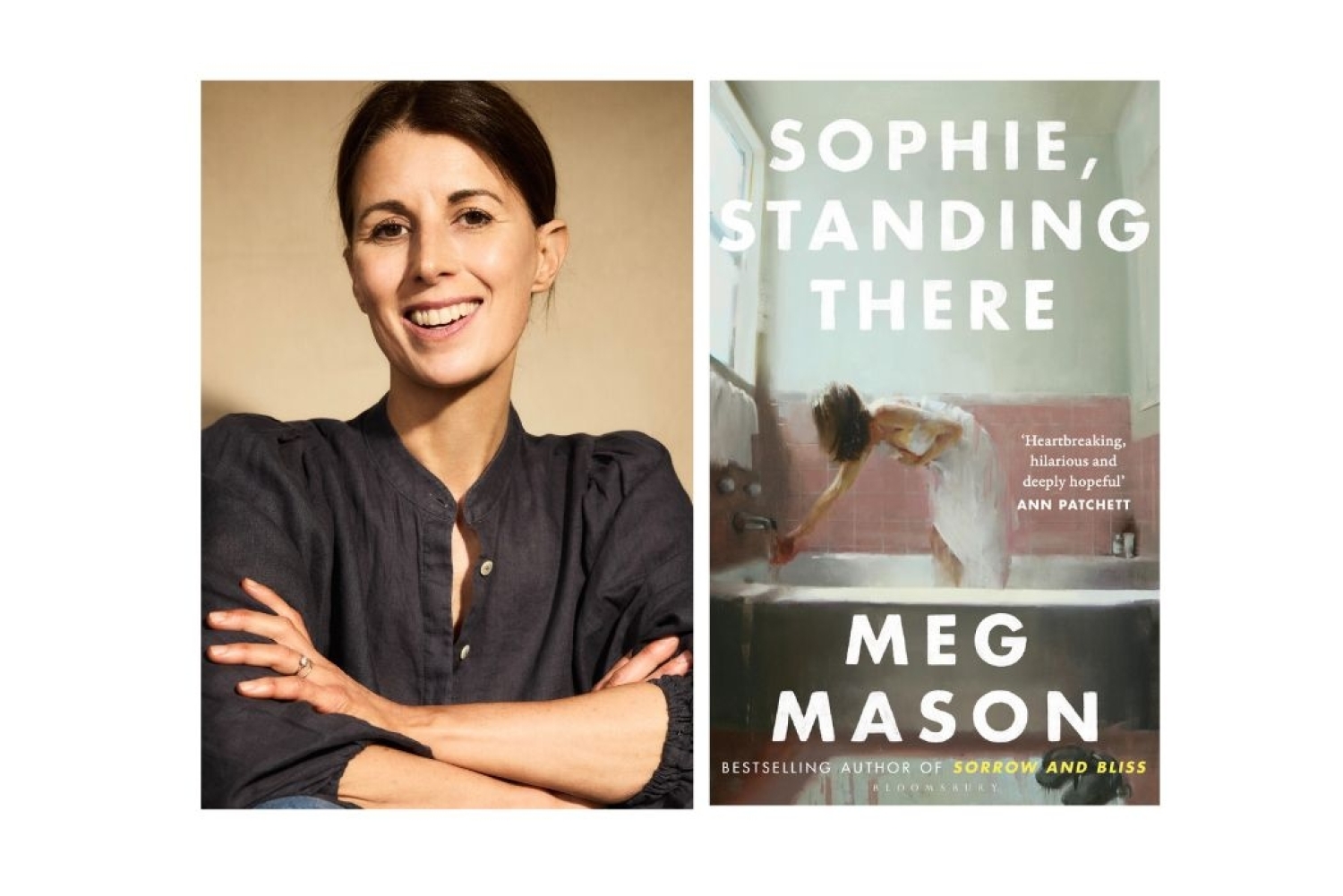
The context for when I encountered Meg Mason’s writing for the first time is a strange one. In my second year of college, I sat alone in the commons of my dormitory, unable to fall asleep. The next day, I had a class called Reading for Writing first thing in the morning, taught by Professor Arunava Sinha, and the assigned reading for the class was Sorrow and Bliss. Almost 400 pages. One night. Did I have what it took to finish it in one night? I did, and it didn't take much effort on my part. From the first sentence to the last, I was unable to look away from Meg’s writing, hungry for every upcoming sentence.
Her newest novel, Sophie, Standing There, has the same effect. Meg has an undeniable gift for writing women in all our contradictions: the things we say, the things we swallow, and the things we barely admit to ourselves. Sophie, our protagonist, has a lot of heart, such deep swells of empathy and an attentiveness to everyone around her. She works backstage at a literary festival and often blends into the background, always trying to put everybody else before her. We follow her as she finds solace in the books of a well-known author and all her book-ish adventures from there on.
This is a book that's so deeply immersed in reading culture, in the environment of the literary world itself. What made you want to write about this?
I think it's because writers often say that they feel like outsiders. You hear writers say that all the time, ‘I'm an outsider.’ Because I didn't read as a teenager, I didn't start reading for pleasure until I was 18, I've always felt illegitimate as a reader, like I can't really claim that I'm a proper reader or that I'm a serious reader. Even to say I'm a bookworm, I'm like, am I? Am I legitimately allowed to claim that for myself? Because all you hear, especially from other authors, is, ‘I was that child reading under the covers with a torch.’ Yeah, I just wasn't.
So then, that's sort of bad enough for anybody who entered reading later, but then to be a writer who didn't read, that puts me in quite a small cohort, probably. Even now, when I'm in a group of other authors and they start talking about how important literature was to them, I will be edging out of the conversation. I think those things make me feel like an outsider to that world, and I think that is actually critical. If you ever felt in the centre of something, you couldn't really write about it because, to observe, you have to be standing back a little way.
But because of what happened with Sorrow and Bliss, I also got much, much closer to the world of authors than I ever expected to in my life because I don't have any friends who are novelists in Australia. Sorrow and Bliss did very well in the UK; I suddenly found myself there and meeting all of these authors who I've loved my whole reading life, just all my heroes.
In my mind, I was just reeling. I was kind of a happy mess for two years because of this extraordinary thing that was happening to me. It meant that I also saw into that world. Obviously, in the book it's a little bit satirical. I hope it seems like a loving satire of that world because I've only ever met authors that are really well behaved. But I think one of the funny things is that readers and writers tend to take ourselves quite seriously. We can be quite earnest and a little bit pretentious.
My little guideline for myself is always to say what happened. Just say what happened. Don't try and be fancy. Don't try and be literary. Just tell the story as it occurred. Even though it's made up, I like the idea that it's one big long anecdote. And because books are part of my life and part of Sophie's life, then suddenly you're like, ‘Oh, I've written a book about books.’
What is your process of writing satire?
Well, I think I never want to be cruel. I would never create a character like Sophie and then make fun of her. I never want to humiliate my character. It's not that I wouldn't have them behaving badly or making bad decisions, but my primary thing is, do I love this person? Do I love this character? Would I want to spend time with her, even if she's not always likeable?
Satire does have that element of, is it mocking? Is it cruel? I would always steer away from that. But I think to then introduce humour into these situations that can be really sad is just a natural human instinct. I think sometimes we make our best jokes when something terrible has just happened because we have no other way of articulating it. When you're in that moment of fear, it's so huge that you almost want to contain it with a joke to make it feel manageable.
Again, it's never that you think, ‘I'm going to try and mix humour and pathos into the same story.’ Life is just a mixture of humour and pathos. Sometimes they're not even like, today was sad, yesterday was funny. It's everything all at once. Overall, I want the book just to be entertaining and to be friendly and welcoming, as though a book is an act of hospitality. I don't want to bring you to my house and then challenge you, make you feel sad, grossed out and a bit depressed. I want you to be comfortable and feel welcome.
“Overall, I want the book just to be entertaining and to be friendly and welcoming, as though a book is an act of hospitality. I don't want to bring you to my house and then challenge you, make you feel sad, grossed out and a bit depressed. I want you to be comfortable and feel welcome.”
In terms of the technical aspects of working behind the scenes of a literary event, is there any research that you delved into?
In 2020, when Sorrow and Bliss came out, I'd only ever been to a literary festival as a member of the audience. I'd never done a literary festival. Then suddenly, when Sorrow and Bliss became successful, I feel like I did nothing but literary festivals for two years. I did half a day of technical research on things like, ‘What's a pulleyway? What's a trap room?’ It was more just from being in that environment and absorbing the activity and learning. There's a line in the book about learning what the last five minutes feel like before you go out on stage, the way that time runs down and suddenly, there's momentum and you can hear the crowd. I'd experienced all of that firsthand. We'd have to ask a real sound production person whether I made it convincing.
Sophie's job could have been anything. She could have served some other function. But what I like about the job, in terms of the role it has in the novel, the metaphorical use of it, is that she is someone who is always whispering and she's in the dark, but her job is light and sound. She's making other people seen, she's making other people heard and facilitating their conversation. But does she ever get to speak? She's often ignored by these authors who are busy and focused on themselves.
I think because the overall theme of the book is connection, she wants to connect with this author in this place of loneliness. We all want to connect with someone. Her actual job is connecting people by their cables, but the connection she really wants... by the time she's done her job and the author's out on stage, she's already had her moment, and the author didn't even speak to her. It's kind of that thing of what does it look like when you put famous people and regular people in the same room? How do they connect? Do they even see and notice each other? I was 43 when I became, I guess, successful, which is quite old. So I wasn't really worried about it changing me and letting it go to my head and believing everything that I was being told.
But you do have these moments of, what if I had become a monster? Then you start to think, have I said thank you to everybody? Did I thank everyone that I met today? Did I thank the bookseller and the person unpacking the books in the festival foyer? What if I was hungry, and what if I was tired and I was frustrated and rude to everyone because you're running around? I just wanted to know what it would feel like from Sophie's side, being kind of both the author and Sophie myself.
Were there any lessons from writing Sorrow and Bliss that carried into this one?
Well, with Sorrow and Bliss, I wrote one book and threw it away and then wrote Sorrow and Bliss. With this book, I wrote maybe three books and threw them all away. Now I think this must just be my process. I'm just working it out on paper. I think the key with Sorrow and Bliss is that nobody was ever going to see it. I didn't think it would ever come out, so I wrote with complete privacy.
With a new book, obviously there was no chance of convincing myself that this was a private experience. That's a wonderful problem to have, but it's still something. Some writers need permission. Some writers need a sense of their public or a sense of their reader. I'm one of the writers who needs to feel safe, protected and really alone. It was very, very hard to convince myself that that was the case. I did it in the end by telling everybody I was writing one thing, while I was actually secretly writing Sophie. Nobody knew. The funny thing as well is that, out of love, when you've had a success, people are like, ‘No, just don't put pressure on yourself because you'll never write another book as good as Sorrow and Bliss. Don't worry about it. You simply cannot replicate that success, so just don't even try.’ You're like, ‘Okay, I guess. Okay, that's probably sensible.’
Then you're like, ‘Well, I still have to write as though I'm hoping it will be the best it can be,’ and not be like, ‘I'll never surpass my own peak.’ It was pretty different, but it was probably more joyful in a way. Once Sophie came to me, because she's such a joyful person, I got to spend eight hours a day with someone optimistic, positive and stoic.
Through the book, Sophie turns to books for solace. She turns to her work for solace. So, what brings you solace?
No one's ever asked me before. I think, truthfully, the 1995 BBC adaptation of Pride and Prejudice is where I will always go in moments of duress. But I think, to be honest, writing. When writing is going well, that's the only place I ever want to be. People will often be like, ‘You need a break. You need to relax.’ I'm like, ‘No, no, no. Writing is a break from everything else.’ If I'm not struggling with what I'm writing, that's my safest place because it's totally constructed. It's all in your head. You can make it whatever you want, and it totally separates you from the real world. You live in this imagined environment where no one can get you.
This is an article from the August EZ. For more such stories, read the EZ here.
Words Neeraja Srinivasan
Photography Anne Peeters
Date 27.8.2026