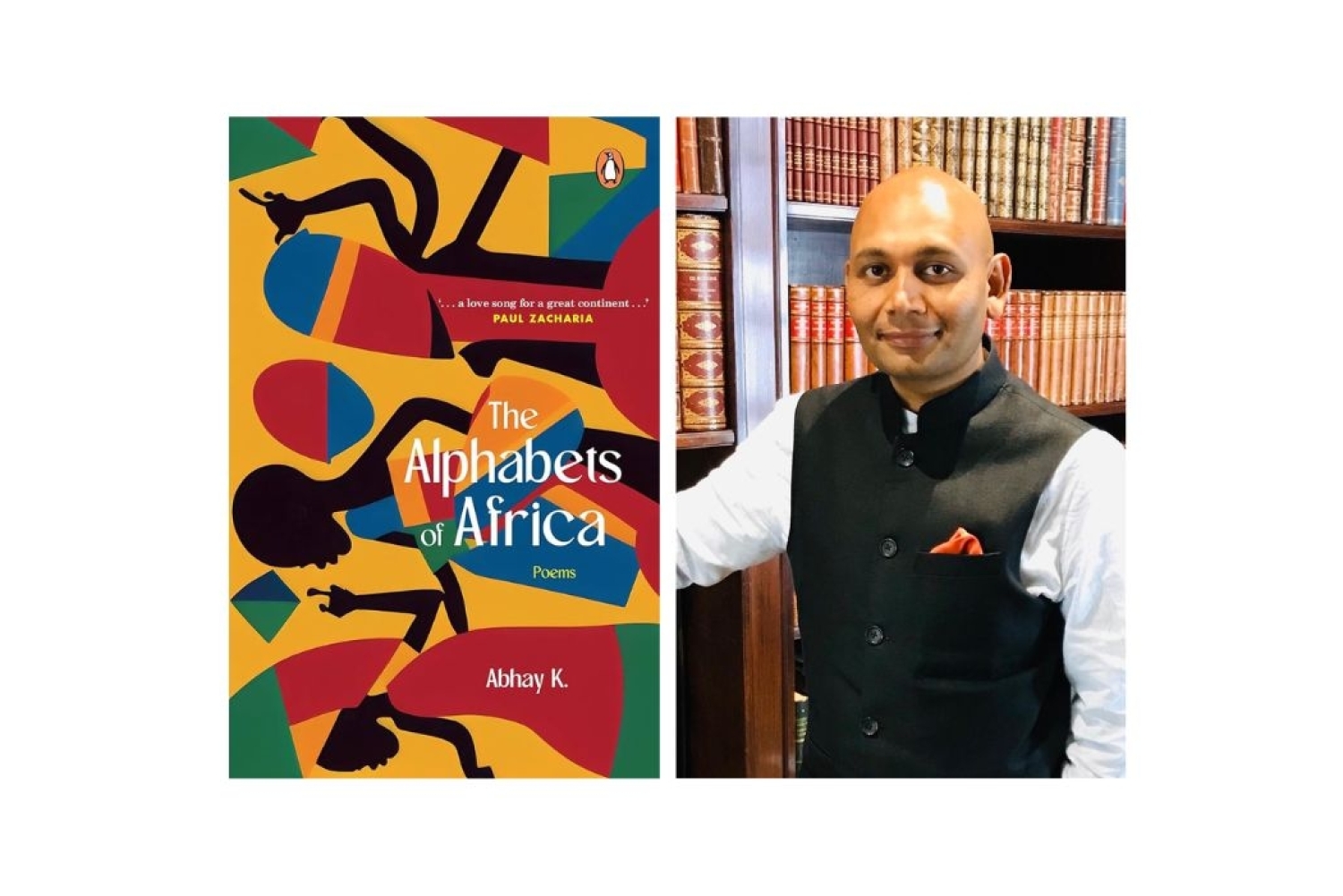
The Alphabets of Africa is an ode to a continent that continues to define the human journey. Through time, space and memory, these poems map Africa, celebrating its vast history. From the splendour of its ancient civilization to the pulse of contemporary African cities, to inspiring icons and leaders, this book summons Africa in all its depth and glory. We're in conversation with the writer Abhay K. on the creation of his collection, the importance of Africa, his writing process and more.
What first compelled you to imagine Africa through the structure of a poetry collection?
Africa is our home continent. Our human ancestors evolved there about 2,00,000 years ago and migrated to the rest of the world about 80,000 years ago. Each one of us, therefore, as Homo sapiens, is African. We all carry African genes. Wherever we live, visiting Africa, our ancestral homeland, may be seen as a sacred act of pilgrimage, at least once in our lifetime. Africa is a continent with a rhythm of its own. Its diversity is immense. To know more about ourselves, we must learn more about Africa. This poetry collection is my attempt to capture the astounding beauty and diversity of the continent. Through The Alphabets of Africa, I invite you on a rewarding and enlightening poetic journey—not only across Africa’s geography but also through its history.
How did your travels across the continent shape the tone of these poems?
I visited Africa on several occasions and gained first-hand experience of its rich and diverse cultures. of Africa. As Lauren Menshikovas writes —‘This collection is truly a beautiful celebration of Africa. I love how the poems are arranged alphabetically, which takes you on a journey across the continent—from its stunning landscapes to its rich history and vibrant cultures. It feels like travelling through Africa, discovering its many layers and wonders with every poem.'
What personal realisations did you encounter through the process of writing this book? What did you lead you to confront about Africa, or about the world at large?
Before starting to write this book, I thought, 'what is it that I don’t know about Africa'? It’s a continent with great biodiversity, where one goes for a safari. But when I started exploring Africa through time and space, reading it’s history and literature, listening to its music and rhythm, watching and experiencing its myriad dance forms and rituals, I realized I know nothing about Africa, absolutely nothing. Here are some interesting facts: If you relish Coca-Cola, the cola nuts come from Africa. If you drink coffee, it originates in Ethiopia. If you love jazz music, it originated among the African inhabitants of New Orleans. If you stop at a traffic light anywhere in the world, it was invented by an African-American, Garret Morgan. The cobalt used in lithium-ion batteries and vitamin B-12 comes from the Democratic Republic of the Congo. The Narmer Palette, the world’s first historical document, a 5000-year-old engraved stone tablet showing the unification of the two kingdoms of Upper and Lower Egypt under one ruler, Narmer comes from Africa. The world’s oldest known surviving peace treaty, between Ramses II and ?attušili III, was concluded in 1259 bce. The Amarna Letters are considered to be the world’s first diplomatic correspondence, between the Egyptian Pharaoh Akhenaten and the Mitanni king Tushratta. The Manden Charter, from thirteenth-century West Africa, is one of the oldest oral constitutions and proclaims social peace, the sanctity of human life, education, food security and the abolition of slave raiding.
Mansa Musa, the fourteenth-century ruler of the Mali Empire, is considered the richest king in world history because of his control of vast gold mines. General Hannibal crossed the Alps to invade Rome. Massinissa, the King of Numidia, turned North Africa into a major regional power in the Mediterranean. Malik Ambar, from Harar, Ethiopia, was taken to India as a slave, but he rose to become a great military leader and statesman and became the de facto ruler of the Ahmednagar Sultanate. He played a significant role in building Maratha power. He recruited Maratha soldiers, and his military strategies and administrative principles heavily influenced future Maratha leaders, including Maloji Bhosale, grandfather of Chhatrapati Shivaji Maharaj. Shaka Zulu united his people and transformed the Zulu kingdom into a powerful empire in southern Africa. These are some astoundingly important contributions of Africa in shaping our modern world, which does not get talked about much. Discussions on Africa rarely happen at literary festivals, which are often dominated by writers from Anglo-Saxon countries.
These 180 poems merely open a window to Africa, inviting the readers to explore a fascinating world which is yet to be experienced afresh.
“I don’t think a poem is ever complete. It is merely abondoned at some point. ”
What does mapping Africa through poetry allow that history cannot?
I think poetry has this unique ability to capture feelings about the people and places, bring them back to life, which history normally doesn’t do. In the words of South African poet Sandile Ngidi, 'The Alphabets of Africa is a warm and delightful love letter to Africa.' Ari Gautier writes 'From A to Z, Abhay K.’s lullaby-rhymes pay tribute to the cradle of humanity. His poetry returns to Africa its stolen, plundered and despoiled humanity over centuries of violence.' I think just writing history in a traditional academic way cannot do it.
What is your writing process? When do you know a poem is completed?
I work with fragments from the lives of interesting people, their quotes, major events in their lives, their trials and tribulations, successes, legends about them, and so on. I write about places that interest me, about their peculiarities and histories, customs and traditions associated with them.
I don’t think a poem is ever complete. It is merely abondoned at some point.
What’s the future like, what are you working on next?
I have written and published poetry collections titled The Alphabets of Latin America and The Alphabet of Africa. In this series, I am working on a poetry collection on India where I spent my last three years travelling all across the country.
Date 10.2.2026