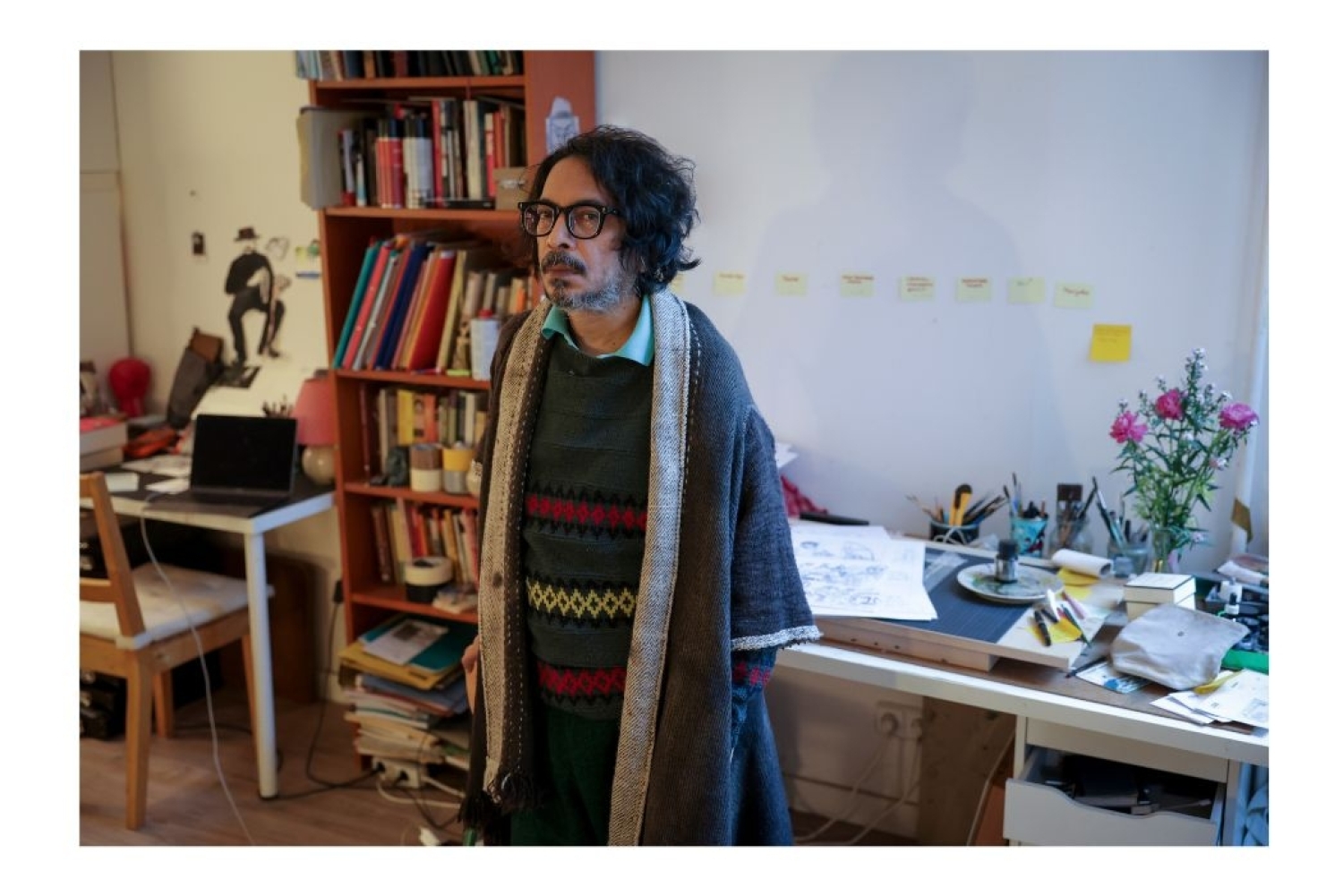
Your City is a series where we ask writers, musicians, artists and designers about their cities, understand their relationship with the city and how it influences their art. Today, we have Sarnath Banerjee tell us about his favourite haunts in Berlin.
What is your favourite quiet corner in Berlin? A place where you go to clear your head and feel lighter?
That would be Tempelhoferfeld, a four-square-kilometre terra nullius of an abandoned Nazi airport at the centre of Berlin. It's vast and empty, and during winters it gets misty and otherworldly.
Tell us about a comfort café or restaurant where the food not only satiates the stomach but mind too?
I live in a migrant heavy area of Berlin. Typically, I avoid hipster cafes and hang around in Turkish coffee houses and Syrian bakeries. There’s a Kurdish falafel place called Barakat where I often eat lunch. When I need to socialize, I take people to a place called Elit Simit, which serves chai, simit and menemen. My high street, Karl Marx street, is full of eateries-Yemeni, Lebanese, Palestinian. I only go to German restaurants when I have guests visiting from India.
If you craved a long, reflective walk, where do you find yourself?
Three chapters of Absolute Jafar are dedicated to walking - Addis Ababa, Karachi, Tokyo, Sarajevo, Dhaka, Delhi and Berlin. When I cross the rail tracks near my house, I enter miles and miles of edge-lands, not quite city, not quite country, mostly dachas, garden houses and woods. They are interrupted by vast industrial landscapes. Barren and disquietingly sparse. Innumerable canals crisscross the area, and as a result, there are many bridges. As I walk through these uncertain areas, I seem to walk out of the confines of time and space.
As I am getting older, I seem to walk away from the city rather than towards it. I sometimes go to Mitte, the CP of Berlin, or Wedding (once a communist hub), or the Frankfurter Allee to walk amidst imposing soviet style architecture and think of a time when Berlin was called soft Moscow.
When I have visitors from India, I take them to the fancier neighbourhoods of Schöneberg, Nollendorfplatz, and Kurfürstendamm to show them that I don’t live in a third-world country.
If someone wanted to go to a lively space for art, music, or events, where would you guide them?
There are a lot of eccentrically run bars in my neighbourhood, and all across Berlin. They are also great musical venues. You find these through word of mouth and underground networks. They are never really advertised in any big way. You can hear Bulgarian folk music, Georgian chants, cool jazz, electronic music, Balkan music, Klezmer, Palestinian dubke and all sorts of stuff. Some of the world's best and poorest musicians live in Berlin. And the best of them don't just play at big clubs like Berghain.
What is your favourite bookshop?
Hopscotch, run by Siddhartha Lokanandi, which, like many good things in Berlin, is also closing down. It feels like the city is coming to an end. The techies, speculators and investors have already moved in. They have money, the city has become more and more precarious for ordinary people. Property prices have shot up.
State funding is also diminishing as the new regime is directing most of its money to the military industrial complex.
Complete the sentence: One should not leave Berlin without…
Visiting the Stasi Museum. A museum dedicated to vintage espionage. Almost cute in this current world.
Words Platform Desk
Date 18.4.2026