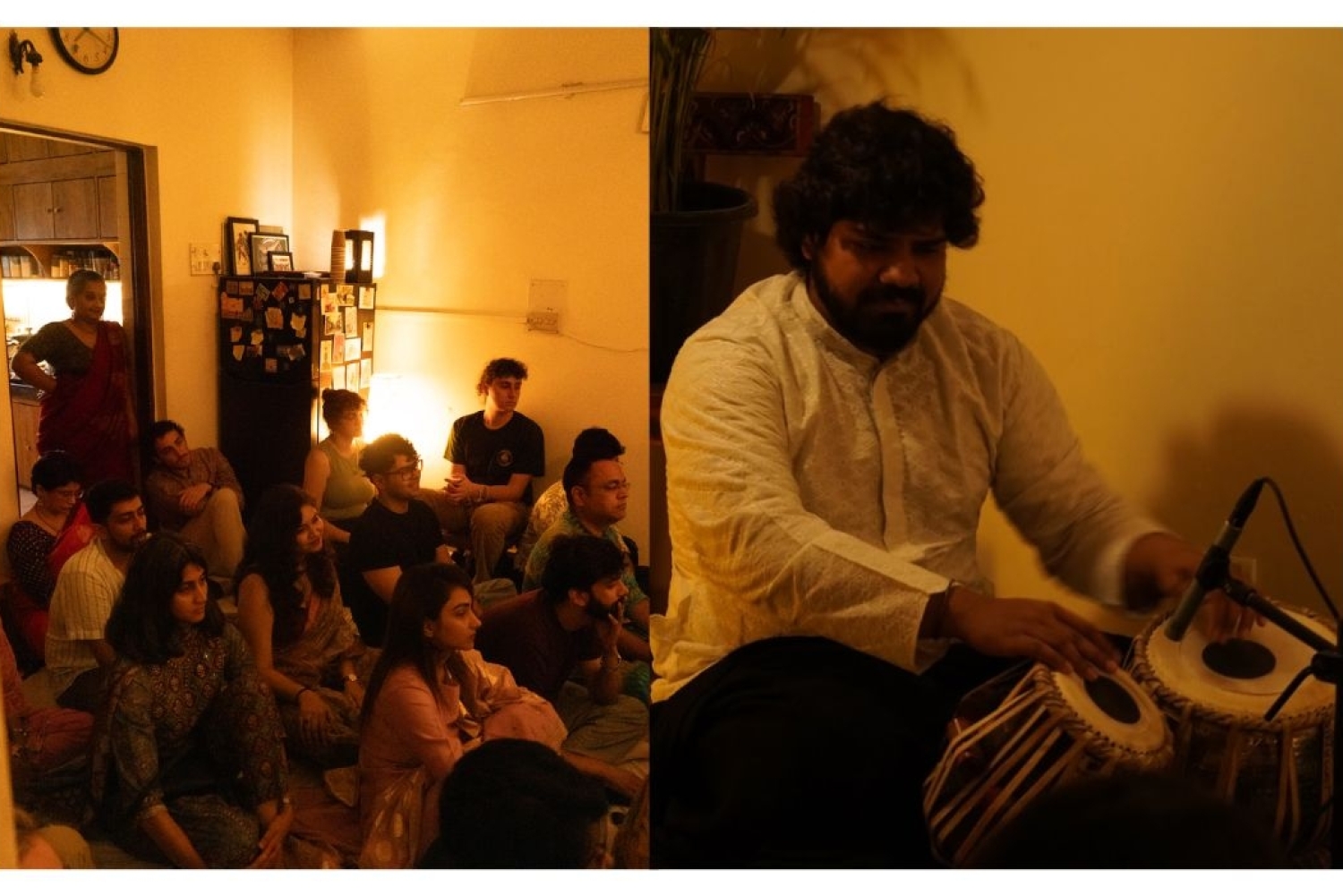
Imagine a classical concert without the bounds of rigid rules and structures, with nobody telling you to hush, or sit a certain way, or perform your understanding of the music. At Upstairs, the idea is quite simple. Open doors to lots of kinds of people: from those who are enjoyers of classical music, to those who are listening to it for the first time. The range of audiences at Upstairs flourishes to present a format of listening and performing as something more democratic, intimate and welcoming.
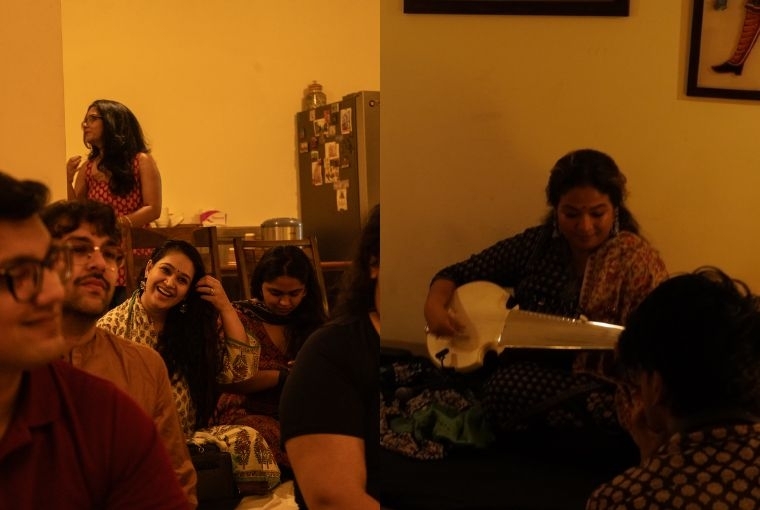
By opening up baithak concerts, encouraging conversation, and prioritising fair pay for artists, Upstairs is reshaping the culture of classical music today. A few weeks ago, I wanted to witness the magic of this baithak myself, and made my way to an Upstairs concert with Debasmita Bhattacharya on the sarod and Zuheb Ahmed Khan on the tabla. The way it unfolded was everything I expected: with a short conversation on everyone’s backgrounds and relationship with classical music, some chai, and lots of anticipation for the performance of the evening. Although I trained in Carnatic music for over six years, the intricacies, or as I like to call it, the rumbles and tumbles of Hindustani music was unfamiliar terrain for me. Irrespective of that lack of exposure, one of the most noteworthy and heartening aspects of Upstairs, is how many young people were in the room: both as the audience, and as members of the organising team.
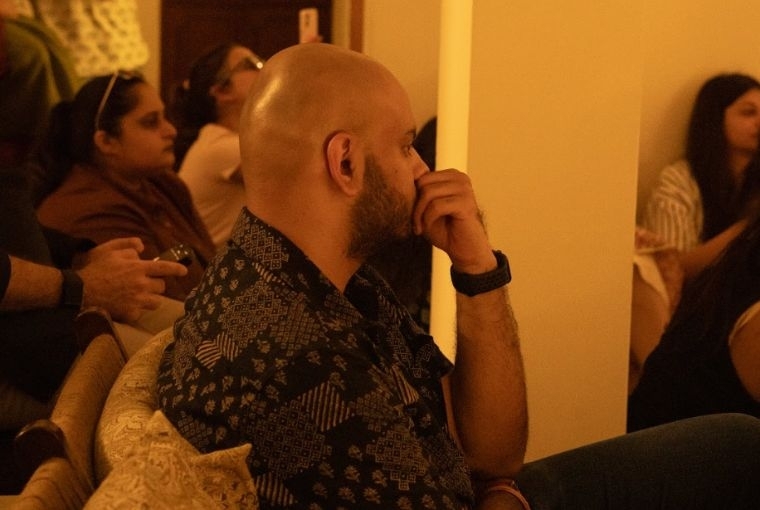
As the concert began, I let myself close my eyes and let the music wash over me. For me, so much of the experience was moulded by the fact that I could see the faces of other members of the audience, observe the moments at which they ‘Aha!'-ed in joy, or when the taalam on their fingers danced along their knees.
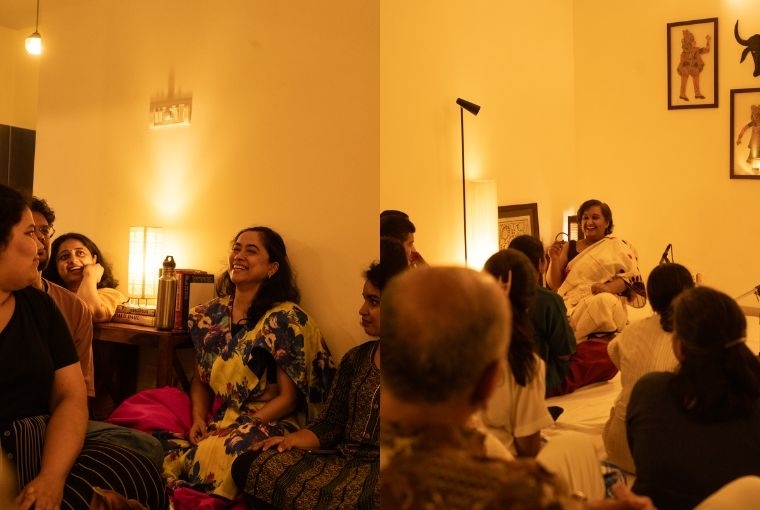
We’re in conversation with Sukanya Banerjee, the heart, brain and soul behind the entire movement. We delved into making classical music more accessible to younger and newer audiences, the importance of shining much needed light on instrumentalists, and giving artists what they deserve.
The Beginning of Upstairs
I come from a family of musicians. My mother, my grandmother, they're all trained classical vocalists and practitioners, meaning that they are both performers and teachers of classical music. So, baithak culture is a very ordinary part of a classical musician's life, except that these baithaks are generally reserved for people that one knows, right?
That was one of our main motivators for starting something where we were doing baithaks that were open to strangers, where strangers could walk in, where people we don't have any connections to could be exposed to them. And also, it's a way of stepping out of one’s own echo chamber. When Tejas and I got married in 2017 and we had our first home, we said that ‘Okay, I mean we're not rich enough to be able to pay fairly, and call artists of our own income. But we do have a home, we have a living room that we can host in, we have a kitchen that we can cook out of. We'll do what we can and we will crowdsource the rest.’
Paying and Valuing Artists
I think it's very convenient that this doesn't get talked about, because as long as you're not talking about it, no one knows that people aren't getting fairly paid and therefore, no one needs to get fairly paid. But in the post-colonial liberalised world where patronage does not exist in the same form as it used to for classical music, as it did when we had princely states and those social hierarchies, where they used to be held by zamindars. These were things that the landed gentry did to hold their community together and these were things that were invested in. The language is still that artists will do service, they will do the seva and they should not care about money, or success, or popularity, because that's not what decides the quality of the music.
It's very easy to continue to oppress the performer by saying,’ why are you asking for money?’ And that's what happens. These conversations need to be out in the open, and we need to start talking about these things, because until we do, we will all live in our own understanding of fairness without actually examining what fair means objectively, and that subjectivity is very convenient for oppression.
Reimagining A Format For Classical Music
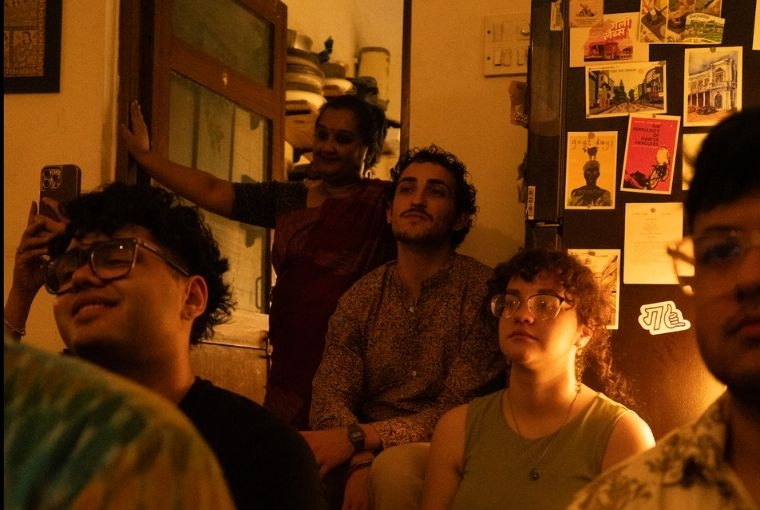
I think there are two things here. One, that the prevalent understanding of engaging with music is that you will listen to music. But you need to also think about music, you need to also talk about music, you need to also analyse music. There's a lot to be said, and a lot to be done, beyond just listening to music over and over. Active listening cannot come without education. And I think the reason that we think this way is because Tejas and I are both educators.
The second reason is again, education. For anyone who is interested in classical music, the only kind of education that exists at the moment is orientated towards performers. So it's like, ‘Oh, you're interested in classical music? Chalo, start learning Sa Re Ga Ma.’ It's a huge logical fallacy. Learning classical music from the ground up, is at least a decade long process before you reach the point of comprehension.
These were our two reasons for doing The Upstairs Immersive, [a festival that comprises of baithaks, workshops, lectures] that we started doing in December. We did not want to spend the majority of our time listening to performances. We wanted to spend the majority of our time decoding things, talking about things. We wanted to design a fest that was orientated towards listeners. Not towards performers.
The Curation Process
There are a few biases that I'm trying to correct through my curation. Let me begin by saying that the process of curation is a subjective process. And as the person who's hosting the baithak at home, or who is curating wherever I'm curating, I have the privilege of being able to curate a person whose performance I would enjoy listening to.
Everybody that I have curated so far, I have curated after having heard three to four hours of their recordings, at least, and sometimes maybe even more. With curation, there should also be a skew in favour of good quality. For that to happen, the curator would have to have that level of understanding of classical music themselves, which most of the time the organisers or curators don’t have.
What’s Upcoming
One, I'm working on curating more Carnatic representation. I think at the Immersive, we've been able to do more of a fair job with that, because in the last Immersive we had one day of Hindustani, one day of Carnatic. This time we couldn't make it happen but, we've already planned it such that the next fest is going to be more towards a swing in the other direction, so that we can again bring things back to an equilibrium.
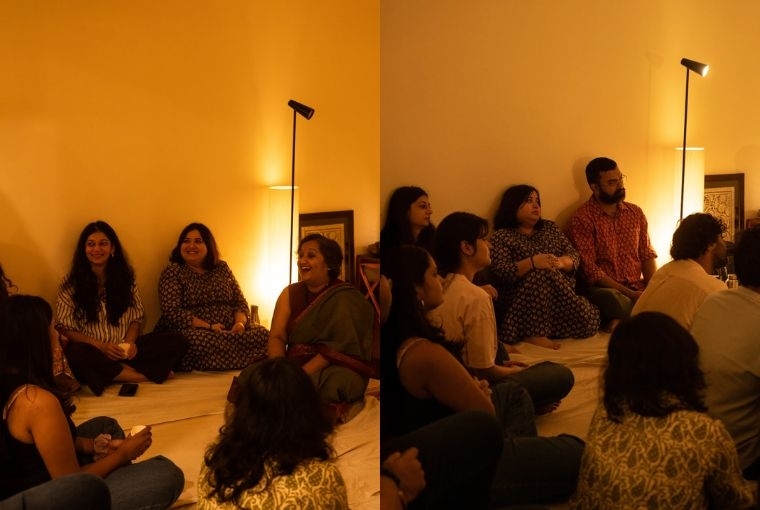
Two, at Upstairs our work is very consciously focused on intimacy at scale, meaning that I would be much keener on increasing the frequency than I am on increasing the size, because there's something very potent about a room where everyone feels familiar and can speak to each other freely. It's only then that questions can happen, that new ideas can be had or you can take the intellectual risk of trying something you've never tried before. Honestly, my dream this year is that by the end of the year Tejas and I should be able to draw salaries. We haven't done that in a year. So, this year I'd like to!
For more details on how to attend an Upstairs event, browse their website here.
Words Neeraja Srinivasan
Date 13.3.2026
Photo Credits Arnav Jindal, Sakshi Mishra