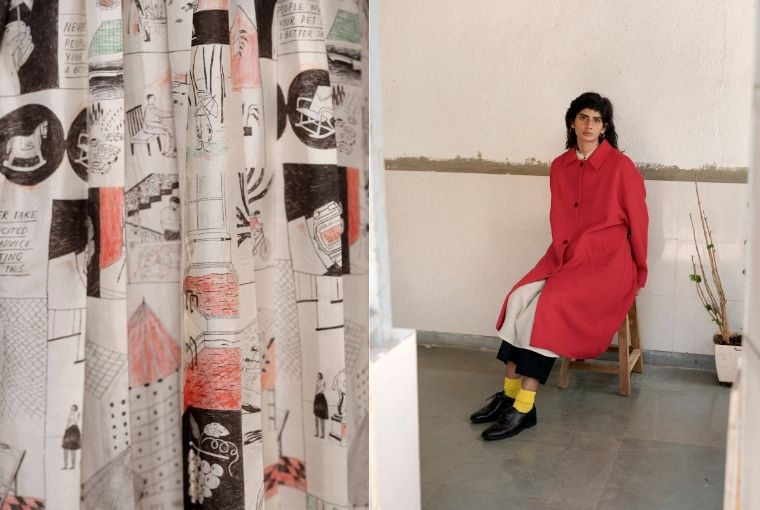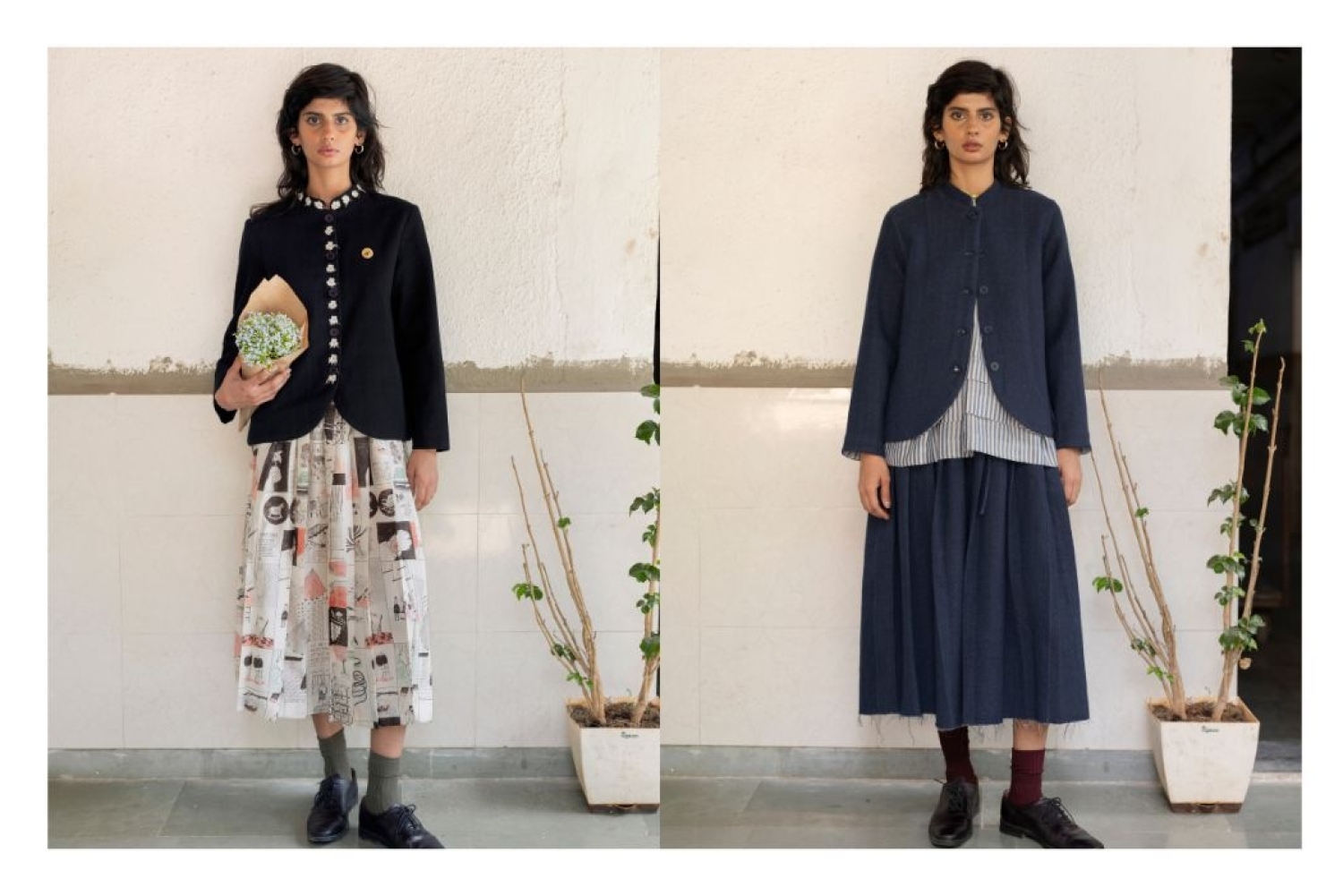
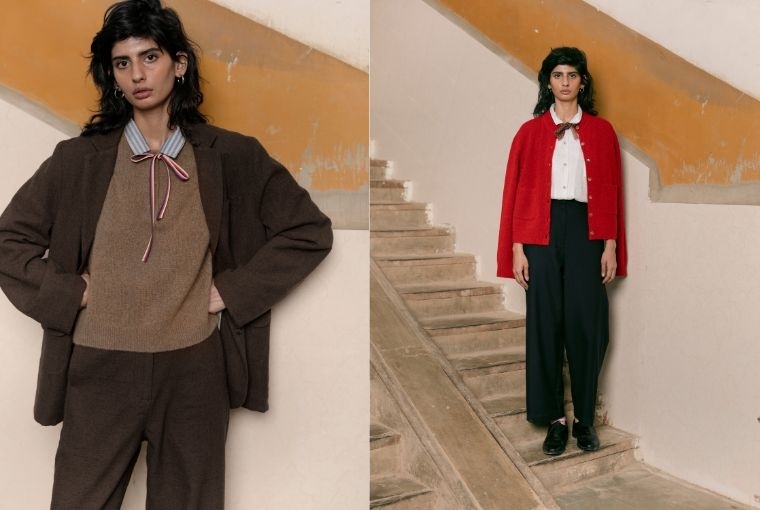
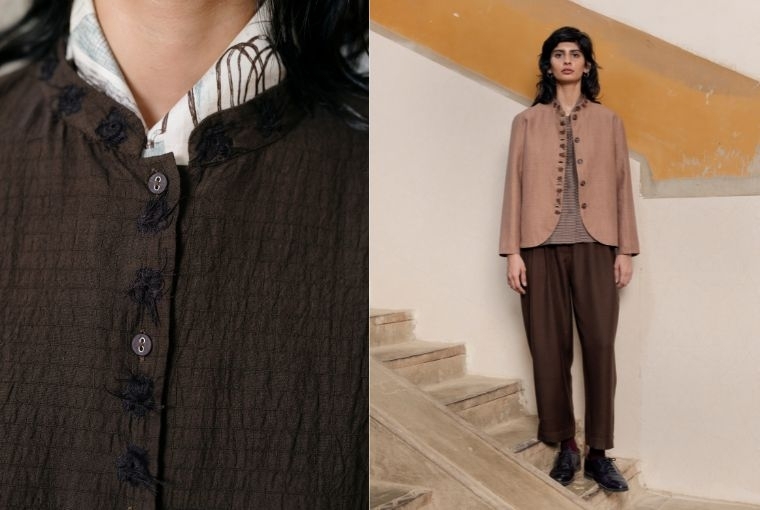
Simple designs that stay contemporary regardless of what’s trending at the moment is the ethos that the founder of Runaway Bicycle, Preeti Verma, follows while designing collections. Here, everyday wear is given a little edge of flair, lots of stripes, checks and the occasional dramatic collar. Even the colours are distinctive in their mutedness and while they are subtle, they still have a character of their own. Dark indigos with small embroidered flowers, earthy browns with raw-edged detailing and soft, rust-toned dresses with gathered skirts bring a slice of chicness that dailywear deserves. The easy-breezy silhouettes make it difficult not to want to touch the fabric and slip into a piece yourself. We spoke to Preeti about the primary ethos behind the label and how it all came about.
What is your relationship with design? Could you tell us a little about the roots of Runaway Bicycle?
Fashion had always been an area of interest for me through my initial years in advertising. I essentially started by designing clothes for myself. Just making things that I’d like to own myself.
Runaway Bicycle started off because I wanted to market those designs which I'd love to wear myself. For instance, what would you make if you had a chance to design your clothes? It isn't about being fashionable and up to date with the trends. Simple designs that will stay contemporary irrespective of the trends.
Tell us about your ethos behind ‘trying to give expression to goodness in every sense of the word’ and how do you translate that in the design of your products?
The language our clothes speak today has evolved over the years and continues to do so. With every conversation we have with our buyers, every interaction we have with our weavers and technicians and every garment we produce.
At Runaway Bicycle, we still don’t know what our ethos is. What drives us everyday is to make simple clothes very well. Clothes that will last, not just the ravages of time but also those of passing trends and fashions. In fashion terms, we will never stand out distinctly but it is in the quality of the fabrics we use, the attention we pay to every stitch and detail that we hope makes us distinct. For example, our attitude to pockets, where our garments without condition came with functional pockets as deep and spacious as those in garments for men.
What kind of materials do you gravitate towards and what is your creative process?
We create our own textile. In the world of similarity, it’s the details that stand out. For some it’s the detail of a cut or a stitch and for some it’s the detail of a weave, For us it’s about how you change your weave in a very simple way that it gives you a very different texture. You might not even notice it but it does serve a purpose.
For us it’s about working with weavers right from the start to make sure we start with the best fabrics. Our fabrics in turn influence our designs which are then crafted with a painstaking eye to detail and craftsmanship. Eventually the aim is to bring together some of the finest handloom fabrics we can design with cuts and forms that do justice to the comfort of the fabric. It’s a simple process. We start with out sketches, narrow down on the fabrics we’d prefer, look for weavers, get in touch with them, some magic and its done.
Could you also take us behind the scenes of your dyeing process and how you achieve specific colours?
All of our dyeing is done at the clusters. These are manual processes and painstakingly require great effort. From cleaning, preparing, and immersing yarn hanks into dye baths before they are wound onto looms for weaving. Achieving an exact shade every time is slightly difficult since it’s a manual process and dye is not done via machines, a slight variant in colours in every batch is quite acceptable for us.
Your clothes are light, airy, simple and yet carry elegance. Where do you look for inspiration and who is the ideal Runaway Bicycle customer?
There is no particular designer really. Our inspirations lie in the small details of our everyday lives, right from our childhood. You could say that the small joys in life and their inherent simplicity inspires us. Just a conscious effort to mold the fabrics into really comfortable clothes. Our ideal customer is someone who approaches life in a carefree manner.
What does sustainability mean to you and how do you enforce it in your practice?
Sustainability is one of the most important things. If it’s not sustainable its not worth it. Fashion certainly needs to be a responsible industry. Not just for the sake of the environment but also for its own sake. There’s a lot of thought put into what we do, right from the weavers we work with or say our fabrics and dyes. There are no middle men involved.
Working directly with weavers or through NGO’s ensures that they are benefitting from this affair. All the fabrics employed by us are handloom. Something deeply rooted and innate to our country’s rich textile culture. We go back to regions where such art and materials have originated and work with the artisans directly, which perhaps gives them more incentive to keep their art going in today’s machine dominated age. The organic cotton for instance is a rare genetically pure grown in the drought prone region of Kachchh without any intervention from expensive pesticides, irrigation, thus is energy efficient and virtually carbon neutral.We’ve also used natural dyes this time around, further working on our sustainable model.
What are you working on currently and what’s next?
We are working on SS27 collection at the moment which we’ll be showcasing in Paris coming October. Also, we are working on a music gig in our studio soon.
Words Neeraja Srinivasan
Date 4.9.2026