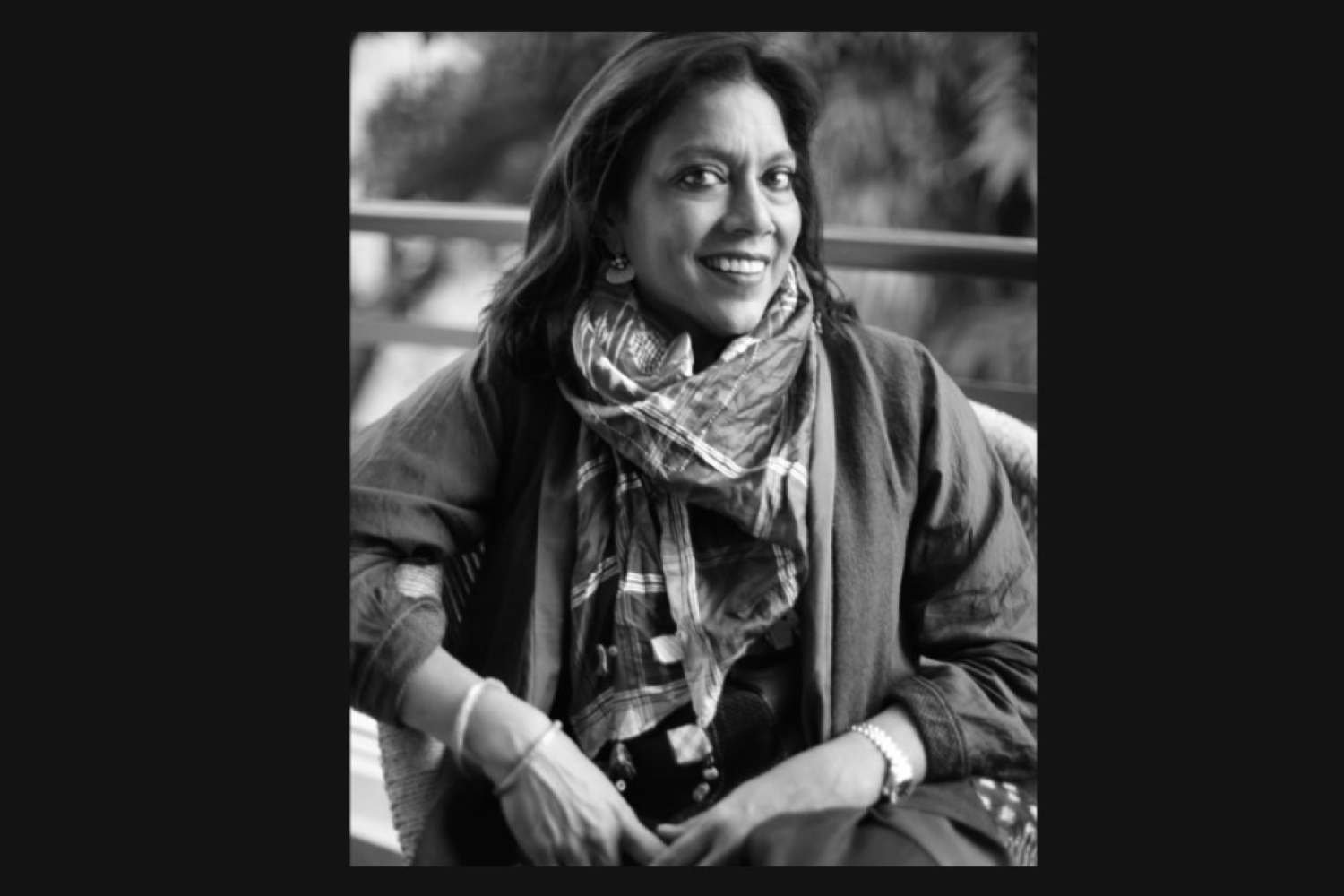
It is a late Monday afternoon when I am invited inside Mira Nair’s residence in New Delhi. Her house has a bewitching aura about it. The space is speckled with quirky little knick-knacks and furniture – a sofa chair patterned with embroidered teacup motifs, an antique pedestal fan in a corner, an unconventional saucer-shaped lamp suspended from the ceiling. Light seeps in through the large French windows as she directs me to her living room. She asks whether I’d be interested in a cup of tea and I sheepishly accept.
I have always nurtured a certain image of Mira Nair, but she is that and perhaps much more. What I had imagined to be a no-nonsense, one-on-one Q&A with this multi-award winning cinematic icon, turned into an intimate affair pickled with laughter and candid gestures, where Mira guided me through her journey as a filmmaker, sometimes leaving me awestruck with the battles she encountered to become who she is, the successes and challenges along the way, and the cinema she stands to represent today.
Radhika Iyengar: Let’s go back to childhood. What’s your first memory of the arts?
Mira Nair: My father grew up in Lahore and we were raised in modern India, in Orissa. We were Lahoris without realising it. We spoke Hindustani and recited the poems of Faiz, we heard Iqbal Bano and Noor Jehan almost daily, and Begum Akhtar came to stay with us. It was amazing, but we never thought of visiting Lahore, because we couldn’t in those days.
[In 2005, Mira was invited to visit the city of her father’s birth for the first time and was engulfed in a deluge of familial get-togethers.] Through the family mehfils, I was introduced to a different portrait of Pakistan – one that was seeped in art, refinement, tehzeeb, music, largesse, hospitality and warmth. It was different from the Pakistan we read about in the newspapers, and I felt that I had to do something about contemporary Pakistan.
RI: And then The Reluctant Fundamentalist happened. What drew you to Mohsin Hamid’s novel?
MN: It gave me the portrait I was looking for. That was the first impetus that led me to seek this novel out, but what was great about the novel was that it was a dialogue with America. It depicted both sides and I also know both sides intimately. As someone who has lived in America for a while, and also is a New Yorker – after 9/11, it was palpably a different city. People like me, who never felt out of place, suddenly were made to feel like the “other”. And one would never hear about the other side there. It was a one-sided demonisation that just kept happening, and I felt that if we didn’t tell our own stories, no one else would.
RI: You often pick up great pieces of literature to give them a place in mainstream cinema. There was also Vanity Fair, The Namesake, and A Suitable Boy. What propels you to choose books for film projects? Is it easier to adapt a novel, as opposed to starting from scratch and writing an original screenplay?
MN: I don’t think it’s a plan. It’s just that if the story possesses me or captures me in some way, then I’d want to make it into a film. Of course, I also have to have a vision for it. Each story culled needs to have an undeniable emotional or inspirational connect.
The Namesake was very different, because I was already making a movie when I had a terrible grief overcome me. I had lost a parent, my mother-in-law, whom I was very close to. It was unexpected and we had to bury her in New York, in a country that was so far away from her home. So I was melancholic and I happened to read the book on a plane back to India and I felt in Jhumpa [Lahiri’s] story that I had found a sister, someone who understood such grief. I dropped everything, including the other movie, and called Jhumpa up and she gave me the book instantly over the phone.
For A Suitable Boy, it comes from the real love for the book and that particular time in India when it was going to have its first national election. It was a charged time for the country, much less populated as compared to what it is now, much more peaceful, much more handmade. It was a time of great co-existence, old associations and total integration between Hindus and Muslims despite partition. And that adaa [charm] and that time, wow, if we don’t remember it, we will never believe it existed, especially with what is going on now in our country. By which I mean, the conscious obliteration of a deep part of our culture. We must remember what India was like – it should not be forgotten, because it’s about who we are as a people.
RI: Did the success of your first feature film, Salaam Bombay, come as a surprise to you?
MN: I had never been to a film festival before, and overnight we were the toast of the world because they had never seen a film like this. At the time I was living in some old lady’s corridor in Cannes because I couldn’t afford it. And I had given this poor lady’s number in the catalogue of the festival program because back then, there were no cell phones. After the premiere, I staggered back home at 3am and until 7am, the lady’s phone kept ringing with distributors from all over the world, and there I was, standing in my pyjamas attending the calls!
“I think the greatest challenge of being an artist is tenacity. Is to run the long distance marathon. To keep the tenacity, and not diffuse the spirit that might have been the inspiration in the first place. That’s key.”
RI: Whether it is Chaipao, the street kid who delivers chai to a prostitution camp in Salaam Bombay, Gogol who finds himself trapped in cultural ambivalence in The Namesake or the beautiful courtesan, Maya, who is a servant girl in Kama Sutra – you tend to pick characters from the peripheries of society and place them at the centre…
MN: I’ve always questioned this idea of the so-called ‘marginal people’. Who decides marginal for us? I’ve always resisted that box that people put others in. More importantly, whether it’s the strippers in India Cabaret or the street children in Salaam Bombay, or a black person in a white context – I have always been inspired by their sheer resilience, their never-say-die attitude and their willingness to live life as it’s handed out, without having a chip on their shoulder. I get so much strength from people who are considered on the edge. So, it’s not because I’m sorry for them or that I want to put them on a pedestal. It’s because their story and the power they have to endure everything with panache is a universal lesson for all of us. It just turns me on.
RI: You have a penchant for holding a metaphorical mirror, where you depict family dynamics through intense events, where you strip the characters down to their truest, most human form. It’s at this point that the viewers begin to identify themselves with these characters. Why is holding this metaphorical mirror so important to you?
MN: I sometimes say that my films are like accordions – they expand and then they squeeze your heart. I believe that if your heart [as a viewer] expands with laughter while watching a character, it will feel much more when the same character is hurting. So, I really believe in this yin and yang, this kind of balance, in order to make the audience more receptive to the characters in the story. That is why I often love to make ensemble films, because I don’t think of life as solely a hero-heroine story – it’s the whole world that I’m fascinated about. However, in that world, if you don’t make each character distinctive, then you’re screwed.
RI: You have mentioned before that ‘for a filmmaker, literally everything has to be chosen – you have to be mindful and aware of every single thing’. Can you give me an example?
MN: I do whatever it takes to make a set come alive. In A Suitable Boy, since it was a period film, everything was preordained. However, when we were filming in a number of ancestral homes, I decided to cast the servants of those particular homes. In India, upper middle-class families can only live the way they do because they have staff. So, in almost every shot, you will see some staff member doing something in the background. Of course, we dressed them according to the period, but it was great because each of them moved in these homes so naturally. Then, everything feels rooted, everything feels so natural, that as viewers, you begin to trust this universe that has been created.
In terms of creating the period, there were beautiful, decayed forts and crumbling havelis in which people really lived, which we refurbished. In the end, everyone wanted us to come back because we made their old homes look so great. We also went to places like Maheshwar, where people often don’t film, so the locals were more authentic and natural for camera. We managed to get a nice evocation of the older world.
RI: How do you make a character from the 1950s fascinating to today’s audience? Let’s talk about Lata, for instance.
MN: Now, Lata [from A Suitable Boy] is intellectual, she’s bookish, she believes in love but hasn’t personally known it. One of my favourite lines is, where Vikram [Seth] asks through Lata, “Is it possible to be happy without making others unhappy?” As human beings, we are all part of many things.
I wanted the film to speak to today’s times – whether it’s in matters of love or the nation. We had to stop shooting when the Ayodhya verdict came out, since Babri Masjid is in the heart of our story. Also, it was it was uncannily timely that we finished shooting on 17th December 2019 and the CAA [Citizenship Amendment Act] protests began on 19th December – where the citizens of India refused to accept the defeat of secularism, which was, of course, written in the Constitution of India. The latter was written in the fifties when our story is set. So, through this film, I hope to speak to the people of today, to tell them, “Look, this is where we came from, this is what existed. Don’t forget what we made our country for.”
RI: What do you want your audience to take away from your cinema?
MN: I would love it if people, once they have seen the film, reflect on their place in the world. And try to ponder on this thought – does it matter where we live? Where does one belong ultimately? It is to question the so-called truth that is being handed out to us.
Words Radhika Iyengar
Photography Ishaan Nair
This month, in the spirit of Women’s Day, we revisit conversations with the countless extremely inspiring women who have graced our pages. This interview has excerpts from our 2013 Literature Issue, as well as our June 2020 Bookazine. Have a look at our Bookazines here.