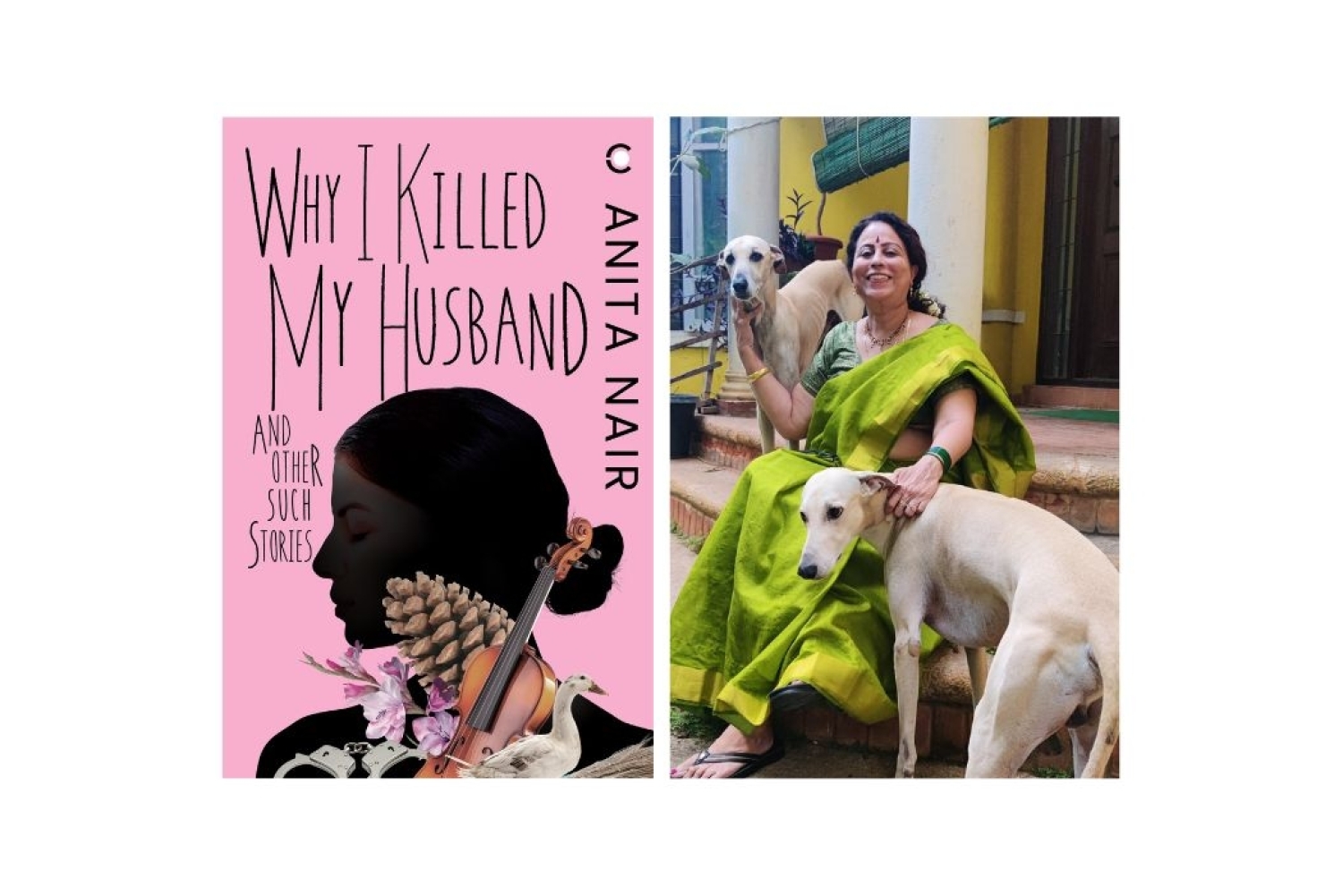
In Why I Killed My Husband and Other Such Stories, Anita Nair turns to the short story form for its ability to hold a ‘kernel of truth within a slice of life portrayal.’ In this collection, she brings together narratives shaped by many different kinds of realities, moving across several regions in the country. These stories draw on the lives of ordinary people to show readers how socio-political-economic happenings have a decided impact on each one of us. Anita Nair speaks to us about what drew her to the form of the short story, her approach to entering the interior lives of women, and why she sees the collection as a reflection of the state of the nation.
What drew you to the form of short stories?
I have always liked the short story as a form. However, what I like most about it is how a short story has a great in-built ability to nestle a kernel of truth within a slice of life portrayal. I wanted to build this collection around several socio-politico truths, and a novel would have become unwieldy. Also contrived, as I wanted to spread the stories across the length and breadth of India.
Many of these stories navigate women’s lives, their burdens and intimacies. What is your approach to writing female characters?
It is no different from how I create male characters. However, as a woman myself, I go beyond slipping into the skin of my character. Here I draw from the marrow of how women are by themselves and when with other people. How they think. How they dream. How they react. How they hate. When I create female characters, I become them as I am writing. Who I am as a person and what my beliefs are cease to exist and at that point, every fibre of my being is resonating with my woman character’s heartbeat.
According to you, what ties these stories together?
What binds these stories is India. In fact, the country is both the canvas and a character. This allowed me as a writer to capture how the last decade in India, tumultuous on so many counts, has a decided impact on how ordinary people live their lives. The greater picture and the specific detail come together on this canvas.
The setting of these stories changes through the collection. What drew you to these spaces, and how do they influence the direction of each story?
I have always set my fiction in places I am most familiar with. Or places I have travelled to and have impacted me in a deep way. The south of India: Kerala, Tamilnadu and Karnataka, is home territory, and four of the stories, Why I Killed My Husband, Quota Girls, The Little Duck Girl and Land of Lost Content, are set in these states. Then, there are places I have travelled to as in Bhutan and was impacted by the benign tyranny of its state. This benign tyranny is representative of the deep state of the couple’s marriage. The place also becomes a setting free of everything familiar for the couple in Twin Beds to unravel their secret selves.
Field of Flowers, a fictitious take on the Hathras rape, is set in UP. It is a state that I have only visited but not spent enough time to understand deep rooted customs and beliefs. So, to ensure the pulse of the place was on point, I dipped into the Mahabharata’s shameful episode of Draupadi’s disrobing. Balarama and Krishna could have prevented it from happening. But Balarama is apathetic and Krishna steps in at the last moment to rescue Draupadi after she has already had to endure much anguish and humiliation. It is this state of invisible gender tyranny and violence that I was seeking to portray against a backdrop of caste violence.
“What I set out to do, is draw on the lives of ordinary people, to show my readers how socio-political-economic happenings have a decided impact on each one of us. ”
You describe these stories as ‘state of the nation’. Could you elaborate?
For some time now, I have realized that a lot of fiction written in English in India exists in an echo chamber. Urban concerns and characters reign as if the very language the fiction is written in causes it to exist in a rarefied realm. The poor and marginalized, the middle class and rural worlds don’t feature much. Yet another lacuna was how the political and personal rarely cross paths in literary works. So much of our fiction is caught within the mindscapes of the characters that the India they inhabit is a by-the-way feature.
While there is nothing wrong at all with this point of view, as every writer has to be true to what and how they write, I was beginning to feel I wasn’t cutting to the bone of Indians as a people. As someone who is very rooted in middle India, what I set out to do is draw on the lives of ordinary people to show my readers how socio-political-economic happenings have a decided impact on each one of us. While we may think we are far removed from politics, this apathy can be shaken only if we see for ourselves that no one is free of the effects of the state of our nation.
What are some of your favourite short stories of all time?
The Lottery by Shirley Jackson. Eidgah by Premchand. Karkitakham by M. T. Vasudevan Nair. Pigeon Feathers by John Updike.
What are you working on currently, and what’s next?
Research on my next novel set in Kerala. And a children’s book I had started on a while ago and would like to finish work on.
Words Neeraja Srinivasan
Date 24.2.2026