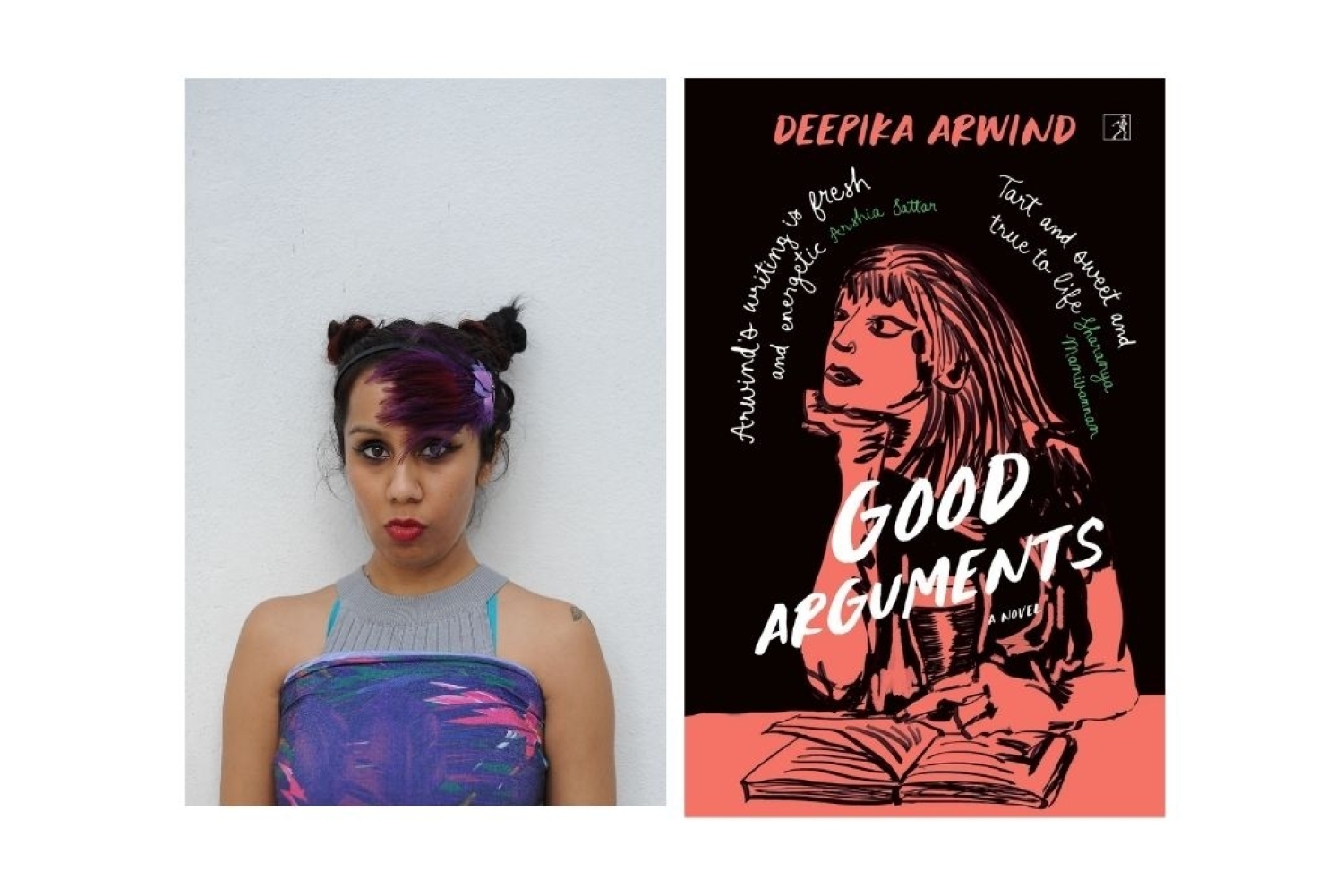
Photo Credits Richa Bhavanam
Photo Credits Richa Bhavanam
Deepika Arwind began working in theatre in her early twenties, still unsure whether it was possible to build a life through art. Many of the models she encountered were people with generational wealth and cultural capital, advantages she did not share. ‘I remember being a wide-eyed young person wanting a life in the theatre,’ she recalls, ‘and I wanted to bottle the essence of this formative time in a young person’s life, through a novel that lived in a city I know well, Bangalore.’
Her debut novel Good Arguments is a layered exploration of theatre, coming-of-age, and the city of Bangalore. Rooted in her artistic journey, the book reflects both the exhilaration and the struggle of forging a life in the arts. For her, writing has always been the foundation of her artistic life. She wrote as a child, trained as a journalist, and later moved into playwriting and performance. Even within her broader practice, writing has remained central. ‘I write because I read,’ she says. ‘I write because it’s a nice way to pass time. Through writing, I’m better as a human and an artist.’
Theatre itself is integral to Good Arguments. Once at the center of her life, it now takes a different shape: she writes plays for others and performs mainly her own work. With that distance, she sees theatre as a complex site of storytelling, one that raises not only questions of representation but also of ethics. As she puts it, ‘We’re not just talking about representation anymore, we’re asking deeper questions of how we tell others’ stories, whose story is whose to tell.’
Her own experience was shaped by what she calls a toxic theatre culture. As a young woman, she worked under directors and actors who wielded disproportionate power, often asking young people to work for free and disguising exploitation as privilege. For years, Arwind and her peers believed the fault lay with them. ‘It takes years to figure out that nobody is allowed to treat you with anything other than respect,’ she says. She wanted to imbue these cultural truths into her fiction, giving characters the weight of that lived reality.
Another key thread is the city of Bangalore, which she describes as ‘source code.’ It is the place where she became a writer, an artist, and a woman. Family, friends, music, food, and books are all tied to the city. The novel offers both a real and fictionalised Bangalore: actual streets, bars, and restaurants sit alongside invented ones. ‘I liked the idea of creating fictions within a real city, because that is how we see places,’ she explains, ‘partly through the fictions we invent about them.’
At its centre is Delphi, the protagonist, a young woman who is observant, intuitive, and ambitious but also insecure and sometimes timid. She hands over her agency without realising it, loves music, and frames her life through soundtracks. She is often passive, unable to say what she thinks, yet deeply curious about the world around her. For Arwind, Delphi embodies the flaws and contradictions of early adulthood, when a person is still forming a voice and learning to move deliberately through the world.
The writing process was not without difficulty. Much of the rewrite unfolded in Berlin’s Kreuzberg neighborhood, steeped in protest culture, while she wrestled with how to make fiction in the midst of global conflicts. ‘How does one write fiction during a live-streamed genocide?’ she asks. The tension between daily writing and witnessing horrors seeped into the book in intangible ways. On a lighter note, she admits she missed Bangalore’s food, sounds, and community. ‘I missed masala dosa and filter coffee,’ she admits. ‘I missed chilling and faffing with my friends.’ What she hopes for readers is simple: that they have an experience. ‘With anything I make, I’d love for the reader to have an experience of time moving,’ she says. ‘I hope they’re not bored. I hope they giggle in moments. That would be the ultimate gift.’
Looking ahead, Arwind is working on a play titled Deutsch, considering a graphic novel, and carrying the first inklings of another novel. She is also writing poems that use Bangalore and Berlin as vessels. ‘Futures are connected,’ she reflects, ‘so the future of anyone reading this and mine have something to do with each other.’
This article is from Platform’s November 2025 Bookazine. For more such stories, purchase your copy here.
Words Neeraja Srinivasan
Date 21.2.2026