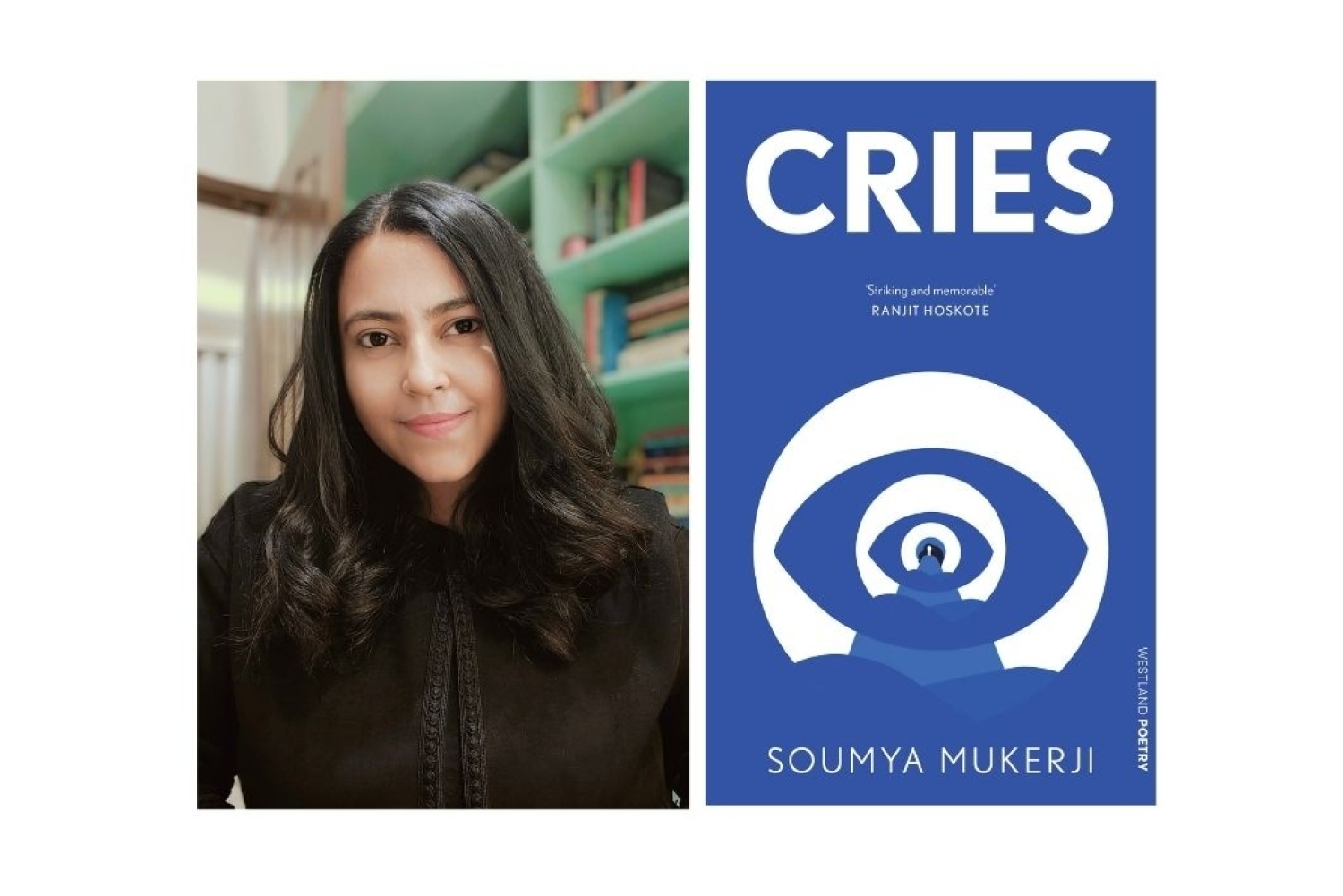
‘When was the last time you let out a good cry? A long, liberating release, tears for love, loss or longing or a lament for the earth, war, disease, oppression, all the despair and dissonance that surrounds us? Or perchance, cries of joy, delight, pleasure from the extraordinary in the ordinary? A cry both for the unparalleled beauty and the unbearable burdens of this life?’ asks Soumya Mukerji, whose debut poetry collection Cries is an attempt to articulate these collective outpourings. The poems scream with concern and chaos but also acknowledge the gifts of grace in nature and the possibility of hope. She reflects on the making of the book and the process that shaped it.
Tell us about this collection of poems and what sparked them into being.
Cries is a slim collection of urgent poems that attempt to articulate our cries in these strange and desperate times. It is an ode to our collective cries; unexpressed, silenced, unheard, unvoiced. The poems have been shaping over the past many years as life evolves, with distinct experiences taking on their own expressions. They have been lucky to find support in Mita Kapur of Siyahi who has been instrumental in bringing them to life, and my publisher Westland that continues to believe in the power of poetry in a crazy, consumerist world.
In 2021, as I lay battling a case of COVID during the devastating delta wave in India, I was scared for the future, grateful to be alive, and compelled to respond. I wanted to make an offering of thought and reflection that spoke straight to the heart, or redesign even if by a little, our collective view of life, waking us up to the monsters that we have created. Therefore, I started creating a poetic archive born out of my extensive explorations in place and time. The poems scream with concern and chaos, but also acknowledge the gifts of grace in nature and the possibility of hope.
There are several themes that these poems tackle; nature, disease, food, death and more. What brings them all together? At its core, what is this collection about?
These are cries of lament, cries of happiness, cries of transformation and transition, cries of and for the spirit through multiple perspectives, informed by the present social, political, ecological and human condition, all interconnected. The poems thread through climate and covid, spin within cyclone and war, spread themselves across the 600-million-year-old islands of Langkawi, conflicted Kashmir and melting mountains. They plunge deep into depressive states of mind and at other times delight in the lightness of spring rain and self-love. The eco-poetics channel the continuum of seasons, species, sentiments.
The verses snake through contemporary enchantments and entrapments, pain and possibility, urging you to take a dip in the blender of our collective consciousness, twisting and turning with the magic and the mundane, with emotion and exhaustion. This post-structuralist work takes shape as an atlas of our shared worlds within, and outside. It is a hope for reflection and ultimately, action, emanating from an earnest empathy for all.
What is your relationship with writing, and specifically poetry?
I was three or so when I wrote my first coherent poem about the Wright Brothers’ first flight (I do not recall now if it was inspired by my father’s services in air defence). The poem dove into the pair’s minds as well as a curious pre-schooler could have slipped into the ingenious landscape that made humankind transcend the lithosphere into realms thence unknown. Ever since, my own imagination has thus afforded me the wings to rise above world-weariness.
I was lucky to grow up across India, immersing myself in diverse cultures and ways of life early on, as a curious and sensitive child. I wrote sneakily all through school and young adulthood, and it was only much later that I was writing in order to fulfil my sole urge – in pursuing journalism as a profession, in taking up literature for a master’s degree, briefly dabbling in advertising, or publishing a personal blog in the blessed pre Tik-Tok aughts.
But it was no mere motivation for a means of living. The word was, beyond bread and butter, my wine, my poison, life-giving elixir, water and cell. The poem became an unquestioning friend, a home and refuge to an itinerant, a piece of art to delight in – as reader or writer, a private tool to crack the most difficult and impermeable souls and situations. At other times, it made magic manifest. It was the only way to make sense of life, to exhale deeply the air we breathed.
My relationship with poetry has grown organically as both a source of joy and meditation. The difference is that when you’re writing a diary, you have yourself to work with. When you’re writing poetry, you have the world to work with. And yet, poetry is where you don’t underline the uncomfortable details but you say them anyway. It’s perhaps the safest space for your thoughts. It packs but it doesn’t probe. It’s a delicious deconstruction of our inner architecture.
The title is intriguing, and the book itself is structured around it. Could you tell us what the crises refers to, and who the cry is directed at?
The poems came first and the title came later. It takes a time’s crises to invoke cries of hope. This compilation navigates everyday life lived through the contextual sections of Us as a whole, of You as another perspective encountered, and as I, often the voice that you hear yourself most in, an experience intimate, personal and yet universal. The three sections are deeply interwoven, for the I is also You and ultimately, Us.
“My relationship with poetry has grown organically as both a source of joy and meditation. The difference is that when you’re writing a diary, you have yourself to work with. When you’re writing poetry, you have the world to work with. ”
Who are some writers, artists, filmmakers or musicians you turned to for inspiration?
Nature as an artist is my biggest source of inspiration. My appetite for the arts, literary and otherwise, is insatiable, and so the human artists I turn to are perhaps too many to name. I will still attempt a few across time and space; Gustavo Adolfo Becquer, Rainer Maria Rilke, Fernando Pessoa, Sylvia Plath, James Baldwin, Walt Whitman, Fanny Howe, Annie Ernaux, Arundhathi Subramaniam, Ryuichi Sakamoto, Carsten Nicolai, Jericho Brown, Norah Jones, Hayao Miyazaki, Kabir … really a convergence of the gifts of classic and contemporary arts that life has presented. I’ve also been fortunate to have had conversations with nearly a hundred creative figures globally, which has given me rare insight into their craft and enriched my own.
In 2018, a chance to stay at the Scottish national poet Robert Burns’s house also compelled me to pursue my curiosities with renewed vigour, as did a considerable time spent in solitude in the Kumaon foothills of the Himalayas over the years.
What is your writing process? How does a poem go from being a thought in your head to a fully-formed piece of writing? Take us through it.
I think poetry asks a certain passivity to allow the flow, a certain belief in being led. It’s a sweet-bitter [not bittersweet] state of swirling, surrender and solitariness. One rises in that whirlpool, and when you fall back on the ground, the skies are suddenly clear and the air distilled. The poem has appeared on the page, and in the moment that follows, you are free, light as a feather.
The process is really one of inviting the poetic impulse into the party of the senses. When it arrives, it's not a creature to be controlled, but to be indulged wildly. That inexplicable impulse makes you see the horizon and the hairpin along the same gaze, and you know it’s part of the same story.
Of course, the collecting of this material has been subconscious and spread over a decade across diverse landscapes, sometimes in responding to discoveries spontaneously. It’s where the intuitive lens plays with field experiences often on the job – but mostly in the moment. Where the expanse of journalism meets the intimacy of personal memory. Where you are both witness and participant.
Did writing these poems bring you any revelations about yourself, or about writing? What did it teach you?
I think the very act that writes poems is an act of self-discovery, but what I learned was that everything around the writing is more difficult than the writing itself. And the more self-conscious or self-critical one grows, the farther poetry runs. That the scales of metre and scheme don’t often fit the muse, and that you need to make friends with doubt because it’s always hanging round the corner. It taught me that you have to be comfortable with being uncomfortable, shed the shoulds, and make yourself home in the liminal spaces.
A refreshing deviation from my other engagements with longform writing, over time it has taught me the importance of coherence over completeness in brevity of form, and its advantages of openness in interpretation. I like the sound of words but not necessarily in perfect sentences, as the other half of my job entails. It taught me that authorship is different from authority, that it is not about control but the continuum. Poetry is about becoming one with both the beauty and the beast; that’s our essential nature, the universal truth.
These poems are deeply rooted in self-reflection, and confronting uncomfortable emotions; anger, grief, pain. What challenges did you face in the process of narrativising these feelings?
The poem is essentially an act of unguarded catharsis or spontaneous expression. So, they mostly came untethered and unhindered, since they didn’t know where they were going at the time. Each one came independently as a sort of reflection in time and mixed reality, and together, Cries felt like coming up for air.
Perhaps the most significant challenge was one of revealing-unrevealing and censorship in the later stages. How vulnerable, how exposing, can be of some of their most human selves? Would a poem offend someone close or some authority of power – what are the risks involved? How does one call each thing / every emotion / the unspoken by its right name? Would loved ones think I am crazy [though they already know]? Would it affect a more formal, journalistic repertoire built over a decade and a half? Can I afford to be the child in my writing after so many years at the desk?
What do you hope for readers to take away from the book?
There is no ‘after word’. And there is nothing that the word is after. All else may remain unachieved, but once a poem has formed itself, it only yearns for one after, the milestone of touching you, perhaps moving you, or just having a conversation. It hopes for you to find yourself there, sit along, share a tear or a laugh, hold space for our crises within and around. It seeks to connect us through our deepest vulnerabilities, wildest wonders, and shared anxieties, fostering empathy and hope for action.
What are you working on next, what is the future looking like?
I am exploring both non-fiction and fiction. I am working on a story with a concrete character in the world of construction. Perhaps a Quixotic telling of the suspension of our urban dreams by a first-person extradiegetic narrator. In one way, it is an extension of the same discourse on our uncertain futures… How we write the crises is how we write the hope.
This is an excerpt from the November 2025 Bookazine. For more such stories, grab a copy here.
Words Neeraja Srinivasan
Date 29.8.2026